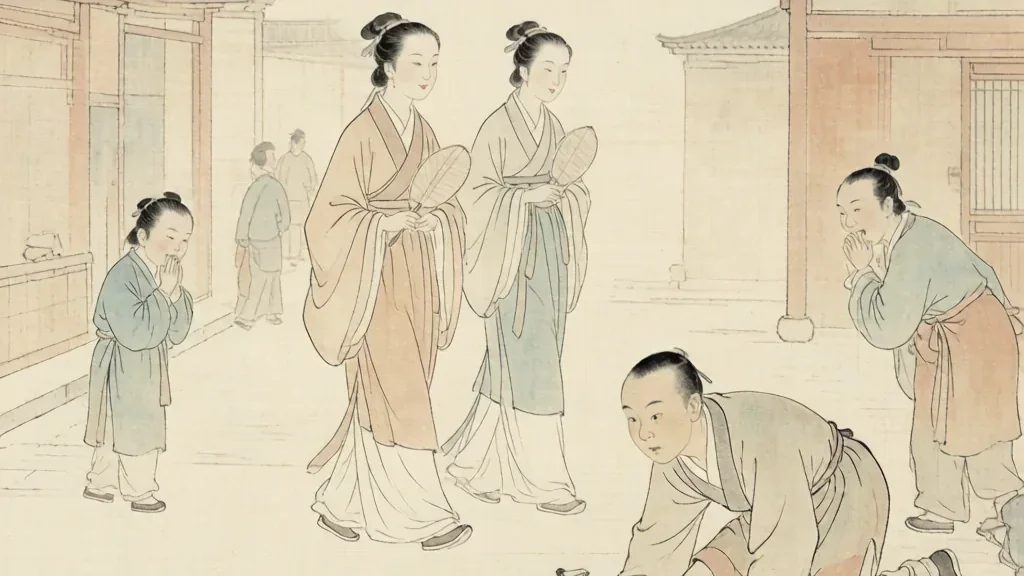
There is a Chinese idiom that is, at its heart, a warning against trying too hard to be someone else. 邯郸学步 (hán dān xué bù) — "learning to walk in Handan" — tells of a young man who traveled to the capital of the state of Zhao to copy its famously elegant gait, practiced so obsessively that he forgot his own way of walking, and had to crawl home in disgrace. The phrase has become the classic Chinese caution against blind imitation: in admiring another's style, you may lose the self you already had. It is funny, humiliating, and oddly modern in its relevance to identity and authenticity.
The Story From the Zhuangzi
The tale comes from the 庄子 (Zhuāngzǐ), the Daoist classic attributed to the sage Zhuangzi, who loved parables that deflate human pretension. In the story, a youth from the state of 寿陵 (Shòulíng) heard that the people of 邯郸 (Hándān), the capital of Zhao, walked with a particularly graceful, admired bearing. Enchanted, he journeyed all the way to Handan to learn their gait for himself.
Once there, he threw himself into imitation. He watched the citizens stroll, studied their posture, and tried to copy every nuance. But in his eagerness he abandoned his native walk entirely, and the harder he tried to master the Handan style, the more his own coordination slipped away. He became a creature caught between two gaits, mastering neither.
The punchline is merciless. When the youth finally gave up and started for home, he discovered he could no longer walk the way he used to. Having lost his original step, he had no choice but to crawl back to Shouling. The image of a grown man crawling down the road is the idiom's unforgettable closing shot.
The Literal Characters and the City of Handan
The four characters are plain: 邯郸 (Hándān) is the city, 学 (xué) "to learn," and 步 (bù) "to walk" or "gait." The phrase names a place and an action: going to Handan to study walking. The humor hides in the mismatch — who travels a great distance to learn how to walk, something every toddler does for free?
Handan's reputation for elegant walking was a literary conceit; the city stood for refinement and fashionable sophistication that provincial visitors found seductive. By invoking a real capital, the story mocks the provincial's awe of the metropolis. We are meant to smile at the youth who mistakes a local strut for a wisdom worth crossing borders for.
The character 步 (bù) is the crux. Walking is the most basic, taken-for-granted skill — the self's first independence. To lose it is to lose a piece of oneself. The idiom therefore escalates from comedy to metaphor: what the youth lost was not just a gait but his own grounded way of being.
The Deeper Lesson: Imitation Without Understanding
The Daoist point is that spontaneous, natural action is superior to contrived imitation. Zhuangzi prized 自然 (zìrán, "self-so" / what is natural) over artificial effort. The Handan youth failed because he copied the surface — the visible grace — without the inner source that produced it. He wanted the effect without the being.
This is a precise diagnosis of a common error. We imitate others' success — their posture, their habits, their style — hoping to import their result, but the result depends on a whole self we do not have. The youth's crawl home is what happens when borrowed form meets absent foundation. The idiom is, among other things, a theory of why faking it usually fails.
Yet the lesson is not "never learn." It is "do not abandon yourself in learning." One can study another's walk and enrich one's own; the catastrophe comes from discarding the original entirely. The wise learner adds without erasing. The youth did the opposite, and paid in knees.
How the Idiom Is Used Today
In modern Chinese, 邯郸学步 is invoked whenever someone imitates a foreign or fashionable model so slavishly that they lose their own strengths. It is a favorite in cultural debates — about whether adopting Western styles means abandoning Chinese traditions, or whether a student who apes a mentor loses their voice.
It also appears in business and self-help contexts as a warning against copying competitors without understanding their logic. A company that clones a rival's product but not its underlying capability may end up, like the youth, unable to walk on its own. The idiom translates surprisingly well into management lessons about authentic strategy.
For individuals, it is a gentle reminder to borrow wisely. Admire the elegant walker, by all means, but keep your own legs. The phrase lets a critic say "you've lost yourself in imitation" with a single classical allusion, which is far kinder than a lecture.
A Reflection on Keeping Your Own Gait
邯郸学步 speaks straight to an age of imitation. We borrow accents, aesthetics, careers, and identities from those we admire, often forgetting the self that set out to learn. The youth of Handan is in all of us when we mistake another's polish for our own worth, and trade our footing for their flourish.
The remedy the idiom implies is not isolation but integration. Learn from Handan, yes — travel, watch, absorb — but never throw away the walk you arrived with. The goal is not to become the other but to return home walking more fully as yourself. Anything less, the old story warns, and you may find yourself crawling. Keep your gait, and the journey was worth it.
Handan, Capital of Zhao
The city in the idiom was no vague setting but a real and glamorous place. Handan was the capital of the state of Zhao during the Warring States period, a center of wealth, fashion, and courtly refinement that provincial visitors found seductive. Its people were said to walk with a particular grace, and that reputation alone was enough to draw a young man from the obscure state of Shouling across the land. By naming a real capital, the Zhuangzi mocks the provincial's awe of the metropolis, the believer that sophistication must lie elsewhere. The joke still lands, because every age has its Handan, a fashionable city or culture whose polish looks like wisdom worth crossing borders to learn, often at the cost of one's own footing. The glamour of the capital was real, but so was the danger of losing oneself inside it.
Zhuangzi's Comedy of Pretension
The tale is told with the light touch typical of the Zhuangzi, a text that prefers laughter to lectures. The image of a grown man crawling home is pure physical comedy, and the absurdity, who travels far to learn something every toddler does free, is the punchline. But the humor carries a serious Daoist claim: spontaneous, natural action beats contrived imitation. The youth wanted the effect, elegant walking, without the being that produced it, and he lost even what he had. Zhuangzi uses the ridiculous to deflate human pride, and the crawl home is the perfect closing shot, a silent rebuke to anyone who mistakes another's polish for their own worth. The idiom proves that philosophy, in skilled hands, can be funny and fatal at once.
Losing the Self in Modern Life
The youth of Handan is easy to meet today. People borrow accents, careers, aesthetics, and identities from those they admire, often forgetting the self that set out to learn, and trade their footing for someone else's flourish. The idiom speaks straight to an age of imitation, where the pressure to look polished can erase the original gait. The remedy it implies is not isolation but integration: travel, watch, and absorb, yes, but never throw away the walk you arrived with. The goal is to return home walking more fully as yourself, enriched rather than replaced. Anything less, the old story warns, and you may find yourself on hands and knees. Keep your legs, and the journey was worth it. The youth's crawl home remains the idiom's unforgettable image of a self needlessly lost.
❓ Frequently Asked Questions
📝 Chinese Vocabulary
邯郸学步 — : "Learn to walk in Handan"; blind imitation that costs you your own ability.
邯郸 — : Capital of the state of Zhao, famed in the story for an elegant gait.
步 — : Gait / to walk; the basic skill the youth loses.
庄子 — : The Daoist classic and sage who told the parable.
自然 — : "Self-so" / natural; the Daoist value the youth violated by contrived imitation.
寿陵 — : The state of Shouling, home of the youth who traveled to Handan to learn its famous walk.
赵 — : The state of Zhao, whose capital Handan was famed in the story for an elegant, admired gait.
爬行 — : To crawl, the humiliating way the youth had to return home after losing his own walk.
🎉 Fun Facts
- The youth was from Shouling (寿陵), a state the story presents as provincial next to sophisticated Handan.
- Handan is a real ancient city that still exists in modern Hebei province, lending the tale a concrete setting.
- The idiom is a Daoist jab at pretension: who travels far to learn something every toddler does free?
- The "crawl home" ending makes it one of the few idioms with built-in physical comedy.
- Handan today markets itself as a city of idioms, and learning to walk in Handan is among the local sayings featured in its tourism.
- Some Chinese language textbooks use the story to warn students not to copy another writer's style so closely that their own voice disappears.