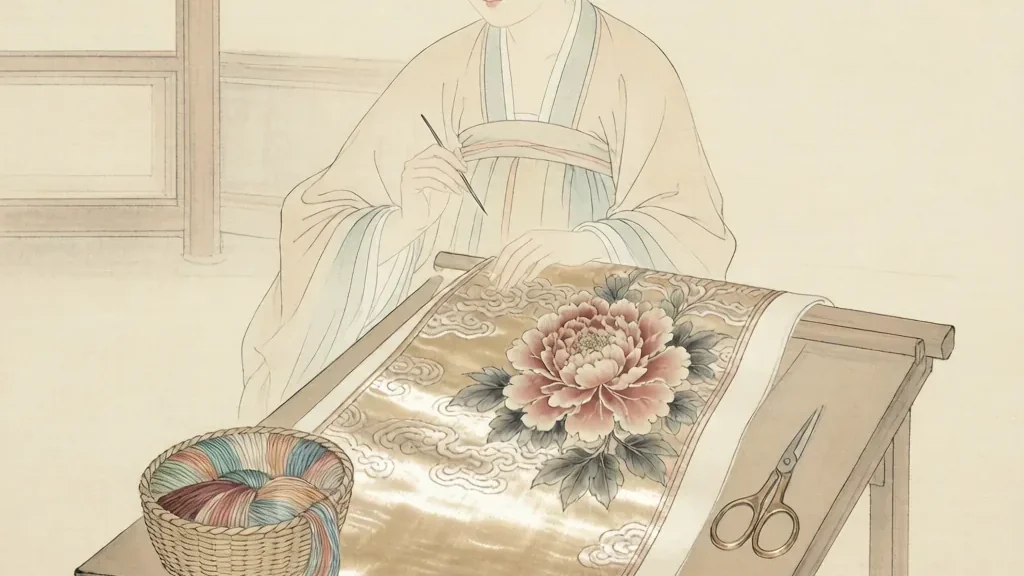
Some acts of kindness are urgent; others are merely ornamental. The Chinese idiom 锦上添花 (jǐn shàng tiān huā) — "adding flowers to brocade" — describes the act of making something already beautiful even more beautiful. A bolt of fine brocade needs no help; yet someone stitches flowers upon it anyway. The phrase is gently double-edged: it can praise a graceful finishing touch, or it can hint that the effort was unnecessary, even self-indulgent. Most often it appears as the natural opposite of "sending charcoal in the snow," reminding us which kind of help truly matters.
The Image: Brocade and the Flowers Upon It
The four characters are almost self-explanatory. 锦 (jǐn) is "brocade," a richly patterned, multicolored silk woven with gold or bright threads — the luxury fabric of imperial and aristocratic China. 上 (shàng) means "upon" or "on top of." 添 (tiān) means "to add," and 花 (huā) means "flower." So the phrase literally shows flowers being embroidered onto cloth that is already splendid.
The visual is one of excess layered on abundance. Brocade is not plain cloth; it is already a finished work of beauty. Adding flowers does not rescue it from plainness but only piles loveliness on loveliness. That is the source of the idiom's ambiguity: the addition is pretty, yet the brocade hardly required it.
Because the image is so concrete, the idiom travels easily. Anyone who has seen ornate Chinese silk understands instantly: the fabric was already enough. The flowers are a bonus, delightful perhaps, but not essential. The phrase thus captures a universal truth about superfluity — that more is not always more.
Origins in Song-Dynasty Poetry
The expression emerged from classical poetry, where "adding flowers to brocade" served as a metaphor for graceful ornament or for honoring the already-honored. Song-dynasty writers used it to describe a fine line added to a fine poem, or a compliment paid to someone already celebrated. Its literary roots gave it a refined, slightly literary register that it retains.
Over centuries the phrase migrated from poetry into everyday moral talk, especially through its pairing with 雪中送炭. Once set against "charcoal in the snow," the brocade idiom acquired a clear ethical shading: it became the symbol of help given where help is not needed, as opposed to help given where it is. The contrast did the cultural work of teaching priority in generosity.
It is worth noting the idiom is not originally negative. In its poetic home it could simply mean a lovely addition. The slightly critical tone came later, from the contrast with urgent aid. Today both senses survive: context tells you whether "adding flowers to brocade" is being praised or gently dismissed.
The Meaning: Ornament Versus Necessity
At its simplest, 锦上添花 names the superfluous improvement. A second dessert after a feast, a gold trim on an already-gilded frame, a compliment to the already-famous — these are flowers on brocade. They please, but they do not meet a need. The idiom thus distinguishes delight from rescue.
Used as a mild caution, it warns against misplaced effort. To spend your energy decorating what is already complete, while ignoring what is broken, is to misunderstand where value lies. A leader who builds monuments while the people freeze is, in effect, adding flowers to brocade. The idiom supplies the critic's quiet zinger.
Yet used affirmatively, it celebrates the finishing touch that makes excellence exquisite. A great meal closed with a perfect sweet, a strong argument capped with a witty line — these too are flowers on brocade, and welcome. The idiom honors craftsmanship that refuses to stop at "good enough." The difference is intent and circumstance.
The Famous Contrast With Charcoal in the Snow
No idiom is more often yoked to another than this pair. Chinese speakers love to say one should prefer 雪中送炭 (charcoal in the snow) to 锦上添花 (flowers on brocade). The pairing turns two images into a small ethics lesson: direct your help to the suffering, not the satisfied.
This contrast is more than politeness; it is a theory of justice. Resources are limited, and the brocade-owner will be fine without your flowers, while the freezing family will not survive without charcoal. The idiom thus nudges the giver toward the marginal, the vulnerable, the unseen. It is, in miniature, a case for priority in compassion.
Still, the contrast need not be harsh. Celebration has its place; weddings and festivals are rightly brocade-and-flowers occasions. The wisdom is one of balance and顺序 (order): first the snow, then the brocade. Attend to need before you attend to splendor, and both will be rightly enjoyed.
How the Idiom Lives in Modern Chinese
Today 锦上添花 appears in compliments, marketing, and casual speech. You might call a lovely addition to an already-beautiful room "the flowers on the brocade," or praise a colleague's final polish on a finished project. In these uses it is warm and approving.
It also shows up in self-deprecating or critical contexts. A minor improvement to an already-successful product may be dismissed as merely 锦上添花, implying the real work was done long ago. And in discussions of policy or charity, the phrase can gently question whether resources are flowing to the comfortable instead of the struggling.
In business writing, the idiom sometimes warns against over-engineering: a product that is already good can be spoiled by needless features. "Don't add flowers to the brocade" becomes a principle of restraint. The old image proves surprisingly useful for modern design and management talk.
A Reflection on When Enough Is Enough
锦上添花 asks us to know the difference between enhancement and necessity, between the brocade that shines and the family that freezes. There is nothing wrong with flowers, properly placed — a kind word to the happy, a flourish on the finished, a celebration of the blessed. Such things make life sweeter.
But the idiom, paired as it so often is with charcoal in the snow, keeps our eyes on the storm. Before we stitch another flower, we might ask: is there snow somewhere that needs charcoal instead? The brocade will wait. It is always beautiful. The person in the cold cannot. That ordering of care is the quiet wisdom stitched into four glittering characters.
Brocade in Imperial Material Culture
To feel the idiom one should picture the real object. Brocade was woven on complex looms with patterned, often gold-wrapped threads, and a single bolt could take a skilled artisan months. It was the dress of court and aristocracy, a stored form of wealth, and a medium of tribute between regions. When the idiom says the cloth is already splendid, it is invoking a fabric whose making was itself a triumph of patience and skill. The flowers added on top therefore represent surplus upon surplus, ornament answering ornament. Understanding brocade as a luxury good explains why the image carries economic weight: it is not a plain cloth being helped, but the richest textile in the realm being decorated further, which is precisely what makes the act questionable.
The Aesthetics of Restraint
Chinese art and design have long prized restraint, the sense that a work stops where it should. Ink painters leave deliberate emptiness, poets cut a line rather than pad it, and gardeners leave a wall unfinished to suggest more. 锦上添花 sits at the edge of this value, because it names the moment a maker adds when adding is no longer needed. The idiom thus doubles as a small aesthetics manual: know when the brocade is enough. In calligraphy and painting the same instinct produces the praise of the 'single stroke that says everything'. The cultural lesson is that mastery includes the discipline to refrain, and that the most confident artist is often the one willing to leave the cloth, or the page, untouched.
❓ Frequently Asked Questions
📝 Chinese Vocabulary
锦上添花 — : "Add flowers to brocade"; embellishing what is already beautiful, or needless help.
锦 — : Brocade; rich patterned silk, already splendid on its own.
添 — : To add; the act of layering ornament on abundance.
雪中送炭 — : "Send charcoal in the snow"; its contrasting pair, help given in true need.
顺序 — : Order / sequence; the wise ordering of care the idiom implies.
花 — : Flower — the ornament layered on already-fine brocade, the thing that pleases but is not required.
上 — : Upon — the preposition placing the flowers on top of cloth that needs no help.
丝绸 — : Silk — the broader cloth family to which brocade belongs, the luxury fiber of imperial China.
🎉 Fun Facts
- The idiom is the standard contrasting pair to 雪中送炭 ("charcoal in the snow"), together forming a mini-ethics of giving.
- 锦 (brocade) was the luxury silk of imperial China, often woven with gold thread — already a finished work of art.
- The phrase began in Song poetry as a metaphor for graceful ornament before acquiring its moral shading.
- In modern business talk it warns against "over-engineering" a product that is already good.
- Imperial workshops kept thousands of weavers producing brocade for robes and tribute, so the image of 'flowers on brocade' would have conjured a very real, very expensive object for early listeners.
- In wedding and festival speech the phrase is often used warmly, because celebration is exactly the moment when ornament on abundance is welcome rather than wasteful.