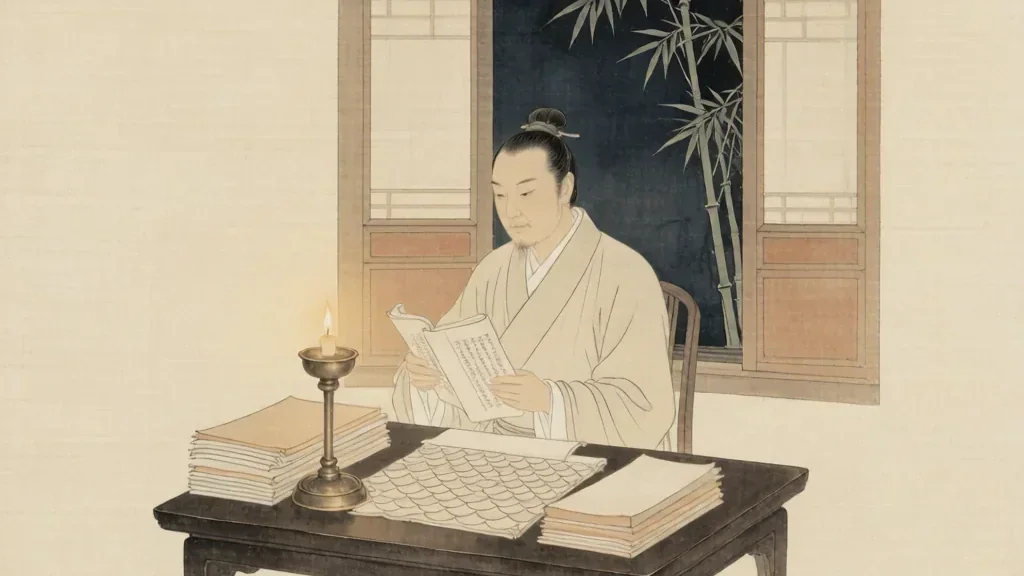
Reading has been called the cheapest ticket to a larger life, and the Chinese idiom kāi juàn yǒu yì says so with imperial authority. Written 开卷有益 and pronounced , it means "opening a book brings benefit" — the calm conviction that simply to read is to gain. English speakers say "reading is good for you," but this phrase carries the weight of a emperor's daily habit and a thousand years of exam-culture respect for the page. For readers new to Chinese culture, the idiom is a doorway into a society that made literacy a path to power and self-improvement alike. In this article we trace the phrase to a Song emperor and his giant encyclopedia, explore why opening a book was seen as always worthwhile, and consider what the motto asks of us today.
The Emperor Who Read Every Day
The idiom is linked to Emperor Taizong of Song (宋太宗, r. 976–997), the founder of the Song dynasty's stable rule. Taizong commissioned a massive compendium called the Taiping Yulan (太平御览, "Imperial Readings of the Taiping Era"), a collection of about a thousand volumes drawing on earlier books on history, philosophy, and literature. He set himself a remarkable discipline: to read a fixed portion of it each day, no matter how busy the affairs of state.
When courtiers worried the emperor was tiring himself, Taizong is said to have replied that opening a book always brings benefit — . The reading refreshed rather than drained him, and the habit became the origin of the phrase. From an emperor's lips the idea gained a permanent respectability: if the busiest man in the realm found time to read, who could claim they were too busy? The story turned a private pleasure into a public virtue.
Literal Meaning and Characters
The characters are plain. (开) is to open; (卷) is a scroll or book (so called because texts were rolled on silk or paper scrolls); (有) is "to have" or "there is"; and (益) is benefit or profit. Read as "open-scroll-has-benefit." The word is a lovely fossil: it literally means "roll," preserving the memory of books as rolled scrolls long after the codex form won out. A learner meets here a small piece of book history encoded in everyday speech.
The claim is strikingly unconditional. The emperor did not say "opening a good book" or "reading with a purpose." The bare act — opening the scroll — is said to yield benefit. That generosity is part of the idiom's warmth; it invites even the reluctant or distracted reader to begin, trusting that the page will give something.
Reading in a Exam Culture
Imperial China selected its officials through rigorous examinations rooted in the Confucian classics. For a millennium, to read well was to rise in the world; literacy was not a hobby but a ladder. In that context, "opening a book brings benefit" was not sentimental — it was practical wisdom about social mobility. Families sacrificed to keep sons studying, and the idiom gave the long nights at the desk a blessing.
Yet the phrase also transcends careerism. It suggests that reading forms the person, not just the résumé. The Song emperors were great patrons of letters, and their age produced a flourishing of printing, scholarship, and poetry. To say reading always benefits is to honour curiosity as a form of self-cultivation — the slow building of a wiser, wider self through other people's words.
How the Idiom Lives Today
In modern Chinese, is used to encourage children, to justify leisure reading, and to open speeches about education. A parent nudges a child toward a book with it; a teacher posts it on the wall; a blogger uses it to recommend a title. The tone is gentle and approving, never nagging — it assumes the reader will discover the benefit for themselves.
The idiom also surfaces in debates about screens and attention. Defenders of reading cite it against the idea that any reading is a waste; even "light" reading, they argue, opens the scroll and therefore gives something. Used this way, the phrase becomes a small manifesto for the printed word in a distracted age — a reminder that the habit of opening books is its own reward, regardless of the topic.
Companions in the Reading Cluster
The idiom keeps company with others about learning. 学富五车 (xué fù wǔ chē, "learned enough to fill five carts") celebrates vast erudition; 开卷有益 promotes the daily act that builds it. 凿壁偷光 (záo bì tōu guāng, "boring a hole to steal the light") honors the poor boy who loved to read; 悬梁刺股 (xuán liáng cì gǔ, "tying the hair, jabbing the thigh") shows extreme devotion to study. Together they map a culture that treats the book as a sacred, transformative object.
For learners of Chinese, this cluster is encouraging because it shows reading is honored at every level — from the emperor's encyclopedia to the child's first scroll. Knowing the phrases lets you talk about study not as drudgery but as a valued, almost reverent practice, which is closer to how Chinese culture has long felt about it.
A Closing Reflection
There is a quiet radicalism in : it trusts the reader. It does not prescribe which book or what lesson; it simply says the act of opening is enough to begin a benefit. In a time when we are told to optimize every minute, the idiom offers permission to read without a goal, to let the scroll surprise us. The Song emperor, buried in statecraft, found renewal in his daily portion. We might find the same — one open book, one small benefit, and the slow accrual of a wider life.
The Song Printing Revolution
Emperor Taizong's daily reading was possible because his age had transformed the book. Woodblock printing, perfected in the Tang and scaled up under the Song, turned manuscripts into reproducible objects, and movable type later pushed the change further. Books that once existed in a handful of copied scrolls now circulated by the thousand, and literacy ceased to be the strict property of the very few. In that world, 'opening a book brings benefit' was not only a moral but a practical observation: the printed word was suddenly abundant, cheap, and within reach of ordinary households. The idiom rides this historical wave, and its warmth reflects a society that had just discovered how widely reading could spread. To know the printing boom is to hear in the phrase a celebration of a new, shared abundance of texts.
Reading as Self-Cultivation
Beneath the habit lay a Confucian conviction that the person is made through study. Reading was not mere information-gathering but a slow shaping of character, a daily discipline that produced the virtuous official and the decent parent. 开卷有益 expresses this faith in its most generous form: simply to open the scroll is to move toward a better self. The exam system gave the belief teeth, tying study to real advancement, yet the deeper claim outlived any career. Even today the idiom is invoked when urging reflection over distraction, trusting that the page forms the reader. Its quiet radicalism is that it asks nothing of the text except to be opened, and nothing of the reader except to begin, promising that the benefit will follow from the act itself.
❓ Frequently Asked Questions
📝 Chinese Vocabulary
开卷有益 — : opening a book brings benefit; reading is always worthwhile.
卷 — : scroll, book.
益 — : benefit, profit.
宋太宗 — : the Song emperor linked to the phrase.
太平御览 — : the thousand-volume imperial encyclopedia he read daily.
开 — : To open — the first, decisive action the idiom says always yields benefit.
有 — : To have — as in 'there is benefit,' the unconditional payoff the phrase promises.
书 — : Book — the object opened, standing for reading in general across the idiom's many uses.
🎉 Fun Facts
- The Taiping Yulan ran to roughly a thousand volumes and quoted from many books now lost.
- Emperor Taizong reportedly read a set number of pages every day regardless of state business.
- The character 卷 preserves the era when books were rolled scrolls, not bound pages.
- The idiom became a cornerstone of a culture that chose officials by written examination for over a thousand years.
- The Song dynasty saw the first large-scale woodblock printing in China, which flooded the market with affordable books and made 'opening a book' a daily possibility for many more people.
- The encyclopedia the emperor read, the Taiping Yulan, survives in part because later scholars copied and reprinted it, preserving quotations from works now lost.