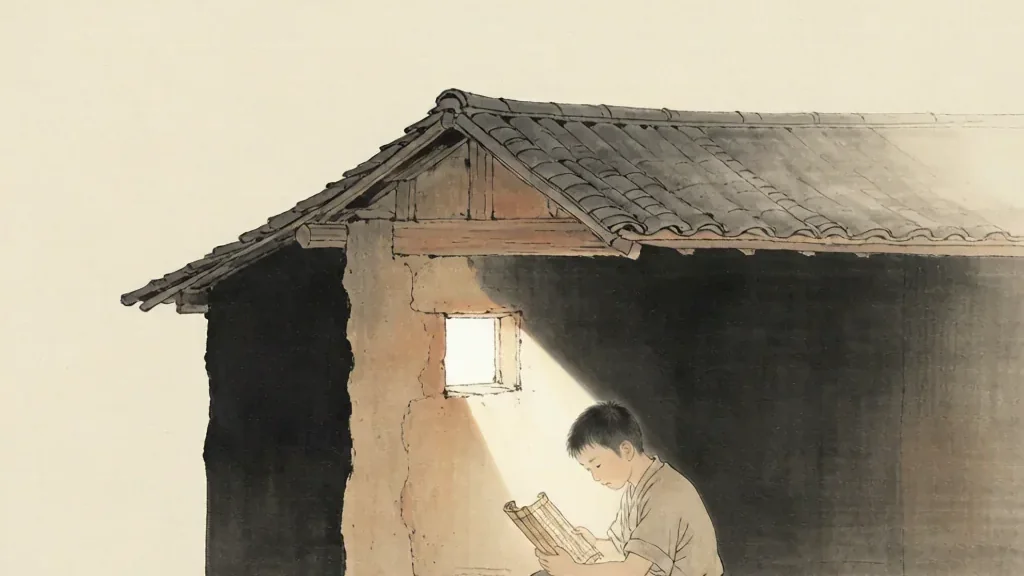
The idiom 凿壁偷光, pronounced , tells the story of a poor boy who bored a hole in his wall to steal the light from his neighbor's lamp so he could keep reading at night. Its literal sense is to chisel the wall and borrow light, and it has become a timeless emblem of diligence in study against all odds. The protagonist is Kuang Heng, a scholar of the Western Han dynasty who rose from humble poverty to high office through relentless learning. Across more than two thousand years the phrase has encouraged countless students to persevere when resources are scarce, and it remains a fixture of Chinese moral education. This article explores the biography behind the idiom, the social world of the Han learner, the meaning of light as a metaphor for knowledge, and the way the story shaped attitudes toward poverty, effort, and examination success.
The Biography of Kuang Heng
Kuang Heng lived during the Western Han dynasty, a period noted for the consolidation of imperial administration and the spread of Confucian learning as the foundation of government service. Historical sources describe him as a member of a poor farming family who nonetheless developed an early passion for books. In an age when literacy and texts were costly, his hunger for learning set him apart from his neighbors, who were chiefly concerned with the agricultural labor that kept them fed.
As a youth Kuang Heng worked in the fields by day and longed to study by night, but his family could not afford the oil for a lamp. The well-known solution was to pierce the wall that separated his dwelling from a wealthier neighbor who burned a lamp late into the evening. Through the narrow opening he could catch enough stray light to read his borrowed scrolls, turning his poverty into a makeshift study hall.
Kuang Heng's later career justified the legend. He became a noted interpreter of the classic of poetry, the 诗经, and eventually served as a high official at the imperial court. The arc from a wall-piercing boy to a counselor of the throne is precisely what makes his story inspirational: it suggests that no external deprivation can block a determined mind.
Poverty and the Cost of Learning
In the Han period, education was concentrated among families who could spare a son from farm work and could buy or copy the bamboo and silk texts that carried the classics. A poor household faced steep barriers: the materials were expensive, teachers were rare in the countryside, and the time spent reading was time not spent earning food. Kuang Heng's ingenuity was a response to this structural inequality rather than a mere personal quirk.
The detail that he borrowed books rather than owned them is important. Manuscripts circulated through networks of lending and copying, and a diligent student might read whatever a richer neighbor possessed. The hole in the wall thus represents not only a clever trick but a claim that light, like knowledge, should not be hoarded by the fortunate alone. The neighbor's lamp becomes a symbol of the resources that the poor can only reach by persistence.
This social dimension explains why later rulers promoted the tale. A regime built on meritocratic examinations needed to assure ordinary subjects that talent, not birth, opened the path to office. Kuang Heng's example supplied that reassurance in narrative form, showing a farmer's son ascending through sheer study.
The Symbolism of Light and Darkness
Light functions throughout Chinese thought as a natural image for understanding. To be enlightened is to be illuminated, and darkness stands for ignorance or confusion. By piercing the wall, Kuang Heng let a thin beam of the neighbor's lamp fall on his scroll, and that beam stands for the small portion of wisdom a poor student can grasp when the world denies him more.
The verb 偷, usually translated as to steal, here carries a playful rather than criminal tone. He did not deprive the neighbor of anything; the light that crossed the hole was surplus that cost nothing. The idiom therefore reframes taking as sharing, implying that knowledge is the one resource that grows when divided. Theft of light is the gentlest theft imaginable, a theft that harms no one.
Darkness in the story is not evil but merely the absence of opportunity. The boy's response is not to curse the night but to engineer a way through it. That practical, almost technical attitude toward adversity is a recurring theme in Chinese self-improvement tales, where misfortune is treated as a puzzle to be solved rather than a fate to be mourned.
Reading in the Age of Bamboo and Silk
To appreciate the effort, one must imagine reading under such conditions with the books of the time. Texts were written on narrow strips of bamboo bound with cords or on rolls of silk, both awkward to handle and easy to damage. Reading by a faint sliver of lamplight, the student had to decipher small brush characters and keep the strips aligned, a task demanding concentration that modern electric light makes hard to imagine.
Copying was itself a form of study. A poor scholar often memorized and recopied borrowed texts because he could not keep them, and the act of writing fixed the words in memory. Kuang Heng's nocturnal reading thus fed a larger discipline of recitation and transcription that defined classical education. The hole in the wall was the gateway to a whole regimen of repetitive, embodied learning.
The physical fragility of early books also meant that light had to be conserved. A lamp left burning all night consumed precious oil, so the neighbor's late hours were a limited window. Kuang Heng's urgency was practical: he read while the borrowed light lasted, then resumed labor at dawn. The idiom preserves the rhythm of a life squeezed between work and study.
From Farm Boy to Imperial Counselor
The historical Kuang Heng is recorded as having mastered the 诗经, the Book of Songs, and become famous for his interpretations. His reputation reached the court, and he was summoned to explain the classics to the throne. Such appointments were the dream of every poor student, because they transformed learning into both moral authority and political influence.
As an official he was known for advising the ruler on virtuous government and for his scholarship rather than for military or administrative brilliance. The arc of his life allowed later commentators to argue that study refines character, not merely that it wins rank. The wall-piercing boy grew into a man whose counsel was sought because his learning was deep and his conduct disciplined.
His eventual high position also served a political myth. The Han state wanted to show that its examinations and recommendations surfaced talent from anywhere. Kuang Heng's biography, with its humble origin and luminous diligence, was the perfect proof text for the claim that the empire rewarded merit above lineage.
The Idiom in Moral Education
For generations, Chinese families have told the story of Kuang Heng to children who complain about study. The image of a boy reading by a borrowed beam shames easy excuses and redirects attention to effort. The tale sits alongside other parables of diligence, such as hanging one's hair from the beam or jabbing one's thigh with a needle to stay awake while reading.
Schools and textbooks use the idiom to link personal discipline to national strength. A student who studies hard, the lesson runs, not only improves his own fortune but contributes to a literate, orderly society. The hole in the wall thus becomes a civic symbol, a small act of self-help that the community applauds and replicates.
Parents also invoke the story to soften the hardship of poverty. Rather than presenting want as a dead end, the idiom presents it as a test that ingenuity can defeat. The message is that circumstances are malleable and that the mind, given a sliver of light, can illuminate itself.
Variants and Related Tales
The motif of studying by borrowed light appears in several related anecdotes. Some versions describe a student who read by the glow of snow reflected from the ground, or by the light of fireflies captured in a bag, or by the phosphorescence of rotting wood. Each variant preserves the core idea that natural or neighborly light can substitute for the lamp a poor family lacks.
These tales form a family of diligence stories that Chinese culture collects like a handbook of perseverance. They differ in setting but agree in moral: the obstacle is external, the response is creative, and the reward is learning that no one can take away. The wall-hole version is simply the most compact and memorable of the set.
Scholars note that the clustering of such stories helped build a cultural expectation that the truly ambitious would overcome material want through cleverness. The idiom therefore belongs to a broader literature that normalizes hardship as part of the scholarly path rather than a reason to abandon it.
Modern Resonance and Critique
In contemporary China the idiom still appears in essays about education, often urging students to value their far better-lit study conditions. The contrast is pointed: if Kuang Heng could learn through a pinhole of light, today's youth with electric lamps and libraries have no excuse for laziness. The story thus functions as a gentle rebuke wrapped in admiration.
At the same time, modern readers sometimes question whether sheer effort can overcome every barrier. Inequalities of schooling, health, and opportunity are real, and the tale's promise that diligence alone guarantees success is not always true. Yet even critics concede that the idiom celebrates a constructive attitude: to use whatever light one has rather than to wait for perfect conditions.
The phrase also survives in everyday speech to describe anyone making do with scarce resources. A researcher sharing a colleague's equipment, a villager studying by a phone's glow, or a worker reading on a night shift may all be described with a nod to Kuang Heng. The wall and the light have become universal images of limited means met by determination.
Why the Wall Still Speaks
The endurance of 凿壁偷光 rests on its simplicity. Four characters summon a whole scene: a dark room, a tiny hole, a neighbor's lamp, a bent figure reading. The picture needs no explanation because everyone recognizes the human wish to learn against the odds. It is a story that flatters the reader's own aspirations while honoring a distant poor boy.
The idiom also reconciles two values that can clash: contentment with one's lot and striving to transcend it. Kuang Heng does not rebel against poverty; he works within it, inventing a narrow passage to light. His obedience to circumstance combined with his refusal to be defeated by it is a characteristically Chinese resolution of acceptance and ambition.
Finally, the tale keeps alive the belief that knowledge is portable and personal. The neighbor could lock his door, but the light that escaped through a chink was free. Kuang Heng's success suggests that wisdom, unlike land or gold, slips through walls and cannot be fully enclosed by the rich. That quiet subversion is part of why the story pleases those who have little.
❓ Frequently Asked Questions
What does 凿壁偷光 mean?
It means to chisel a hole in the wall to borrow a neighbor's lamplight, and it describes studying diligently despite poverty.
Who was Kuang Heng?
He was a scholar of the Western Han dynasty who rose from a poor farming family to high office through relentless study.
Why did he bore a hole in the wall?
His family could not afford lamp oil, so he let a sliver of his neighbor's light reach his room so he could read at night.
What does the idiom teach?
It teaches that determination and cleverness can overcome material hardship in the pursuit of learning.
Is the story historically attested?
Kuang Heng is a real historical figure recorded as a classicist and official, though the wall-hole episode is a famous anecdote about him.
How is the idiom used today?
It is used to praise students who study hard under difficult conditions and to remind others not to waste their advantages.