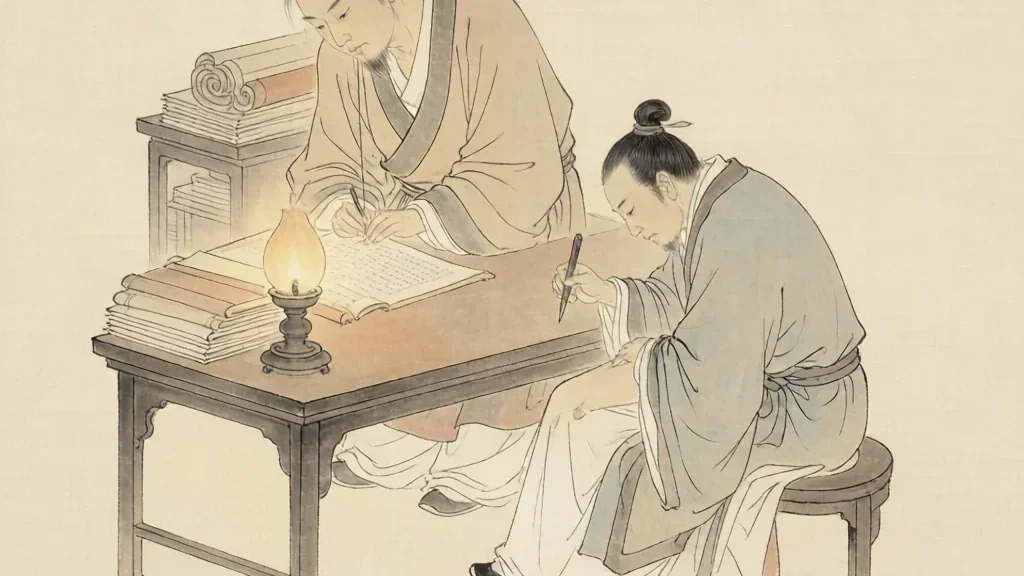
Some stories about study are gentle; this one is not. The Chinese idiom 悬梁刺股 (xuán liáng cì gǔ) — often rendered as "tying the hair to the beam and jabbing the thigh" — captures a degree of devotion to learning that borders on the extreme. It pairs two separate historical anecdotes into a single four-character phrase, and together they have come to stand for the absolute refusal to waste a single waking hour. For more than a thousand years, Chinese parents have whispered or shouted this idiom at children who would rather sleep than read, and students facing the rigors of imperial exams invoked it as a kind of personal motto. To understand why such a brutal image endures, we have to look at the two men behind it and the culture that turned their self-discipline into legend.
The First Story: Sun Jing and the Beam
The first half of the idiom belongs to 孙敬 (Sūn Jìng), a scholar of the Eastern Han dynasty who lived around the first century CE. According to the 太平御览 and other later compilations, Sun Jing was so committed to his books that he would read late into the night and inevitably fight against falling asleep. Rather than surrender to drowsiness, he devised a painful solution: he tied his own long hair to the wooden beam above his desk. When his head nodded forward in sleep, the pull of the hair against the beam jerked him awake with a sharp sting. In this way he could keep studying until exhaustion finally overcame him.
The image is vivid and a little horrifying, but it makes a point that Chinese tradition has always prized: that the mind must master the body, and that learning is worth a measure of suffering. Sun Jing was not wealthy or well-connected, and the story implies that his only path upward was sheer, sleepless effort. His later reputation as a learned man was offered as proof that the method worked. The beam became a symbol not of cruelty but of unbending will.
What makes this anecdote striking is its physical intimacy. We do not imagine Sun Jing hiring a tutor or building a library; we imagine a solitary man tethered to his own ceiling, fighting his eyelids. The idiom compresses an entire philosophy of self-discipline into four characters, and the first two — 悬梁 (xuán liáng), "hang from the beam" — carry the whole visual weight of that lonely, determined figure.
The Second Story: Su Qin and the Awl
The second half comes from the tumultuous Warring States period, more than two centuries before the common era. 苏秦 (Sū Qín) was a political strategist who traveled from court to court trying to sell his advice to rival kings. Early in his career he failed spectacularly; no ruler would listen, and he returned home penniless and despised by his own family. Humiliated, he threw himself into study, poring over military and diplomatic texts by candlelight.
To keep himself awake during these long nights, Su Qin kept a sharp iron awl (股 here refers to the thigh) beside him. Whenever sleep crept in and his eyes closed, he stabbed the awl into his own thigh. The pain and the sight of his blood renewed his concentration. After years of this punishing routine, he mastered the art of persuasion and eventually persuaded six states to form an alliance against the powerful state of Qin, briefly becoming a man of enormous influence.
Su Qin's story adds a dimension the first lacks: failure redeemed by effort. He was not naturally victorious; he was rejected and mocked. The awl in the thigh is the instrument of his comeback. Together, Sun Jing and Su Qin represent two faces of the same ideal — the quiet student and the humiliated striver — both refusing to quit.
How the Two Stories Became One Idiom
Though the two men lived centuries apart, later anthologists loved to set their stories side by side as twin examples of diligence. By the time of the 三字经 (Sān Zì Jīng, the "Three Character Classic") and Song-era collections, "tying the hair" and "jabbing the thigh" were fused into a single expression. Readers were expected to know both references, and the combined phrase carried more force than either alone: if two such different men reached greatness through the same refusal to sleep, the lesson was universal.
It is worth noting that the idiom is descriptive, not prescriptive in a literal sense. No one actually recommends tying children to beams. The phrase functions as shorthand for extreme dedication, the way English speakers might say "burning the midnight oil" without meaning they set anything on fire. The violence of the image is precisely what makes it memorable — it shocks the listener into respecting the seriousness of study.
In the broader family of Chinese idioms about perseverance, 悬梁刺股 sits at the intense end of the spectrum. Other sayings praise steady dripping water or grinding an iron rod into a needle; this one praises the willingness to hurt yourself rather than stop learning. That rawness is why it has survived.
The Cultural Meaning: Learning as a Moral Duty
To modern readers the idiom can seem alarming, but within the Confucian framework that shaped imperial China, self-cultivation through study was a moral obligation, not merely a practical one. A person who neglected learning was, in a sense, neglecting their duty to family and society. The imperial examination system (keju) made this concrete: scholarly success could lift a whole family out of poverty and bring honor to ancestors.
Against that backdrop, the suffering in 悬梁刺股 is reframed as noble. The pain is temporary; the reward — wisdom, office, respect, the ability to help others — is enduring. The idiom teaches that there are no shortcuts to mastery, and that the body's comfort must sometimes be sacrificed to the mind's growth. This message resonated especially with poor students, for whom disciplined study was the only ladder available.
Yet the same culture also warned against excess, and later commentators sometimes used the idiom as a cautionary contrast rather than a model — a reminder of how far people would go. The phrase thus carries a faint ambiguity: admiration mixed with a wince. That tension is part of its staying power.
How It Is Used in Daily Life Today
In contemporary China, 悬梁刺股 appears most often in encouragement aimed at students, particularly around the gaokao, the national college entrance exam. Banners in classrooms, motivational speeches, and worried parent conversations invoke it to summon the spirit of total commitment. It is also used somewhat ironically by overworked employees to describe their own exhaustion, a way of laughing at the grind while acknowledging its seriousness.
You will rarely hear someone use it to describe casual hobbies. The idiom implies high stakes and a willingness to suffer for a goal that matters. If a friend says they are "tying hair and jabbing thigh" for a project, they mean they are all in, losing sleep, abandoning comfort. The phrase has become a colorful way to signal intensity without a long explanation.
Interestingly, modern educators often pair the idiom with a gentle corrective: study hard, yes, but protect your health. The old story is honored even as its literal practice is discouraged. The image remains a touchstone of ambition while the method is left safely in the past.
A Reflection on Devotion and Its Limits
悬梁刺股 asks a question every serious learner eventually faces: how much should I sacrifice for what I want to know or become? The idiom answers boldly, almost recklessly, that the price of greatness can be the comfort of your own body. There is something inspiring in that refusal to be defeated by tiredness, and something unsettling in the methods it celebrates.
Perhaps the healthiest reading is symbolic. Tie your attention to your goal so it cannot drift; jab yourself awake when indifference sets in. The beam and the awl need not be literal to teach their lesson. What endures is the conviction that learning is worth fighting for — that the mind, properly trained, can overcome the weakness of the flesh. For two thousand years, that conviction has sent Chinese students back to their desks long after the candle should have been snuffed.
A Family of Diligence Idioms
悬梁刺股 is the loudest member of a large family of Chinese sayings about effort. Its gentler cousins include 囊萤映雪, students who read by firefly light or the glow of snow, and 铁杵磨成针, the promise that an iron rod can be ground into a needle with enough patience. 滴水穿石 adds that steady dripping wears through stone, and 愚公移山 compares perseverance to moving a mountain. What sets the hair-and-thigh idiom apart is its bodily cost: the others admire calm, sustained work, while this one admires pain borne to keep working. Read together, they show a culture that valued effort so highly it produced a whole range of images for it, from the peaceful to the punishing. The idiom is simply the most extreme note on that scale, which is precisely why it is remembered.
Why Hardship Became Holy in Exam Culture
The idiom's fierceness makes sense against the imperial examination system. For most of Chinese history, scholarly success through the keju exams was the main ladder out of poverty, the one path by which a poor family could gain office and honor ancestors. With stakes that high, discomfort looked like a reasonable price, and self-discipline through study became a moral duty, not a hobby. A student with no connections had only effort to spend, so tales of men who hurt themselves to stay awake read as inspiring, not alarming. The brushwood, the awl, and the beam were symbols of merit won the hard way. Understanding this context explains why the image endured for centuries and why, even now, it surfaces each exam season as a half-joking emblem of total commitment.
❓ Frequently Asked Questions
📝 Chinese Vocabulary
悬梁刺股 — : "Tie the hair to the beam and jab the thigh"; extreme devotion to study.
悬梁 — : To hang (one's hair) from the beam; the Sun Jing half of the story.
刺股 — : To prick the thigh with an awl; the Su Qin half of the story.
孙敬 — : The Eastern Han scholar who tied his hair to a beam to avoid sleeping.
苏秦 — : Warring States strategist who jabbed his thigh to stay awake while studying.
锥 — : An awl, the sharp tool Su Qin used to jab his thigh and shock himself awake while studying.
三字经 — : The Three Character Classic, a primer that helped fuse the two diligence anecdotes into one idiom.
囊萤映雪 — : Bagging fireflies and reflecting snow; a gentler sibling idiom about studying by borrowed light.
🎉 Fun Facts
- The idiom fuses two men who lived roughly two centuries apart, yet Chinese readers treat them as a single paired example of diligence.
- Sun Jing's "beam" method relied on long hair — a detail that highlights how hair styles of the era made the trick physically possible.
- Su Qin's awl (锥, zhuī) was a common tool of the period, kept close at hand, which is what made his self-punishment so practical.
- The phrase still appears on motivational banners in Chinese high schools during gaokao season.
- Because the two anecdotes were fused so completely, many Chinese speakers assume Sun Jing and Su Qin were contemporaries, when they lived roughly two centuries apart.
- Modern sleep scientists would warn that the idiom glorifies exactly the sleep loss they tell students to avoid, a telling clash between an ancient motto and current health advice.