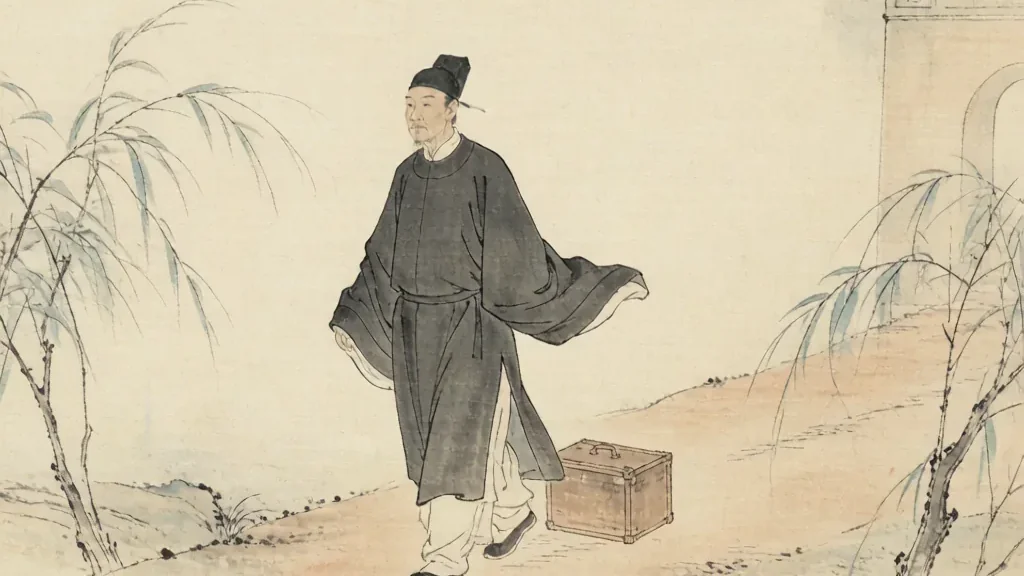
The idiom 两袖清风 (liǎng xiù qīng fēng), literally "two sleeves of clear breeze," is the classical Chinese way of praising an official who is clean, honest, and free of corruption. The image is quietly poetic: when a magistrate leaves office, his sleeves contain nothing but wind, because he took no bribes and accumulated no illicit wealth. The phrase thus compresses an entire ethical ideal into four characters, linking personal integrity to the physical emptiness of a garment. It belongs to a long tradition in which literature, drama, and popular saying held up the uncorrupted administrator as a moral hero. To describe a servant of the state as 两袖清风 is to grant him the highest civic virtue in a society that historically viewed the conduct of officials as a matter of cosmic as well as political order.
The Literal Image and Its Poetic Logic
The four characters are easily visualized. Sleeves in traditional dress were broad and capacious, capable of holding gifts, money, and documents. To say that both sleeves hold only the clear breeze is to say that the official carried away nothing of material value when he departed his post. The breeze, a clean and weightless thing, becomes a symbol of an unburdened conscience and an unsullied record.
This imagery is effective because it turns an abstract virtue into a bodily fact. Honesty is not argued but shown: the man's very clothing testifies to his restraint. The poem or saying that uses the image invites the listener to imagine the official walking away empty-handed, and that picture carries more moral force than any lecture on propriety could supply.
Historical Roots in Official Culture
The ideal behind the idiom runs deep in Chinese political culture, where the scholar-official was expected to serve with integrity and to treat public resources as a trust. From the imperial examination system onward, local magistrates were simultaneously judges, tax collectors, and moral exemplars, and their conduct was thought to affect the welfare of the region and the favor of heaven. Corruption was therefore not merely a legal offense but a breach of the moral economy connecting ruler, official, and people.
Stories, plays, and ballads repeatedly celebrated the poor but honest judge who refused bribes and defended the weak. Such figures became folk heroes, and the phrase 两袖清风 crystallized the admiration they inspired. It functioned as both praise and a standard, reminding officeholders of what the public expected and remembered.
The Examination System and the Scholar-Official
The imperial examination produced a class of administrators selected for literary and classical learning rather than birth. In theory this system rewarded merit and cultivated a shared ethical vocabulary drawn from Confucian texts. The clean official became an emblem of the system's promise: that a man of learning and virtue, not a hereditary lord, would govern.
Reality was of course mixed, and corruption was a recurring problem addressed by repeated reforms, censorate investigations, and harsh penalties. Yet the persistence of the ideal, repeated in the idiom, shows that clean administration remained a genuine cultural aspiration. 两袖清风 named the standard against which actual magistrates were measured, and its use in parting poems to departing friends was both compliment and gentle exhortation.
Use in Farewell Poetry and Letters
A common occasion for the phrase was the departure of an upright official from his post. Colleagues and friends would compose poems wishing him well and praising his clean sleeves, turning a career transition into a moment of moral表彰. The breeze in the sleeves stood for a reputation that traveled with him, lighter than silver but far more valuable.
In personal letters the idiom could also carry a slightly self-deprecating tone, as a poor but principled gentleman might describe his own empty sleeves with a wry smile. The flexibility of the image, at once lofty and humble, helped it survive across registers of speech, from formal encomium to private jest.
The Censorate and Anti-Corruption Institutions
Imperial China developed supervisory organs, most famously the censorate, charged with monitoring officials and reporting misconduct directly to the throne. Censors themselves were expected to be beyond reproach, and the idiom suited the self-presentation of an investigator who had resisted temptation. The institution and the phrase reinforced each other: one supplied the mechanism, the other the ideal.
Although these bodies were not always effective, their existence testifies that the culture took official probity seriously enough to build structures around it. 两袖清风 thus lives at the intersection of literature and administration, a value that was preached, institutionalized, and memorialized in verse.
Contrast With the Corrupt Official in Drama
Chinese opera and vernacular fiction thrive on contrast, and the honest magistrate is most vivid when set against the greedy one. Plots frequently pit a clean official who hears the widow's plaint against a wealthy villain who expects his silver to buy silence. The audience's satisfaction comes from watching the breeze-filled sleeves triumph over the money-filled ones.
This dramatic structure did real cultural work. By making integrity entertaining and corruption ridiculous or terrifying, popular art taught ethics without sermonizing. The idiom, when spoken by a stage hero, condensed the whole moral frame of the play into a single resonant image that audiences carried home.
Material Simplicity as a Virtue
The phrase also reflects a broader esteem for plain living in Confucian and Daoist thought. The gentleman who does not covet wealth is free to act according to principle, whereas the one entangled in possessions becomes their servant. Empty sleeves are therefore not poverty alone but a chosen lightness that protects independence.
This connection explains why the idiom could be used beyond officialdom, to praise any person of modest means and unblemished character. A teacher, a doctor, or a retired servant described as 两袖清风 was being honored for a life unstained by greed, the same virtue scaled from the courtroom to the household.
Modern Usage and Continuing Relevance
In contemporary China the idiom remains active in political speech, anti-corruption campaigns, and everyday praise of public servants who live simply. News reports and speeches invoke the clean-sleeves image to encourage upright conduct and to commemorate model officials. Its ancient pedigree lends weight to modern exhortations, linking current efforts to a venerable tradition.
The phrase also survives in casual life, where people may use it half-playfully to describe a friend who is broke but unbothered, or a colleague known for refusing favors. This playful survival proves the idiom's firm place in the language: it can be both a serious ethical standard and a light social remark without losing its core sense of clean-handedness.
Kindred Idioms of Integrity and Excess
两袖清风 belongs to a cluster of phrases about conduct and restraint. 廉洁奉公 (lián jié fèng gōng) explicitly means to serve the public with integrity. 一尘不染 (yī chén bù rǎn) describes being unstained by even a speck of dust, used for spiritual or moral purity. At the opposite pole, 贪得无厌 (tān dé wú yàn) condemns endless greed. Knowing these relatives lets a speaker place the honest official precisely on a scale of virtue and vice that the language has mapped in fine detail.
Together these idioms form a moral vocabulary that ordinary people can deploy without special learning. To call someone clean-sleeved is to draw on centuries of consensus about what good conduct looks like, and to place that person within a lineage of admired figures rather than merely offering a private opinion.
Why the Image Endures in Cultural Memory
The longevity of 两袖清风 rests on its perfect union of sense and symbol. It says something true about integrity, that the honest person leaves no illicit trace, while clothing the truth in an image gentle enough to be repeated by children and potent enough for statesmen. Few phrases manage both intimacy and authority so completely.
In a world still struggling with the costs of corruption, the clean-sleeved official remains a useful ideal. The idiom does not pretend that honesty is easy or common; it simply keeps the standard visible, reminding each generation that an administrator's worth is measured not by what he carries away but by what he leaves behind for others to inherit.
❓ Frequently Asked Questions
What does liangxiu qingfeng literally mean?
It literally means two sleeves of clear breeze, describing an official who left office with no illicit wealth.
What virtue does the idiom praise?
It praises integrity and freedom from corruption in public service, the highest civic virtue.
Why mention sleeves specifically?
Broad sleeves could hide bribes, so empty sleeves visually prove the official took nothing.
Is it only about government officials?
Primarily yes, but it can praise any person of modest means and unstained character.
How is it used in modern China?
It appears in anti-corruption campaigns, news, and casual praise of simple living.
What idioms contrast with it?
Tan de wu yan, endless greed, stands opposite, while lian jie feng gong names the same ideal plainly.