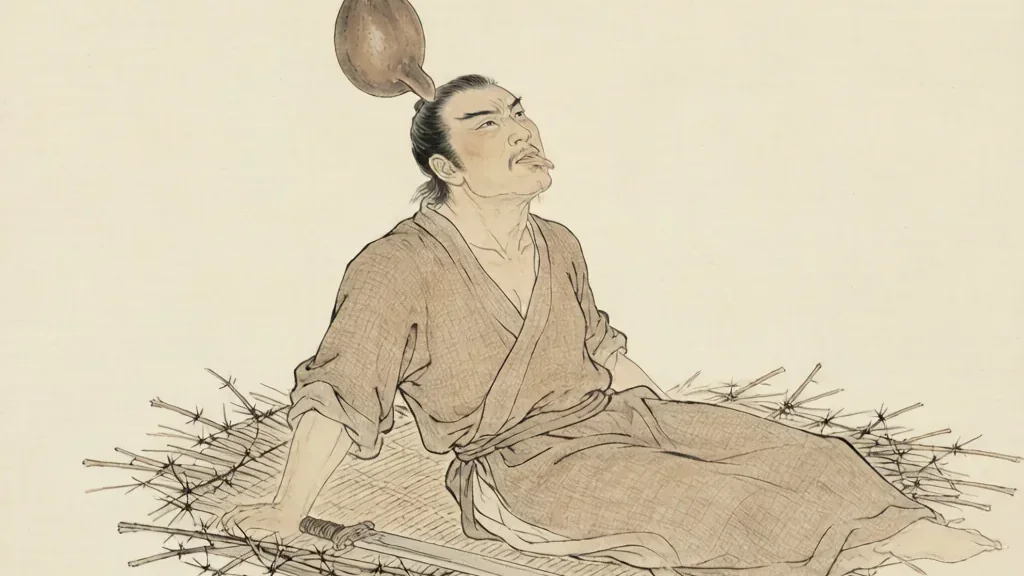
There is a kind of determination that does not burn bright and hot like a sudden fire, but smolders low and steady for years, decades even, until the moment is right. The Chinese idiom 卧薪尝胆 (wò xīn cháng dǎn), "sleeping on brushwood and tasting gall," is the story of this kind of determination — the long, grinding patience of a man who turned his own suffering into fuel for the greatest comeback in Chinese history. It is the tale of King Goujian of Yue, who lost everything, endured unimaginable humiliation, and then spent twenty years rebuilding himself and his kingdom for a single purpose: revenge.
The story comes from the Spring and Autumn period (770-476 BCE), an era of constant warfare among the many states that made up ancient China. It is recorded in the "Records of the Grand Historian" (史记) and has been told and retold for over two thousand years as the ultimate example of what patience, endurance, and unshakeable will can achieve. It is a story so dramatic that it has inspired countless works of literature, opera, film, and television, and its central image — a king choosing to sleep on sticks and taste bitterness every day — has become the definitive Chinese symbol of self-discipline in pursuit of a goal.
The Fall of a King
In the late sixth century BCE, the kingdoms of Wu and Yue were bitter rivals in the lower Yangtze River region. In 494 BCE, King Fuchai of Wu launched a devastating attack on Yue. The Yue army was crushed at the Battle of Fujiao, and King Goujian found himself trapped with only five thousand soldiers in the hills of Kuaiji. He had two choices: fight to the death and see his kingdom annihilated, or surrender and live, however degraded that life might be.
Goujian chose to surrender. He sent his minister Wen Zhong to negotiate with Fuchai, offering himself and his wife as servants to the King of Wu. The terms were harsh: Goujian would become a slave in Fuchai's court, performing the most menial tasks, while Yue would become a tributary state, stripped of its army and forced to pay heavy tribute. Fuchai, against the advice of his own wise minister Wu Zixu, accepted the offer. He wanted not just victory but the pleasure of seeing his enemy humiliated.
For three years, Goujian lived as a servant in the court of his conqueror. He wore coarse clothing, ate simple food, and performed labor that was beneath the dignity of any king. He was made to serve as a groom, tending to Fuchai's horses. According to some accounts, when Fuchai fell ill, Goujian tasted the king's excrement to diagnose his illness — an act of such extreme self-abasement that it convinced Fuchai of Goujian's complete submission and loyalty. Whether this detail is historically accurate or a later embellishment, it captures the depth of the humiliation Goujian was willing to endure.
The Price of Endurance
Eventually, Fuchai was persuaded to release Goujian and allow him to return to Yue. The decision was a catastrophic mistake, but it was understandable. Goujian had performed his role so perfectly — the broken king, the loyal servant, the man without pride or ambition — that Fuchai genuinely believed he was no longer a threat. He could not see that beneath the mask of submission, a fire was burning that would never go out.
When Goujian returned to his ruined kingdom, he did not celebrate. He did not rest. He moved out of the palace and into a simple hut. He replaced his soft bed with a pile of brushwood — dry, prickly sticks that made sleep uncomfortable and shallow. And he hung a gall bladder, the bitterest part of an animal, from the ceiling of his room. Every morning and every evening, he would lick the gall bladder and ask himself aloud, "Have you forgotten the humiliation of Kuaiji?"
The Long Road Back
The brushwood and the gall bladder were not mere theatrical gestures. They were tools of psychological conditioning, designed to ensure that Goujian never became comfortable, never forgot what he had lost, and never lost sight of his ultimate purpose. Every night of uncomfortable sleep was a reminder that he was not yet home. Every taste of bitterness was a memory of the bitterness of defeat. Comfort, Goujian understood, was the enemy of resolve. As long as he was uncomfortable, he would keep fighting.
Goujian's strategy for rebuilding Yue was comprehensive and far-sighted. He reformed agriculture, encouraging farmers to produce more food so the population could grow. He personally worked in the fields alongside his people, demonstrating that he was not above the labor of ordinary men. He promoted a policy of population growth, rewarding families that had many children with tax exemptions and material support. He trained a new army in secret, hiding its size and strength from Wu's spies. And he cultivated talented advisors — men like Wen Zhong and Fan Li, whose wisdom and strategic genius would prove decisive in the years to come.
The most remarkable aspect of Goujian's recovery was its patience. He did not rush. He did not seek a quick revenge that might fail. He understood that Wu was still powerful, that Fuchai's army was still formidable, and that a premature attack would only result in another devastating defeat. So he waited. Year after year, he rebuilt his kingdom, strengthened his army, and licked his gall bladder. Ten years passed. Then twenty. And still he waited.
The Moment of Reckoning
Meanwhile, King Fuchai of Wu was busy destroying himself. Flushed with his earlier victories, he had grown arrogant and complacent. He launched expensive military campaigns against other states, depleting Wu's treasury and exhausting its army. He fell under the influence of a corrupt minister named Bo Pi, who had been secretly bribed by Goujian's agents. And he ignored the warnings of Wu Zixu, his most loyal and far-sighted advisor, eventually forcing Wu Zixu to commit suicide. The kingdom that had humiliated Goujian was rotting from within, and its king was too blind to see it.
In 473 BCE, after twenty years of preparation, Goujian struck. The Yue army, now battle-hardened and fiercely motivated, invaded Wu with devastating speed. Fuchai's forces, weakened by years of foreign wars and internal corruption, crumbled before the assault. The King of Wu, who had once forced Goujian to taste his excrement, now found himself cornered in his own palace. He sent messengers begging for peace, offering to become Goujian's vassal in turn. But Goujian had not spent twenty years sleeping on brushwood and tasting gall to accept anything less than total victory. He refused.
Fuchai, seeing no way out, took his own life. The state of Wu was annexed by Yue, and Goujian became the most powerful ruler in the region. The man who had been a slave and a groom was now a hegemon, the leader of the alliance of states. The bitterness of the gall bladder had been transformed into the sweetness of absolute triumph.
Why the Story Resonates
The idiom 卧薪尝胆 has survived for millennia because it speaks to something deep in the human spirit — the belief that suffering, properly used, can become a source of strength. Goujian did not merely endure his humiliation; he weaponized it. The brushwood and the gall bladder were constant reminders that turned pain into purpose and kept him focused on a goal that took two decades to achieve.
In modern China, 卧薪尝胆 is used to describe anyone who is undergoing hardship in pursuit of a long-term goal. A student who studies through the night for years to pass a crucial exam, an entrepreneur who lives frugally while building a business, an athlete who trains relentlessly for an Olympic medal — all of these are said to be "sleeping on brushwood and tasting gall." The idiom is a recognition that greatness rarely comes without sacrifice, and that the willingness to endure discomfort is often what separates those who succeed from those who give up.
The story also carries a darker lesson about the nature of revenge and the psychology of humiliation. Goujian's twenty-year campaign was extraordinary, but it was also terrifying. He dedicated his entire life — and the lives of his people — to the destruction of an enemy. The line between determination and obsession is thin, and Goujian walked it for two decades without falling. Whether this makes him a hero or a cautionary tale depends on one's perspective, but there is no denying the sheer force of will that the story celebrates.
Perhaps the most enduring aspect of the tale is its insistence that defeat is not final unless you accept it as final. Goujian lost everything — his army, his freedom, his dignity. By any conventional measure, his story should have ended in the hills of Kuaiji, with a last stand and a noble death. Instead, he chose to live, to endure, and to wait. And in doing so, he proved that the most dangerous enemy is not the one who has never been defeated, but the one who has been defeated and refused to stay down.
The Fate of Goujian's Advisors
Goujian's revenge was not solitary. Two men made it possible: Wen Zhong, who managed the state's recovery, and Fan Li, who guided strategy and diplomacy. Their fortunes after victory show the danger of succeeding a suspicious ruler. Fan Li, wary of court intrigue, withdrew from power and, by legend, became a wealthy merchant, later honored as a god of commerce. Wen Zhong stayed and, according to tradition, was urged by the departing Fan Li to do the same; he did not, and fell victim to the king's fear. The advisor's story is a quiet appendix to the idiom: endurance wins the war, but survival at court requires its own wisdom. The brushwood and gall built a kingdom, yet even the builders could not always trust the king they served.
Goujian on Stage and Screen
The tale has never left Chinese stages. Operas dramatize the humbled king tending horses and the later triumph, while television has returned to it repeatedly, most notably in a 2006 series that brought the ancient revenge to new audiences. Filmmakers are drawn to its clean arc: fall, disguise, grueling wait, reckoning. The images of the brushwood bed and the hanging gall bladder are instantly recognizable cultural shorthand, summoned whenever a story needs a symbol of patient, burning resolve. This afterlife matters because it keeps the idiom alive as feeling, not just quotation. A viewer who has watched Goujian suffer for twenty years understands 卧薪尝胆 more deeply than a dictionary definition allows, and carries the picture into their own struggles.
A Cautionary Tale as Well as a Triumph
For all its glory, the story carries a warning. Goujian spent two decades transforming humiliation into revenge, and in doing so devoted his life and his people's to the destruction of an enemy. The same unbreakable will that rebuilt Yue also consumed it in a single aim; the line between noble endurance and obsession is thin, and he walked it without wavering. Readers may admire the king and still wonder at the cost, the families spent, the hatred nursed for a generation. The idiom therefore teaches two things at once: that suffering used well can become strength, and that a mind fixed only on payback can become its own cage. The healthiest use of the phrase remembers both, celebrating resolve while staying alert to where resolve tips into ruin.
❓ Frequently Asked Questions
📝 Chinese Vocabulary
卧 — : "To sleep" or "to lie down" — representing the deliberate choice to forgo comfort as a form of self-discipline.
薪 — : "Brushwood" or "firewood" — the rough, uncomfortable bedding that ensured Goujian never forgot his purpose.
尝 — : "To taste" — the daily ritual of reminding oneself of bitterness and defeat.
胆 — : "Gall bladder" — the bitterest part of an animal, symbolizing the bitterness of humiliation and the fuel for revenge.
勾践 — : The King of Yue whose name has become synonymous with patient endurance and ultimate triumph over adversity.
吴 — : The state of Wu, the rival kingdom Goujian served as a slave and later destroyed.
越 — : The state of Yue, Goujian's own kingdom, which he rebuilt through twenty years of endurance.
夫差 — : King Fuchai of Wu, the conqueror whose arrogance and corrupted court enabled Goujian's revenge.
🎉 Fun Facts
- The idiom 卧薪尝胆 is often paired with 十年生聚,十年教训 (shí nián shēng jù, shí nián jiào xùn) — "ten years to gather strength, ten years to train" — describing Goujian's twenty-year preparation for revenge.
- The legendary sword of Goujian was discovered in an archaeological excavation in 1965 near Jingzhou, Hubei province. After over 2,400 years, the bronze blade was still sharp and showed no signs of rust — a testament to the advanced metallurgy of the Yue kingdom.
- Fan Li, one of Goujian's key advisors, is said to have retired after the victory over Wu and become a successful merchant, eventually being deified as the God of Wealth (财神) in Chinese folk religion.
- The story has been adapted into numerous Chinese TV dramas and films, most notably the 2006 series "The Rebirth of a King" (卧薪尝胆), which brought the ancient tale to a new generation of viewers.
- Because 胆 also means courage, 'tasting the gall' is read as steeling one's nerve, the bitter flavor becoming a metaphor for brave resolve.
- The tale is a staple of Chinese sports and business pep talks, where 'sleeping on brushwood' stands for any grueling preparation for a comeback.