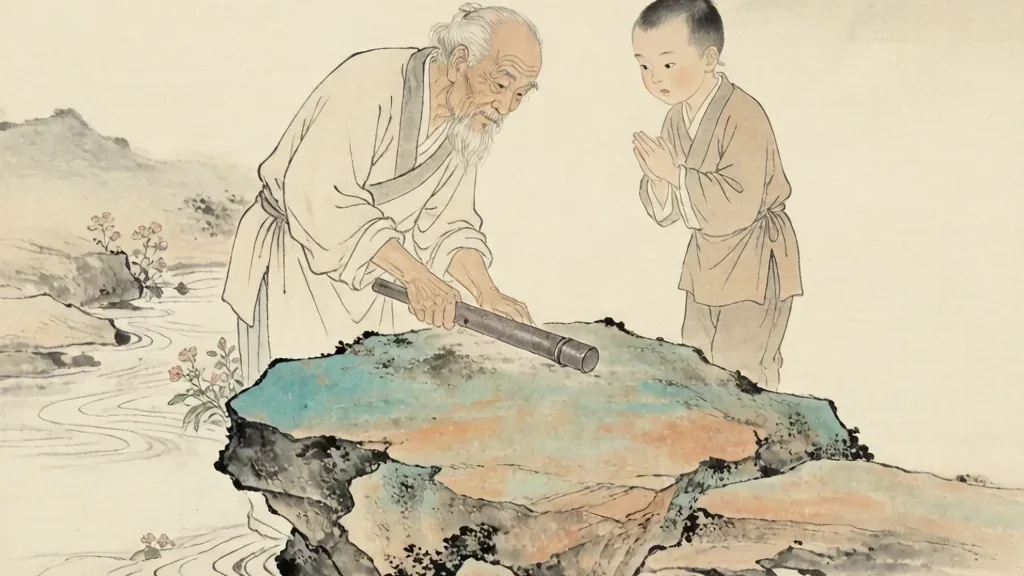
The idiom 磨杵成针 tells of grinding an iron pestle down into a sewing needle, and it has long served in Chinese culture as the supreme emblem of patient persistence. According to a well-loved legend, the great Tang dynasty poet Li Bai, as a restless boy tempted to abandon his studies, encountered an old woman by a river who was rubbing a thick iron rod against a stone, explaining calmly that she meant to wear it into a needle. The encounter struck Li Bai so deeply that he returned to his books and later became one of the most revered poets in Chinese history. The phrase now encourages anyone facing a long, difficult task to trust that steady effort, however small, can transform the hardest material into a finished goal.
The Legend of Li Bai and the Old Woman
The central story places a young Li Bai near a stream, discouraged by the difficulty of his lessons and ready to give up. He meets an elderly woman bent over a grindstone, working a heavy iron rod with unhurried determination. When the boy asks what she is doing, she replies that she intends to grind the rod into a needle, certain that constant effort will accomplish it. Her quiet confidence shames his impatience.
Li Bai is said to have been transformed on the spot, realizing that the same principle applied to his own learning. He resumed his studies with renewed discipline and, in the traditional telling, went on to compose poetry of such brilliance that he was later called a banished immortal of verse. The anecdote is less a verified biography than a teaching parable, but its association with a national literary hero gave it enormous persuasive power in classrooms for generations.
Historical Figure Behind the Tale
Li Bai lived in the eighth century during the golden age of Tang poetry and is ranked with Du Fu as one of the two greatest poets of the tradition. His biography, recorded in the standard histories, emphasizes his romantic spirit, his love of wine, and his spontaneous genius rather than grinding labor, which is precisely why the grindstone legend is charming: it supplies the discipline his official life story seems to lack. The tale humanizes a figure often portrayed as effortlessly inspired.
Scholars note that the story of the old woman does not appear in the earliest biographies and was likely attached later as a moral lesson for students. Its durability shows how strongly Chinese education valued perseverance and how willingly audiences accepted a humble folk encounter as the turning point in a genius's life. The gap between the historical Li Bai and the boy of the legend is itself instructive about the culture's priorities.
Literal Meaning and Symbolism
The phrase names a physically absurd task: an iron pestle, a heavy kitchen implement used for pounding, slowly worn to the slender fineness of a needle. The contrast between the starting mass and the intended delicacy is the point, because it dramatizes how far patient repetition can carry a person. Grinding is slow, noisy, and unglamorous, which makes it a fitting symbol for daily study or practice.
Each element of the image carries meaning. The iron stands for difficulty and resistance, the stone for the steady surface of habit, and the needle for a precise, useful result earned over time. Because the transformation is almost invisible day to day, the idiom also teaches faith in cumulative progress, reminding learners that small actions, continued without interruption, eventually produce outcomes that once seemed impossible.
Role in Chinese Education
For centuries teachers used this story to answer the student's eternal complaint that learning is too hard or too slow. The old woman's reply became a kind of slogan against quitting, and the idiom appeared in primers, moral tales, and family instructions meant to build character as much as scholarship. Its lesson transcended poetry and applied to calligraphy, craft, and any skill requiring repetition.
Unlike idioms that celebrate sudden brilliance, this one honors the unglamorous middle of the journey, the hours when no visible result appears. Educators valued that emphasis because most real achievement consists of exactly such hours. The tale also reassured slower students that talent matters less than endurance, a democratic message that helped ordinary children persist in their studies despite modest gifts.
Connection to Other Perseverance Idioms
Chinese has a rich vocabulary of persistence idioms, and mochu-chengzhen belongs to a family that includes dripping water wearing through stone and the old man who moved mountains. All share the conviction that time and will defeat even massive obstacles, but each frames the idea differently: water stresses gentle repetition, the mountains stress collective effort, and the iron rod stresses transforming raw difficulty into precision.
Teachers often grouped these stories so students would hear the same truth from several angles. The variety kept the lesson fresh and let a child who disliked one image respond to another. Together they formed a cultural curriculum of grit, transmitted not through abstract exhortation but through memorable characters and impossible tasks that nonetheless succeeded through sheer continuity of effort.
Philosophical Dimensions of Effort
The idiom reflects a broader Chinese philosophical stance that human nature is malleable through practice and that mastery is a matter of method and time rather than fixed destiny. Where some traditions stress innate gift, this story insists that the needle is made, not born, and that the maker is anyone willing to keep grinding. It aligns with Confucian emphasis on self-cultivation through steady discipline.
At the same time, the tale implies wisdom about choosing the right task: the old woman is not merely stubborn but purposeful, aiming at a definite needle. The lesson is not endless labor for its own sake but directed persistence toward a clear goal. Modern readers sometimes note that the story also warns against mistaking motion for progress, since grinding must have a finished needle in view to be meaningful.
Use in Art and Popular Culture
Painters and illustrators have depicted the riverbank scene with the old woman at her stone and the young poet looking on in awakening wonder, a composition that appears in children's books and scrolls alike. The image is easy to stage and visually legible, which helped it spread as a subject across media from woodblock prints to modern animation aimed at schoolchildren.
In contemporary culture the phrase survives in graduation speeches, motivational writing, and parents' advice to children facing exams. Its familiarity means a speaker can summon the whole grindstone scene with four characters, and audiences immediately understand the call to perseverance. The idiom's journey from a Tang legend to a modern motivational cliche shows how stable the value of persistence remains in Chinese life.
Modern Lessons for Learning and Work
Today the idiom speaks to anyone beginning a long project, from language study to scientific research, where early progress feels invisible and the goal seems absurdly distant. It reframes frustration as normal and temporary, a stage every learner passes through if they keep the stone moving. Productivity writers cite it to argue against abandoning effort just before results appear.
The story also comforts the self-doubting by suggesting that greatness often begins with a small, almost foolish-looking commitment, like an old woman rubbing iron by a stream. Its enduring appeal is that it asks for no special talent, only continuation, and it promises that continuation itself is a kind of genius. Few idioms offer such practical, repeatable encouragement across the whole span of a working life.
❓ Frequently Asked Questions
What does mochu-chengzhen mean?
It means to grind an iron pestle into a needle, a metaphor for achieving a hard goal through patient, continuous effort.
Who is the old woman in the story?
She is a humble figure by a stream who tells the young Li Bai she is grinding an iron rod into a needle, teaching him perseverance by example.
Did this really happen to Li Bai?
The anecdote is a later moral legend rather than a recorded historical event, attached to Li Bai to encourage students facing difficult studies.
What lesson does the idiom teach?
It teaches that steady, repeated effort can accomplish what seems impossible, and that persistence matters more than innate speed or talent.
How is it used in modern Chinese?
It appears in advice about exams, training, and long projects, urging people not to quit when early progress is slow or invisible.
Are there similar idioms?
Yes, it belongs with water-wears-stone and the old man moving mountains, all celebrating endurance against great obstacles.