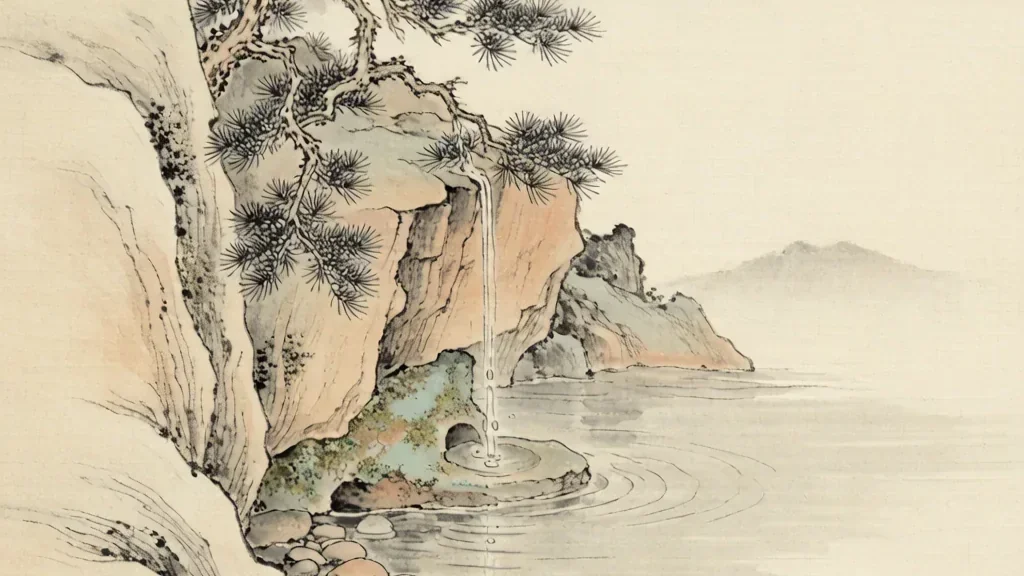
The idiom 水滴石穿 means that dripping water, given enough time, wears a hole through solid stone, and it has long stood in Chinese culture for the power of steady persistence against even the hardest obstacle. The image is drawn from ordinary observation: a leak or a cave drip marking a rock year after year until a groove appears where none existed. A well-known anecdote attaches the phrase to a Song dynasty magistrate named Zhang Guaiya, who used the idea to justify punishing a small theft, arguing that a thread snaps from many pulls and a stone yields to many drops. The idiom now encourages anyone facing a long struggle to keep applying small, regular effort, confident that accumulation itself defeats resistance that force alone cannot.
The Image of Dripping Water
The literal scene is humble and quiet: a single drop falling again and again onto one spot of stone, each impact too slight to notice, yet the sum of millions changing the surface forever. This everyday phenomenon, seen in caves and old roofs, gave Chinese observers a perfect natural metaphor for patience. The water does not hurry, yet it wins precisely because it does not stop.
What makes the image powerful is the mismatch between cause and effect: a soft, formless drop against unyielding rock, with the drop finally prevailing. The idiom thus reassures the weak or the slow that consistency, not strength, decides long contests. It also implies faith in invisible progress, since the first thousand drops leave no mark worth seeing, and only the long view reveals the hole that perseverance has made.
The Story of Magistrate Zhang Guaiya
The most cited story behind the idiom comes from the Song dynasty, where the official Zhang Guaiya discovered a subordinate stealing small amounts of public money. When the thief pleaded that the sums were trivial, Zhang is said to have replied that a thread is cut by constant pulling and a stone is pierced by constant dripping, meaning that minor wrongs or minor efforts both compound with time. He then punished the offender as a lesson.
In Zhang's hands the metaphor served justice, warning that small repeated faults erode character and order just as drops erode rock. But the same image also inspired the positive reading, that small repeated virtues build great results. The dual use shows the idiom's flexibility: it can warn against gradual decay or encourage gradual achievement, depending on whether the drops are vice or effort. Both lessons share the core insight that time multiplies the tiny.
Literal Meaning and Translation
Broken into characters, 水 is water, 滴 is a drop, 石 is stone, and 穿 is to pierce or wear through. A plain translation is "dripping water penetrates stone," though it is often rendered as "constant dripping wears away a stone." The four characters carry the whole process from cause to result without naming time, which the reader supplies from experience.
The compactness aids memory, letting a speaker invoke the entire natural process in a breath. Learners meet the idiom early because the scene is easy to picture and the grammar is simple. Its clarity is why it pairs naturally with other persistence sayings, and why it survives in both solemn lectures and casual encouragement, equally at home in a courtroom anecdote or a parent's advice to a struggling child.
Connection to Persistence Traditions
The idiom belongs to a Chinese family of sayings about gradual power, alongside grinding an iron rod into a needle and the old man who moved mountains. Each frames endurance differently, water stressing gentle repetition, the rod stressing transformation of difficulty, and the mountains stressing collective will against huge mass. Together they form a cultural curriculum of patience taught through nature and legend.
Teachers value the variety because different learners respond to different images, and the water version has the advantage of being observable by anyone with a leaking roof or a cave to visit. Its democratic, everyday quality means the lesson needs no special story to land, though the Zhang Guaiya anecdote gives it a memorable human frame. The idiom thus operates both as pure observation and as attached moral tale.
Philosophical Resonance With Softness
The image resonates with a broader current in Chinese thought that values the soft overcoming the hard, the flexible subduing the rigid. Water is the classic symbol of this principle, formless yet able to shape landscapes over centuries. The dripping drop is water at its most modest, yet it defeats stone, the emblem of stubborn strength, which makes the idiom a tiny parable of that philosophy.
Read this way, the phrase counsels humility in method: one need not be mighty to prevail, only continual. It also suggests that the apparently fixed, like a stone or a settled habit, is not permanent against patient pressure. The philosophical depth behind so simple a scene is part of why the idiom is quoted by both farmers and philosophers, each finding in it a fitting image for their particular struggle against resistance.
Use in Education and Parenting
In homes and schools the idiom is a staple for urging children through dull, slow tasks such as practicing an instrument or memorizing characters. Parents cite the dripping water to normalize the lack of quick results, explaining that the hole appears only after many unseen drops. The metaphor turns patience from a vague virtue into a concrete, almost physical expectation.
Educators also use it to reframe failure, since a single missed day of effort is like one drop that does no harm, but the habit of return is what wears the stone. The idiom thus supports consistent routine over intense bursts, a message backed by modern learning science that favors distributed practice. Its ancient origin lends authority to everyday advice, and children remember the picture long after the lecture is forgotten.
Modern Motivational and Scientific Echo
Contemporary self-improvement writing echoes the idiom constantly, often without naming China, in the claim that small daily actions compound into large outcomes. Habit research confirms that tiny repeated behaviors reshape skills and even neural pathways, a scientific restatement of the stone and the drop. The idiom therefore reads as folk intuition later validated by experiment.
In the workplace the phrase encourages steady progress on long projects that frustrate those wanting instant marks. It also comforts people recovering from setbacks, suggesting that renewal need not be dramatic to be real, since quiet regular effort rebuilds what seemed broken. The durability of dripping-water wisdom across a thousand years shows how a single observed fact of nature can become a permanent guide for human persistence.
The Idiom in Poetry and Paired Sayings
The image of the dripping drop was too natural to remain only a cautionary anecdote, and it migrated into classical poetry describing leaking eaves, cave drips, and the patient wearing of stone by water. Poets used it to evoke longevity and quiet determination, and the four characters fit neatly into couplets where they could be set against a matching line about time and effort. Its concrete picture made it a favorite for closing a verse on perseverance.
In proverb collections the phrase is usually paired with a twin saying, that a rope saws through wood and a constant drop pierces stone, the two offered together as parallel proofs that slow pressure defeats hard matter. This pairing shows how the idiom was taught as part of a set of patience sayings rather than in isolation, each image reinforcing the others. The habit of coupling it with the rope saw kept the lesson memorable and gave speakers a ready, rhythmic way to urge persistence.
❓ Frequently Asked Questions
What does shuidi-shichuan mean?
It means dripping water penetrates stone, a metaphor for the power of small, steady effort repeated over time to overcome hard obstacles.
Where does the story come from?
The image is natural observation, but a Song dynasty anecdote about Magistrate Zhang Guaiya uses it to justify punishing a small, repeated theft.
What is the literal translation?
The characters read water, drop, stone, pierce, so a faithful rendering is "dripping water wears through stone."
Does it only encourage effort?
No, it also warns that small repeated faults compound like drops, so it teaches both gradual achievement and gradual decay.
How is it used in education?
Parents and teachers cite it to normalize slow progress and to promote consistent daily practice over intense, brief bursts.
Is there scientific support?
Modern habit research agrees that tiny repeated actions compound into large skills, echoing the idiom's ancient intuition about accumulation.