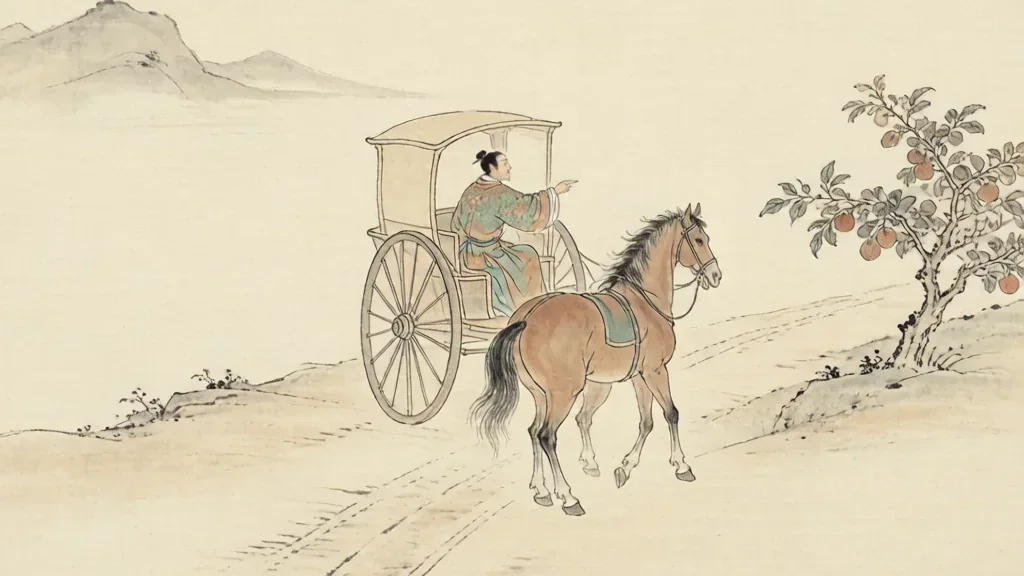
The faster you go in the wrong direction, the further you end up from where you want to be. The Chinese idiom 南辕北辙 (nán yuán běi zhé) — "the carriage heads south, the tracks go north" — captures this maddening truth with perfect economy. A man wants to reach a southern state but drives his cart northward; the better his horse and the fuller his provisions, the more hopeless his journey becomes. The phrase has become the classic Chinese image for contradictory aims and methods, and for the peculiar human habit of accelerating toward the wrong goal.
The Envoy and the Wrong Road
The story is recorded in the 战国策 (Zhàn Guó Cè, "Strategies of the Warring States"), a collection of political rhetoric from the contending states before China's unification. An envoy from the state of 魏 (Wèi) was preparing to set out for the state of 楚 (Chǔ), which lay to the south. A bystander noticed the envoy's carriage was pointed north and asked where he was going. Told "to Chu," the bystander pointed out the contradiction: Chu is south, but the carriage faces north.
The envoy was unfazed. He listed his advantages: his horse was swift, his travel funds were ample, and his driver was highly skilled. Each, he implied, would speed him to his destination. The bystander's devastating reply was that none of those advantages mattered — in fact, the stronger the horse and the better the driver, the further he would stray from Chu. His resources were real; his direction was fatal.
The anecdote was originally a diplomatic parable, used to warn a ruler that a powerful state pursuing the wrong policy would only compound its error by its very strength. The image of the misdirected carriage made the abstract point unforgettable.
The Characters and the Contradiction
The four characters lay out the mismatch: 南 (nán) "south," 辕 (yuán) "the shaft or front of the carriage" (hence the direction the carriage faces), 北 (běi) "north," and 辙 (zhé) "the wheel tracks" or "ruts" left on the road. So "south carriage, north tracks" means the vehicle is oriented south but its tracks run north — a literal impossibility that stands for any aim-and-method mismatch.
The beauty of the idiom is that it names both the intention (south) and the actual path (north) in the same breath. The contradiction is not hidden; it is the whole phrase. A listener immediately sees the absurdity of wanting one thing while moving toward its opposite.
The character 辙 (wheel ruts) is especially apt. Tracks are the visible record of where you have actually gone, indifferent to where you meant to go. The idiom thus quietly distinguishes intention from evidence — what you say you want versus where your ruts prove you are headed.
The Lesson: Direction Beats Resources
The envoy's mistake is to confuse means with ends. A fast horse, full purse, and skilled driver are all good things — but only if aimed correctly. Pointed the wrong way, they magnify the error. The idiom teaches that correctness of direction is prior to quality of resources; a modest effort in the right direction outperforms a huge effort in the wrong one.
This has a sobering application to life. We often console ourselves with our advantages — talent, money, education, effort — while ignoring whether we are headed where we claim to want to be. The idiom asks the uncomfortable question: are your "fast horse" and "skilled driver" carrying you toward Chu, or away from it? Resources cannot substitute for a true bearing.
It also warns against the seduction of motion. The envoy is doing something — driving, preparing, spending — and activity feels like progress. But busyness in the wrong direction is not progress; it is escalating distance. The idiom is a critique of mere motion without orientation, strikingly relevant to the modern cult of productivity.
How It Differs From Similar Idioms
南辕北辙 is often confused with 缘木求鱼 (climbing a tree to catch fish), another image of futile effort. But they differ in emphasis. "Climbing a tree for fish" means using a method that cannot possibly work — the goal and means are incompatible. "South carriage, north tracks" means pursuing a goal while moving opposite to it — the direction is simply wrong.
The distinction is useful. Some failures are like fishing in a tree: the task is impossible by that route. Others are like driving north to Chu: the task may be perfectly achievable, but you are going the wrong way. The idiom family lets Chinese speakers diagnose which failure they are watching.
There is also a flavor of self-contradiction in 南辕北辙 that the fish idiom lacks. The envoy simultaneously wants Chu and flees it. The phrase thus describes not just error but incoherence — a life pulling in two directions at once, the south of intention and the north of action never meeting.
How the Idiom Is Used Today
In modern Chinese, 南辕北辙 is ubiquitous in criticism of policy, strategy, and personal choices. An environmental policy that increases pollution, a diet that makes you gain weight, a study method that guarantees failure — all are "south carriage, north tracks." The phrase names the gap between aim and outcome.
It is also a gentle interpersonal correction. A friend working furiously toward a goal their actions undermine might be told, with a smile, that they are driving north for Chu. Because the image is so concrete, the rebuke lands without heavy moralizing.
In management and self-help writing, the idiom is a favorite for urging alignment: make sure your daily tracks run toward your stated south. The "compass before the engine" principle is exactly what the ancient envoy forgot, and what the idiom forever recalls.
A Reflection on Checking Your Tracks
南辕北辙 is a gift of perspective. We are all, sometimes, the envoy — proud of our swift horse, certain of our ample funds, unaware the carriage faces away from Chu. The idiom does not say stop the horse; it says turn the carriage. Effort is not the problem; orientation is.
The next time your busyness feels like progress, check your ruts. Do they run toward what you claim to want? If your south is family but your north is endless overtime, the idiom is speaking to you. Turn first, then ride. A slow cart facing Chu will arrive; a fast one facing away only travels further from home.
Warring States Diplomacy
The anecdote was not offered as mere entertainment but as statecraft. In the Zhan Guo Ce, persuaders known as shi traveled between courts selling strategies to rulers, and the misdirected carriage was a vivid way to warn a prince that a powerful state pursuing the wrong policy only compounds its error. The envoy's mistake, trusting resources over direction, mirrored the danger of a ruler who pours troops and treasure into a strategy aimed at the wrong goal. Advisers of the period prized such images because they could make an abstract policy error instantly visible to a busy sovereign. The idiom therefore carries the fingerprints of a debating culture in which a single memorable scene could shape the fate of armies and kingdoms.
Carriage and Road as Moral Map
Classical Chinese thought often used the road and the journey as metaphors for a life or a reign, so the image of a carriage pointed the wrong way carried moral weight beyond its comic surface. To travel south toward Chu was to follow the proper bearing; to face north was to have lost one's orientation altogether. The idiom joins a wider family of path metaphors, the Way or Dao itself is a road, in which direction is never neutral but always a comment on whether one is living or ruling correctly. Seen this way, the envoy is every person who mistakes motion for progress, and the wheel ruts are the quiet record of a life's true heading. The image endures because the road metaphor is built into how Chinese has long thought about purpose.
❓ Frequently Asked Questions
📝 Chinese Vocabulary
南辕北辙 — : "South carriage, north tracks"; acting contrary to one's goal.
辕 — : Carriage shaft / the direction the vehicle faces (toward the goal).
辙 — : Wheel ruts / actual tracks taken (away from the goal).
战国策 — : "Strategies of the Warring States," the source of the parable.
楚 — : The southern state the envoy wrongly headed away from.
魏 — : The state of Wei, from which the envoy set out in the Warring States parable.
方向 — : Direction or bearing; the key concept the idiom turns on, since the carriage faced the wrong way.
背道而驰 — : To run counter to the proper way; a near-synonym idiom for acting in the opposite direction from one's goal.
🎉 Fun Facts
- The envoy boasted of a swift horse, ample funds, and a skilled driver — all advantages that only worsened his error.
- The idiom originally warned a Warring States ruler that power aimed at the wrong policy compounds the mistake.
- 辙 (wheel ruts) represents the evidence of where you actually went, versus where you meant to — intention vs. proof.
- Its close cousin 缘木求鱼 ("climb a tree for fish") means impossible method, while this one means simply wrong direction.
- The real states of Wei and Chu in the story were among the seven major powers of the Warring States period, and the southward geography of Chu is what makes the envoy's northward carriage literally absurd.
- Modern Chinese navigation advice and productivity writing still borrow the image, urging people to check their wheel ruts and recalculate before accelerating further in the wrong direction.