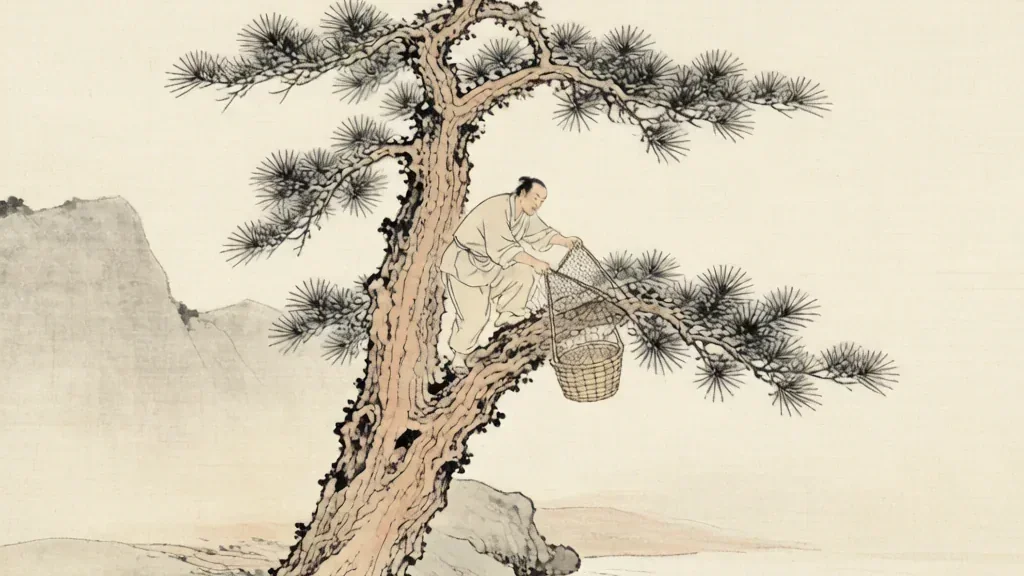
Some efforts are not just difficult; they are impossible by definition. The Chinese idiom 缘木求鱼 (yuán mù qiú yú) — "climbing a tree to catch fish" — pictures a person shinning up a trunk in search of a fish, an act so mismatched to its goal that failure is guaranteed. The phrase comes from the philosopher Mencius and has become the standard Chinese way to say someone is pursuing an end by means that can never reach it. It is gentler than "south carriage, north tracks" because the climber at least faces the right pond — he has simply chosen a route nature forbids.
Mencius and the King Who Wanted More
The idiom appears in the 孟子 (Mèngzǐ, the Mencius), in a famous conversation between the philosopher 孟子 (Mèngzǐ) and King Hui of Liang (梁惠王). The king boasted of his efforts to enrich and strengthen his state and to satisfy his desires, yet he remained unsatisfied and his people unrestful. Mencius challenged him: your methods are like climbing a tree to catch fish.
Mencius's deeper point was about means and ends in governance. The king sought happiness and stability through expansion and force, but those very methods produced anxiety and enmity. Just as no fish lives in a tree, no lasting peace comes from the pursuit of domination. The image let Mencius deliver a sharp political critique wrapped in a homely absurdity the king could not miss.
What makes the Mencius passage rich is the philosopher's nuance. He says that climbing a tree for fish is, at least, not disastrous in itself — you simply will not catch a fish. But the king's wrong method (war and extortion) does cause real harm. The idiom thus marks the lower bound of folly: some mistakes merely fail, others actively destroy.
The Characters and the Absurd Picture
The four characters are: 缘 (yuán) "to climb along" or "to follow up" (a tree), 木 (mù) "tree" or "wood," 求 (qiú) "to seek," and 鱼 (yú) "fish." The phrase sketches a person scaling bark in pursuit of a creature that lives in water. The mismatch is total and slightly comic.
The verb 缘 is lovely — it implies clambering up along the trunk, hands and feet, with determination. The climber is not lazy; he is energetically wrong. That detail matters: the idiom mocks not idleness but misapplied effort. The man is trying hard, just in the wrong element.
The fish (鱼) is one of the most common symbols in Chinese idiom and art, associated with abundance and ease (it puns on "surplus," 余). To seek it in a tree is to seek good fortune by a route that guarantees its absence. The idiom turns a familiar symbol of gain into a symbol of futility.
The Meaning: Wrong Method, Not Wrong Goal
Crucially, 缘木求鱼 does not say the goal is bad. Wanting fish is reasonable; wanting peace, as King Hui did, is reasonable. The folly is in the method — climbing where no fish can be. The idiom therefore diagnose a specific error: a sensible aim pursued by an impossible route.
This distinguishes it from mere foolishness. A person who wants to fly by flapping their arms has a dubious goal; a person who wants fish by climbing a tree has a fine goal and a broken plan. The idiom is a tool for separating ends from means, and for asking whether our methods can actually deliver what we claim to want.
It also implies a kind of blindness. The climber sees the fishpond, knows fish exist, yet chooses the trunk. Often we do the same: we know what we want (health, love, peace) but reach for the tree instead of the water — the crash diet, the jealous control, the war. The idiom is a quiet invitation to look again at the route.
Comparison With "South Carriage, North Tracks"
As noted, 缘木求鱼 is the close companion of 南辕北辙. Both describe failing effort, but the fish idiom is about incompatible method (fish are not in trees), while the carriage idiom is about contrary direction (you face away from your destination). Together they cover the two main ways to fail: wrong means, or wrong way.
There is also a difference in tone. Climbing for fish is gently absurd — we picture a baffled climber and almost pity him. Driving north for Chu is more willful — the envoy insists he is fine. The fish idiom thus reads as innocent error; the carriage idiom as stubborn error. Chinese speakers choose between them by how much blame they wish to assign.
Both, however, share the core lesson that effort is not enough. You can work tirelessly and still catch no fish, still reach no Chu. The idioms are antidotes to the naive faith that activity equals achievement, a faith the modern world does little to correct.
How the Idiom Is Used Today
In contemporary Chinese, 缘木求鱼 is used wherever someone chases a goal by a method certain to fail. A company seeking profit by destroying its customers' trust, a student seeking fluency by memorizing without speaking, a government seeking security by provoking neighbors — all may be told they are climbing a tree for fish.
It appears in science communication and rationalist writing as a figure for methodologically impossible research — looking for evidence where none can exist. The idiom thus bridges ancient philosophy and modern method-talk, a sign of its flexibility.
The phrase is also used self-deprecatingly. Admitting "I've been climbing trees for fish" is a graceful way to say "my approach was wrong," without abandoning the goal itself. That nuance — you can keep wanting the fish, just get to the water — is what makes the idiom kindly as well as corrective.
A Reflection on the Right Pond
缘木求鱼 is a compassionate little parable. It does not tell you to stop wanting fish; it tells you to climb down. The goal may be perfectly good. What must change is the route. Most of our futile labors are not dreams mischosen but methods mistaken, and that is fixable.
The next time effort yields nothing, ask whether you are in the right element. Perhaps the fish you want is real and near, and you have simply been in the wrong tree. Climb down, find the water, and try there. The idiom's enduring comfort is that failure often isn't the end of desire — only the end of a bad method.
Mencius and the Art of Persuasion
Mencius is remembered as a master of suasive conversation, and the tree-climbing image shows why. Rather than lecture King Hui about failed policy, he handed the king a picture absurd enough to disarm him, then let the king draw the conclusion himself. This method appears throughout the Mencius: vivid, concrete scenes that make a moral point land before the listener notices he is being corrected. The philosopher trusted images over abstractions, and he aimed his parables at rulers whose pride made direct criticism dangerous. The fishing idiom is therefore not just a comment on governance but a specimen of Mencius's technique, using a ridiculous action to open a door that a stern sermon would have shut. Readers who study the text meet the same tactic again and again.
The Fish as a Cultural Symbol
In Chinese culture the fish is rarely only a fish. It stands for abundance, because its name sounds like surplus, and it appears at New Year banquets, in paintings of plump carp, and on children's clothing as a wish for plenty. To seek a fish is thus, symbolically, to seek good fortune, which is exactly why Mencius's choice is so pointed: the goal is not foolish, the route is. The idiom turns a happy symbol into a symbol of futility by relocating it to the wrong element, the tree. Folk art and idiom alike show how deeply the fish saturates Chinese imagination as a sign of what people hope to gain. Knowing that background makes the climber's error funnier, since he reaches for the very emblem of prosperity in the one place it cannot be.
❓ Frequently Asked Questions
📝 Chinese Vocabulary
缘木求鱼 — : "Climb a tree to catch fish"; pursuing a goal by impossible means.
缘 — : To climb along; the determined, misapplied effort.
木 — : Tree / wood; the wrong element for fish.
孟子 — : The philosopher who coined the image in dialogue with a king.
梁惠王 — : The king whose expansionist methods Mencius criticized as tree-climbing for fish.
南辕北辙 — : South carriage, north tracks; the companion idiom of wrong direction rather than wrong method.
鱼 — : Fish; the goal sought in the tree, a common symbol of gain and ease.
余 — : Surplus; the word whose sound echoes 鱼, linking fish to abundance.
🎉 Fun Facts
- Mencius noted that climbing a tree for fish at least causes no disaster — unlike the king's warmongering, which did real harm.
- The fish (鱼) puns on 余 ("surplus"), a common symbol of abundance, here rendered unattainable.
- The idiom separates ends from means: the goal (fish) is fine; only the route (the tree) is wrong.
- It pairs with 南辕北辙 as the two classic images of futile effort — wrong method vs. wrong direction.
- Mencius used the fishing image more than once; in another passage he tells King Hui that a true ruler helps the people catch fish through good government, turning the same symbol toward wise policy rather than folly.
- The idiom is a common example in Chinese civil-service and language exams, where candidates must explain why the goal, fish, is reasonable but the method, the tree, is not.