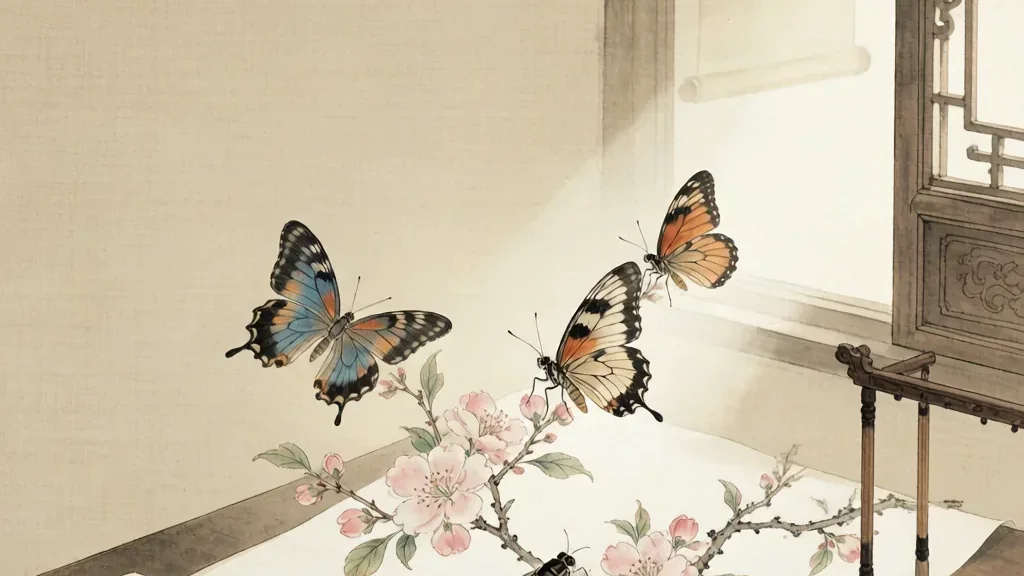
The idiom 栩栩如生 (xǔ xǔ rú shēng) captures the quality of being vivid and lifelike, as if the depicted thing were actually alive. It is applied to paintings, sculptures, literary descriptions, and performances so convincing that the viewer or reader forgets the subject is only represented. The first two characters, 栩栩, convey a lively, fluttering, self-possessed motion, while 如生 means "as if living." Together they name a specific triumph of representation: not mere accuracy of outline, but the transmission of breath and vitality. In Chinese aesthetic thought this has always been the highest task of art, more important than photographic likeness. To call a work 栩栩如生 is therefore to say that the maker succeeded in lending spirit to form, so that a painted bird seems about to take flight or a written character seems to breathe.
The Origin of the Phrase in the Zhuangzi
The expression is traditionally traced to the Zhuangzi, the foundational Daoist text, where the philosopher describes the breeze as "xuxu ran," fluttering and alive as it moves through the world. Early commentators connected this sense of spontaneous, self-moving life to the appearance of well-made images. Over time the reduplicated adjective was joined to "ru sheng" to form the fixed idiom we know, shifting the reference from wind to the liveliness of depicted creatures.
This origin matters because it roots the idiom in a philosophical attitude. The Daoist esteem for natural spontaneity supplied exactly the standard by which lifelike art was judged: a representation should not be dead and stiff but should participate in the same flowing vitality that animates clouds, water, and living beings. The phrase thus carries a quiet metaphysical claim inside what looks like a simple compliment.
What "Lifelike" Means in Chinese Aesthetics
In Chinese criticism the contrast is often drawn between "form likeness" and "spirit resonance," the latter being the deeper goal. A painter might render the correct number of feathers and still fail to make the bird live on the silk. The idiom 栩栩如生 is awarded precisely when spirit resonance is achieved, when the image possesses what critics call the breath of life. This priority shaped training, in which students copied masters not to imitate surfaces but to learn how vitality was conveyed through brush pressure, negative space, and rhythmic line.
The standard also explains why Chinese portraiture and animal painting often favor suggestive economy over exhaustive detail. A few confident strokes of a leaf or a claw can read as more alive than a heavily rendered copy, because the viewer is invited to complete the life through imagination, and that collaboration is itself part of the lifelike effect.
Painting and the Rendering of Creatures
The idiom is most at home in the criticism of bird-and-flower painting and of animal subjects. Historical anecdotes tell of painters whose dragons, horses, or fish seemed ready to move, and of viewers who mistook a painted insect for a real one. Such stories are the folklore of the phrase, repeated for centuries to illustrate what the highest skill looks like when spirit is successfully transmitted to the surface.
Literal examples survive in museum collections where a Song dynasty painting of a bird or a Ming painting of fish retains a startling immediacy across the centuries. The viewer feels addressed by the creature rather than merely shown a picture of it. That feeling, more than any measurable accuracy, is what the idiom names and what collectors and connoisseurs have pursued.
Sculpture, Relief, and Three-Dimensional Art
Relief carvings, wooden figures, and clay sculptures also earn the label when they seem to possess independent presence. Temple statuary, theatrical mask carving, and the small devotion figures placed in household shrines were all judged by how convincingly they embodied the being they represented. A carved lion guarding a bridge or a painted opera face could be praised as 栩栩如生 when the form carried temperament, not just anatomy.
In three dimensions the challenge is different from painting, because mass and shadow must be managed so the figure does not read as a block. The idiom acknowledges those works in which the carver's understanding of posture and expression makes the stone or wood appear to harbor a living subject waiting to be released by a viewer's belief.
Literature and the Art of Description
Beyond visual art, the idiom describes prose and poetry that render scenes and people with such concreteness that they seem present to the reader. A novelist who sketches a market crowd, a faces in a courtroom, or a landscape at dawn may be praised for making the page breathe. The compliment then speaks to verbal craft: the selection of telling detail, the rhythm of sentences, and the disciplined avoidance of abstraction.
Classical tale collections and vernacular novels cultivated this effect deliberately, using small physical gestures and sensory specifics to make characters inhabit the reader's mind. When a description is called 栩栩如生, it means the words did the work normally expected of a brush, proving that liveliness is a property of representation in any medium.
Performance, Puppetry, and the Living Stage
Chinese opera, shadow puppetry, and related performing arts extend the idiom into time-based media. A skilled actor or puppet master can make a flat figure or a stylized gesture carry genuine feeling, so the audience temporarily believes in the character's life. The painted-face conventions of opera, far from limiting expression, can intensify it when the performer understands how to animate the codified forms.
Shadow puppetry is a especially pure example: a two-dimensional cutout lit from behind becomes a breathing personality through movement and voice. Spectators routinely describe the experience with the idiom, confirming that lifelike power depends less on the material than on the intelligence behind it.
The Idiom in Everyday Modern Speech
Today 栩栩如生 has escaped the art gallery entirely. It appears in reviews of animation, in praise of a realistic video game environment, in travel writing about a restored historic street, and in compliments to a home cook whose carved vegetables look too perfect to eat. Its migration shows how a classical aesthetic term can keep its core sense while attaching to new technologies of representation.
The durability is instructive. Even when the medium changes from silk to screen, the underlying value persists: people still want representations that convince through vitality rather than mere information. The idiom gives speakers a compact way to say that a thing feels alive, and that feeling remains the gold standard of successful making.
Connections to Other Descriptive Idioms
栩栩如生 sits among several idioms about vivid representation, and the distinctions are useful. 活灵活现 (huó líng huó xiàn) similarly means vivid and realistic, often of storytelling. 跃然纸上 (yuè rán zhǐ shàng) says a figure leaps from the page. 惟妙惟肖 (wéi miào wéi xiào) praises both wonderful and accurate likeness. Where qiaoduo tiangong praises the maker's skill against nature, xuxu rusheng praises the result's aliveness, a related but distinct achievement that listeners mark with a separate word.
Learning these neighbors helps a speaker choose precisely. One might call a garden qiaoduo tiangong for its crafted perfection, then call a painted carp within it xuxu rusheng for its lifelike vigor, using two compliments that together capture the full range of Chinese praise for made beauty.
Why the Idiom Endures in Cultural Memory
The phrase has lasted because it names something universally desired and rarely achieved: the crossing of the gap between sign and living thing. Every culture values convincing representation, but Chinese tradition articulated the standard with unusual precision and tied it to a philosophy of spontaneous vitality. Children learn the idiom early, often through picture books and museum visits, so it functions as a small piece of inherited taste passed across generations.
In an age of digital imagery, the idiom also offers a quiet correction. Photographic or computational realism can be mechanically perfect yet feel dead, while a few lively strokes can feel more alive than a high-resolution render. 栩栩如生 reminds users that lifeness is a quality of attention and spirit, not merely of detail, and that remains a living lesson rather than a museum relic.
❓ Frequently Asked Questions
What does xuxu rusheng literally mean?
It literally means lively and as if alive, describing a representation so vivid it seems to possess life.
Where does the idiom come from?
It is commonly traced to the Zhuangzi, where xuxu described the lively motion of the wind before being applied to images.
Is it only about visual art?
No, it also describes vivid writing, performance, puppetry, and any medium that makes a subject feel present.
How does it differ from wei miao wei xiao?
Wei miao wei xiao stresses accurate likeness, while xuxu rusheng stresses the feeling of aliveness above exactness.
Can it describe modern digital work?
Yes, it is used for animation and games when the rendering conveys genuine vitality rather than mere detail.
Why is lifelike art so valued in China?
Because aesthetics prize spirit resonance, the transmission of breath and vitality, above photographic form.