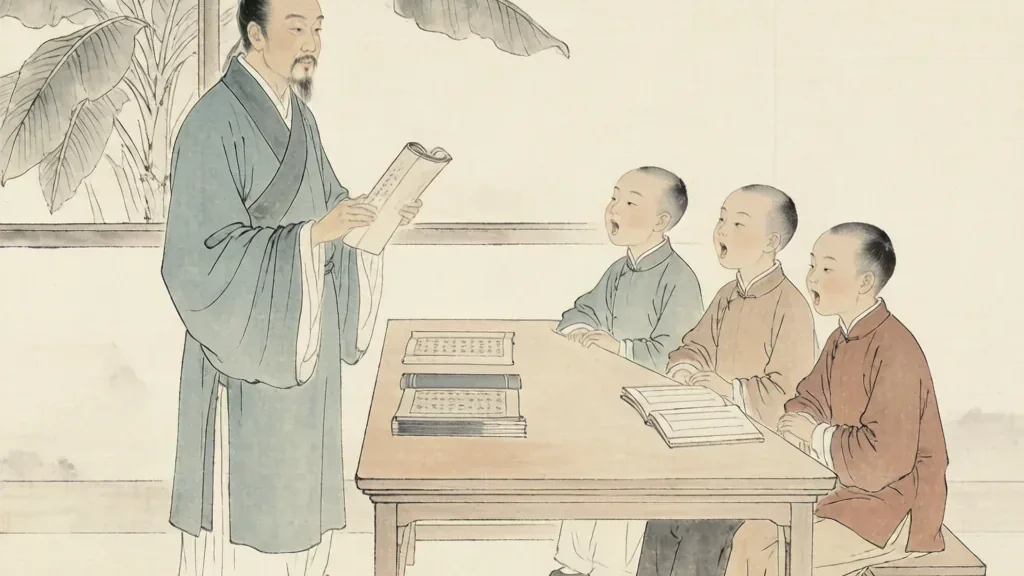
Guwen Guanzhi (古文观止), which translates as "The Ultimate Anthology of Classical Prose," has been the standard introduction to Chinese literary prose since its compilation in 1695. Edited by Wu Chucai and Wu Diaohou, two obscure schoolteachers from Shaoxing in Zhejiang province, the anthology contains 222 pieces spanning roughly 2,000 years — from the Zhou dynasty (c. 1046–256 BCE) through the late Ming dynasty (1368–1644). Its title, which literally means "ancient prose stopped here for viewing," is a boast: that this collection contains the finest specimens of the classical prose tradition, beyond which the reader need not look. For over three centuries, Guwen Guanzhi has been the gate through which Chinese students enter the vast edifice of their literary heritage.
Wu Chucai and Wu Diaohou: The Schoolteachers Who Created a Canon
The story of Guwen Guanzhi's compilation is as remarkable as the anthology itself. Wu Chucai (吴楚材, c. 1655–1720) and his nephew Wu Diaohou (吴调侯, dates unknown) were not famous scholars or high-ranking officials — they were village schoolteachers in Shaoxing, a city in Zhejiang province renowned for its literary culture. In an era when scholarly prestige was measured by success in the imperial examinations, the two Wu's were obscure figures who had failed to achieve official careers. Yet it was precisely their experience as teachers that qualified them for the task: they understood, as the great scholars of the academies did not, what a beginner needed. They compiled the anthology not as a display of erudition but as a practical teaching tool, selecting pieces that were both representative and accessible. The work was published in the 34th year of the Kangxi Emperor's reign (1695) with financial support from a local patron. It found immediate success among students preparing for the civil service examinations, and its reputation grew steadily through the 18th and 19th centuries. Today, the names of countless more celebrated contemporaries have been forgotten, while the two schoolteachers from Shaoxing are remembered wherever classical Chinese is studied — a testament to the power of pedagogy over pedantry.
The 222 Pieces: A Two-Thousand-Year Curriculum
The anthology is organized chronologically, beginning with 34 pieces from the Zuo Zhuan (左传), a narrative commentary on the Spring and Autumn Annals that is the fountainhead of Chinese historical prose. From there it proceeds through the Guoyu (Discourses of the States), the Zhanguo Ce (Intrigues of the Warring States), the impassioned memorials of Han dynasty statesmen, the lyrical prefaces and letters of the Six Dynasties, the magnificent essays of Tang and Song masters like Han Yu and Su Shi, and the refined occasional pieces of Ming dynasty literati. The 222 pieces are not merely literary exercises — they are the documents that shaped Chinese civilization. Jia Yi's "The Faults of Qin" analyzes the reasons for the Qin dynasty's rapid collapse — a text that every ruler and minister studied as a warning against tyranny. Zhuge Liang's "Memorial on Sending Out the Troops" articulates the ethics of loyal service with such power that it moved emperors to tears. Li Mi's "Petition on Behalf of His Grandmother" is a plea for leave to care for an aged relative so perfectly crafted that the emperor granted the request. The chronological arrangement is itself pedagogical: as the student progresses through the anthology, they trace the evolution of the classical language from the terse, elliptical style of pre-Qin texts to the more expansive and personal prose of the Tang and Song periods, gaining an intuitive grasp of linguistic change that no grammar book could provide.
Educational Value: How Guwen Guanzhi Shaped Chinese Learning
For over three centuries, Guwen Guanzhi served as the primary textbook for learning classical Chinese prose. A student who memorized all 222 pieces — and the educational tradition demanded extensive memorization — would possess a working vocabulary of the classical language, a grounding in Chinese history and philosophy, and an internalized repertoire of rhetorical models for their own writing. The pedagogical method was simple: the student would read a passage aloud repeatedly until it could be recited from memory, then the teacher would explain the meaning, and finally the student would write a composition imitating the style of the original. This method, which modern educators might dismiss as rote learning, was in fact a sophisticated training in literary sensibility: by memorizing the rhythms of the finest Chinese prose, the student absorbed the language's patterns of emphasis, transition, and conclusion at a pre-conscious level. The anthology also served a social function: shared knowledge of Guwen Guanzhi created a common literary culture among the educated elite. A scholar from Beijing and one from Guangzhou, speaking mutually unintelligible dialects, could communicate by quoting passages and alluding to texts from the anthology. It was the glue that held together the vast Chinese literate community across regions and centuries.
Classic Masterpieces: Peach Blossom Spring, Old Drunkard's Pavilion, and Yueyang Tower
Some pieces in the anthology have achieved such cultural resonance that they transcend the category of "literature" to become landmarks of the Chinese imagination. Tao Yuanming's "Preface to the Poem on the Peach Blossom Spring" (桃花源记) tells the story of a Wuling fisherman who follows a stream of peach blossoms into a cave and discovers a hidden valley where refugees from the Qin dynasty have lived in peaceful isolation for 600 years, ignorant of the rise and fall of empires. The story's power lies in its ending: when the fisherman leaves, he marks his path but can never find the valley again — a parable of lost innocence that has haunted Chinese culture for 1,600 years. Ouyang Xiu's "Record of the Old Drunkard's Pavilion" (醉翁亭记) is a lyrical essay about the joy of drinking in a mountain pavilion with friends, famous for its use of the particle 也 (ye) at the end of 21 consecutive sentences — a rhythmic device that creates a tipsy, looping cadence that mirrors the author's intoxication. The essay's opening line — "The master who built this pavilion was not alone in his delight" — establishes a tone of shared, inclusive pleasure that defines the Chinese ideal of literati sociability. Fan Zhongyan's "Record of Yueyang Tower" (岳阳楼记) gave the Chinese language its most-quoted political maxim: "Be the first to bear the world's troubles, and the last to enjoy its pleasures" (先天下之忧而忧,后天下之乐而乐). These pieces, memorized by every educated Chinese person for centuries, continue to supply the phrases, images, and ethical ideals that shape Chinese public discourse in the 21st century. Today, it remains a bestseller in China, available in countless annotated editions, and is still assigned in high schools and universities. Its endurance testifies to the anthology's pedagogical genius: the Wu uncles understood that the best way to preserve a tradition is not to argue for its importance but to select its most beautiful examples and let them speak for themselves. In an age of digital distraction, Guwen Guanzhi continues to serve as a gateway to the Chinese literary tradition — 222 windows opening onto two millennia of human experience, waiting for the next generation of readers to look through them.
The Ancient-Prose Revival
Guwen Guanzhi is the popular fruit of a long argument about style. In the Tang and Song dynasties, writers such as Han Yu and Ouyang Xiu led the guwen, or ancient prose, movement, rejecting the heavy parallel couplets then in fashion in favor of a clearer, more direct prose modeled on pre-Qin and Han masters. The anthology enshrines that reform by giving those reformers and their models equal space. A student reading straight through meets the very writers who fought for plainness, then sees their victory echoed in later Ming occasional pieces. In this way the book is not neutral; it argues, through selection, that good prose is plain, purposeful, and morally serious.
A Canon Shared Across East Asia
Because it taught the shared written language of the literati, Guwen Guanzhi traveled. In Korea, Vietnam, and Japan, scholars of classical Chinese used the same anthology to train in composition, so its pieces became common reference points across the region. A letter writer in Hanoi and a tutor in Kyoto could allude to the same Yueyang Tower maxim. In the modern period the book followed Chinese communities overseas and became a standard reader for foreigners learning classical Chinese. Its portability as a single, manageable volume helped it outlast far larger collections that stayed at home on scholars' shelves.
What the Editors Left Out
The anthology's strength is also a limit: by promising the ultimate selection, the Wu editors necessarily omitted a great deal. They included almost no parallel prose, little philosophy in the abstract, and nothing from the great novels or vernacular fiction of later centuries. Poetry is absent except where embedded in prose. The result is a deliberately narrow canon of polished argument and narration, not a survey of everything classical Chinese produced. Readers who take the title literally may miss the rich, experimental writing the book sets aside in favor of safe, teachable models.
Still Taught, Still Read
More than three centuries after 1695, Guwen Guanzhi remains in print and in classrooms. In China it is assigned in high schools and universities as a bridge to the classical language, and annotated editions crowd bookstore shelves. Learners abroad still use it as a graded reader because the pieces grow progressively harder and cover two millennia of style. Digital editions and apps now pair the original text with audio recitation and notes. Its survival shows that a good teaching anthology can outlive the examinations it was built to serve, remaining useful long after the world that needed it has changed.
❓ Frequently Asked Questions
Key Terms
古文观止 古文 (Gǔ Wén) 左传 (Zuǒ Zhuàn) 韩愈 (Hán Yù) 苏轼 (Sū Shì) 桃花源记 (Táo Huā Yuán Jì) 岳阳楼记 (Yuè Yáng Lóu Jì) 八大家 (Bā Dà Jiā)Fun Facts
- The two compilers, Wu Chucai and Wu Diaohou, were uncle and nephew — schoolteachers, not famous scholars — yet their anthology outlasted all the works of their more celebrated contemporaries.
- Guwen Guanzhi was compiled in the 34th year of the Kangxi Emperor's reign (1695), the same year the emperor personally led a military campaign against Galdan of the Dzungar Khanate.
- The anthology's famous pieces have been set to music, adapted into calligraphy scrolls, and inscribed on monuments across China — Yueyang Tower in Hunan owes much of its fame to Fan Zhongyan's essay about it.
- The anthology's title promises that guwen stops here, implying a reader need look no further for models of fine prose.
- Because the selections are short and self-contained, the book became a favorite gift for students and a common first reader of classical Chinese abroad.
- Several pieces in the collection are letters and memorials, showing how classical prose served real statecraft and friendship, not only literature.