The opening lines of Romance of the Three Kingdoms (三国演义) contain perhaps the most famous observation in Chinese literature: "The empire, long divided, must unite; long united, must divide." This cyclical vision of history — in which order and chaos alternate like breathing — sets the stage for one of the world's great epics of war, politics, and human character. Across 120 chapters and nearly a thousand named characters, the novel chronicles the collapse of the Han Dynasty and the century of warfare that followed, a period that has become the foundation myth of Chinese strategic thinking.
Attributed to Luo Guanzhong (罗贯中) in the fourteenth century, the novel blends historical fact with dramatic embellishment. The events it describes — the Yellow Turban Rebellion of 184 CE, the rise of the warlords, the formation of three rival kingdoms, and their eventual reunification under the Jin Dynasty in 280 CE — are largely historical. But the characters have been elevated into archetypes, their words polished into proverbs, their strategies studied as textbooks of statecraft. For centuries, Chinese generals, businessmen, and politicians have read Three Kingdoms not merely as entertainment but as a manual of power.
The Three Heroes: Liu Bei, Guan Yu, and Zhang Fei
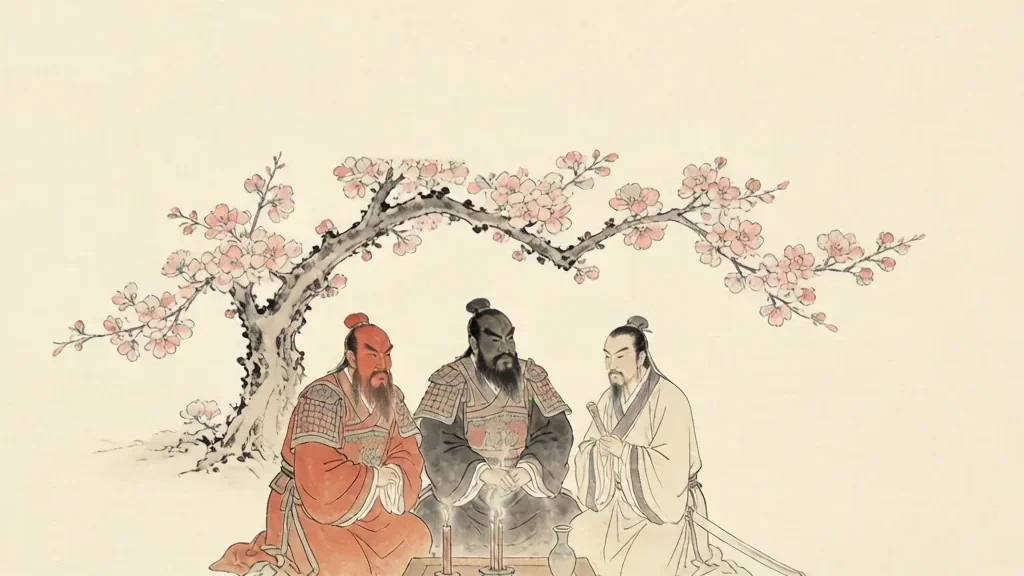
The novel's moral center rests on the Peach Garden Oath, sworn in the very first chapter. Three men of different backgrounds — Liu Bei (刘备), a distant imperial clansman reduced to weaving straw sandals; Guan Yu (关羽), a fugitive with a magnificent beard and a weapon called the Green Dragon Crescent Blade; and Zhang Fei (张飞), a butcher with a thunderous voice — pledge themselves as brothers, vowing: "Though we were not born on the same day, we wish to die on the same day." This oath of sworn brotherhood becomes the emotional and ethical anchor of the entire narrative.
Liu Bei is the novel's virtuous king — patient, compassionate, and unfailingly loyal to the Han dynasty. Critics have noted that as a literary character, he can seem almost too perfect, a Confucian ideal rather than a flesh-and-blood man. But his virtue serves a structural purpose: it establishes the moral claim of his kingdom, Shu Han, as the legitimate successor to the Han, against the usurpation of Cao Cao.
Guan Yu is perhaps the novel's most beloved figure, and his posthumous career is extraordinary. Deified as Guandi (关帝), the God of War, he is worshipped in temples across the Chinese-speaking world — a rare instance of a fictionalized historical character becoming an active deity. Guan Yu embodies the martial virtues: loyalty unto death, physical courage, and an unshakeable sense of honor. His most famous exploit — allowing his defeated rival Cao Cao to escape at Huarong Trail, repaying a past kindness even though it meant disobeying orders — encapsulates the novel's complex treatment of honor as something that transcends military necessity.
Zhang Fei provides the trio's raw power and occasional comic relief. His defining moment comes at Changban Bridge, where he single-handedly holds off Cao Cao's entire army by standing alone on the bridge and roaring a challenge so terrifying that an enemy officer dies of fright. Yet Zhang Fei is also the trio's tragic figure, whose fatal flaw — cruelty toward his own soldiers — leads to his assassination.
Cao Cao: The Ambiguous Villain
No character in Chinese literature inspires more debate than Cao Cao (曹操). The novel paints him as the arch-villain — cunning, ruthless, and willing to sacrifice anyone to his ambition. His most famous line, "I would rather betray the world than let the world betray me" (宁教我负天下人,休教天下人负我), has become shorthand for Machiavellian ruthlessness in Chinese culture. He murders his host's entire family on a paranoid suspicion, executes his own physician, and schemes constantly against the Han imperial house.
Yet Cao Cao is no simple villain. He is also a brilliant strategist, a patron of literature (his own poems are considered classics), and a ruler who brings order to the chaotic central plains. The novel grants him moments of genuine grandeur — his toast to the moon before the Battle of Red Cliffs, his generous treatment of Guan Yu after capturing him. Many modern readers, particularly those familiar with historical scholarship that treats Cao Cao more sympathetically, find him the novel's most compelling figure.
The tension between the historical Cao Cao and the novel's villainous portrayal reflects a deeper dynamic: Three Kingdoms is not history but historical fiction, and its biases reflect the political needs of the era in which it was written. The novel's preference for Liu Bei's Shu Han kingdom over Cao Cao's Wei aligns with centuries of Chinese popular sentiment that favored the Han loyalists.
Zhuge Liang: The Sleeping Dragon Awakens
If the Peach Garden brothers provide the novel's heart, Zhuge Liang (诸葛亮) provides its brain. Known as the "Sleeping Dragon" (卧龙) during his years as a reclusive scholar-farmer, Zhuge Liang is recruited by Liu Bei after three personal visits — a story so famous that "Three Visits to the Thatched Cottage" (三顾茅庐) has become a Chinese idiom for sincere recruitment of talent.
Zhuge Liang is the archetype of the Chinese strategist, combining military genius with Confucian loyalty and Daoist mysticism. He predicts weather patterns, devises elaborate stratagems, and at one point summons an east wind through ritual magic to enable the fire attack at Red Cliffs. His most famous strategic victory — the Empty Fort Strategy, in which he sits calmly playing his zither on the city wall while the gates stand open, bluffing an entire enemy army into retreating — has entered the strategic vocabulary of cultures far beyond China.
Yet Zhuge Liang is also a tragic figure. His later years are consumed by a series of northern campaigns against Wei that he knows are doomed but pursues anyway, out of loyalty to Liu Bei's dying wish that he restore the Han dynasty. His death from exhaustion in camp, working until his last breath, makes him a symbol of devotion that transcends the possibility of success. The novel asks whether loyalty that leads to failure is still virtue — and answers, through Zhuge Liang, that it is.
The Battle of Red Cliffs: Strategy as Spectacle
The novel's centerpiece is the Battle of Red Cliffs (赤壁之战, 208 CE), occupying chapters 43 through 50 and representing perhaps the most elaborate battle sequence in world literature. Cao Cao has assembled an overwhelming fleet, intending to crush the southern warlords Sun Quan and Liu Bei in a single campaign. The southern allies, vastly outnumbered, must rely on stratagem.
The battle unfolds as a symphony of deception. A series of interlocking schemes are set in motion: a false defection by the veteran general Huang Gai, who "surrenders" to Cao Cao with a fleet of ships secretly filled with kindling; the manipulation of Cao Cao's spy network to feed him false intelligence; the use of "borrowed arrows" obtained by sailing straw-laden boats into the enemy fleet under cover of fog; and finally the fateful decision to chain Cao Cao's ships together to reduce seasickness among his northern troops — which makes them a single, unmaneuverable target for the fire ships.
When the east wind finally rises — summoned, according to the novel, by Zhuge Liang's Daoist ritual — the fire ships sail into Cao Cao's chained fleet, and the northern invasion goes up in flames. The sequence has been adapted countless times in film, television, opera, and video games. It remains the definitive demonstration of the novel's central thesis: that intellect, properly applied, can overcome any material disadvantage.
Sun Quan and the Kingdom of Wu
The third kingdom, Wu, is often overshadowed in popular imagination by Shu's heroes and Wei's villain-hero, but Sun Quan (孙权) and his generals represent a distinct model of power: pragmatic, patient, and rooted in regional loyalty. Sun Quan's decision to ally with Liu Bei against Cao Cao at Red Cliffs, and his later decision to betray that alliance by seizing Jing Province (leading to Guan Yu's death), demonstrate the novel's unsentimental understanding of politics. Alliances are temporary, interests are permanent.
The Wu general Zhou Yu (周瑜) provides one of the novel's great tragic subplots. A brilliant strategist in his own right, Zhou Yu is driven to fatal jealousy by Zhuge Liang's superior abilities. His dying words — "If Heaven has already given us Zhuge Liang, why must it also give us Zhou Yu?" (既生瑜,何生亮) — have become a Chinese idiom for the bitterness of meeting one's match.
The Novel's Enduring Wisdom
Romance of the Three Kingdoms is not merely a novel but a cultural institution. Its characters have become personality types — calling someone a "Cao Cao" in Chinese conversation implies cunning and ambition; calling someone a "Guan Yu" implies loyalty and martial honor. Its strategies are studied in business schools across Asia. Its proverbs and quotations pepper everyday speech. The novel has spawned operas, television series, video game franchises, and an entire genre of strategic board games.
What gives the novel its extraordinary staying power is the quality of its characterization. Unlike the flat heroes and villains of lesser epics, the characters of Three Kingdoms are fully human — flawed, contradictory, capable of both nobility and cruelty. Liu Bei's virtue can shade into weakness, Cao Cao's ruthlessness into vision, Zhuge Liang's brilliance into tragic obsession. The novel offers no easy moral calculus, only the hard wisdom that greatness and goodness are not the same thing, and that history is made by those who understand the difference.
Luo Guanzhong and the Making of the Novel
Romance of the Three Kingdoms is attributed to Luo Guanzhong, a writer of the fourteenth century who lived through the fall of the Yuan and the rise of the Ming. By his time the Three Kingdoms story had already grown for a thousand years through oral storytelling, staged plays, and earlier written versions, and Luo's achievement was to gather that material into a single sweeping narrative of 120 chapters. He shaped the mass of legend into a coherent arc built on the opening idea that divided realms must unite and united realms must divide. Later editors and commentators added prefaces and annotations that guided how readers judged the characters. The novel's assembly from popular tradition explains both its encyclopedic cast of characters and its pulsing, spoken-energy prose, the mark of a book born as much from the storyteller's stage as from the scholar's desk.
The Novel's Influence on East Asian Popular Culture
Few Chinese books have shaped popular imagination as broadly as the Three Kingdoms. Its characters became reusable types across the Sinosphere: operas, woodblock illustrations, and temple murals fixed their images, and in Japan the tale spawned epic novels, television serials, and strategy games that remain bestsellers today. The novel's idioms and stratagems pass into daily speech, business training, and even diplomacy, where citing a Three Kingdoms episode can make a point without explanation. Modern film, animation, and video games keep retelling Red Cliffs and the Peach Garden oath for new audiences. This cultural saturation means the novel functions less as a closed classic than as a shared vocabulary of heroism, loyalty, and cunning that still circulates throughout East Asia.
❓ Frequently Asked Questions
📝 Chinese Vocabulary
- 三国演义 (Sān Guó Yǎn Yì) — "Romance of the Three Kingdoms"; one of the Four Great Classical Novels
- 桃园结义 (Táo Yuán Jié Yì) — The Peach Garden Oath; the sworn brotherhood of Liu Bei, Guan Yu, and Zhang Fei
- 诸葛亮 (Zhū Gě Liàng) — Zhuge Liang; the "Sleeping Dragon," the novel's archetypal strategist
- 赤壁之战 (Chì Bì Zhī Zhàn) — The Battle of Red Cliffs; the novel's central military confrontation
- 天下大势,分久必合,合久必分 (Tiān xià dà shì, fēn jiǔ bì hé, hé jiǔ bì fēn) — The novel's famous opening line: "The empire, long divided, must unite; long united, must divide."
🎉 Fun Facts
- The historical Guan Yu was elevated to godhood centuries after his death. Today, there are more temples dedicated to Guan Yu in China than to any other historical figure, and he is worshipped by both police officers and triad gangsters — the former for his justice, the latter for his loyalty.
- The novel contains over 1,000 named characters across 120 chapters. Its influence on Chinese language is so profound that hundreds of Chinese idioms and proverbs originate from its pages.
- Modern historians estimate that the Three Kingdoms period (220-280 CE) saw China's population drop from roughly 56 million to 16 million due to war, famine, and disease — making it one of the deadliest periods in human history.
- The earliest surviving printed edition of the novel is a 1522 Ming-dynasty block-printed book, showing how quickly it spread after it appeared.
- Zhuge Liang's Empty Fort Strategy, in which he sits playing his zither as enemy troops approach, is still taught in Asian business and military schools as a lesson in psychological warfare.
- The phrase Three Visits to the Thatched Cottage has entered everyday Chinese as an idiom for a leader's sincere, repeated effort to recruit talent.