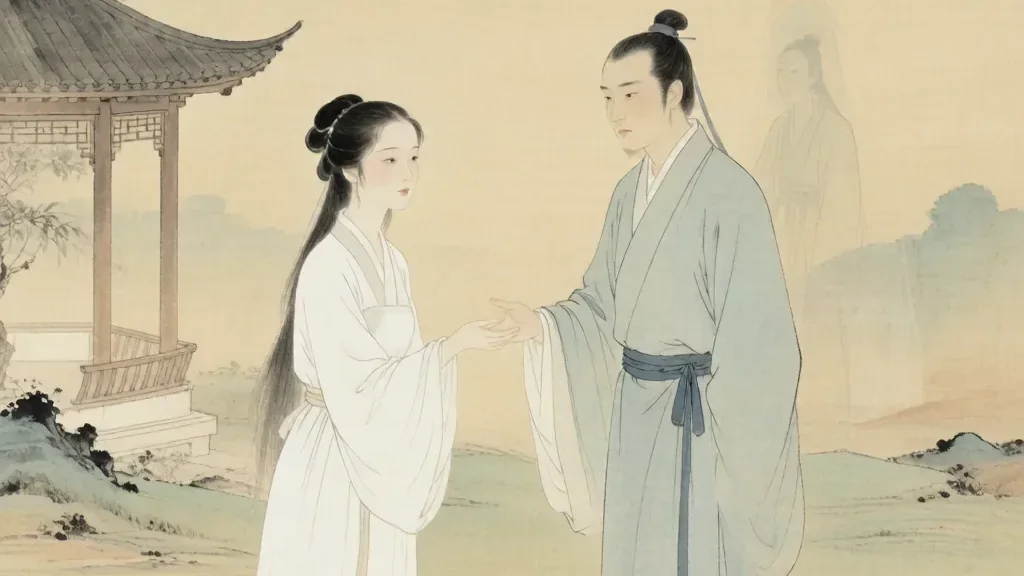
Liaozhai Zhiyi (聊斋志异), or "Strange Tales from a Chinese Studio," is the crowning achievement of classical Chinese supernatural fiction. Compiled over approximately four decades by Pu Songling (1640–1715), a failed examination candidate from Zichuan, Shandong, the collection contains nearly 500 tales of ghosts, fox spirits, demons, Taoist immortals, and other denizens of the Chinese paranormal imagination. Written in elegant classical Chinese rather than the vernacular, Liaozhai bridges elite literary tradition and folk supernatural belief, producing stories of astonishing range: some are chilling horror, others romantic fantasy, still others biting social satire. The book has never been out of print since its first publication in 1766, half a century after Pu Songling's death, and its stories have been adapted into countless operas, films, and television series.
Pu Songling: The Failed Scholar and His Life of Writing
Pu Songling (蒲松龄) was born in 1640 in Zichuan, Shandong province, into a family of declining merchant-scholar status. His father had abandoned commerce for scholarship, and the family's fortunes were modest. Pu Songling showed early brilliance, earning his first civil service degree (xiucai) at the age of 19 with the highest marks in his district. But this early success was never repeated: for the next five decades, he sat for the provincial examination again and again, failing each time. To support his family, he worked for thirty years as a private secretary and tutor in the household of the Bi family, wealthy local gentry who respected his learning. It was during these long years of service, often late at night after his tutorial duties, that Pu Songling composed his strange tales. Local legend claims he set up a roadside tea stall, offering free tea to travelers in exchange for their strangest stories — a charming but probably apocryphal image. What is certain is that he drew on a vast range of sources: classical literary precedents from Tang dynasty chuanqi tales, Buddhist and Taoist scriptures, local Shandong folklore, and his own prodigious imagination. He continued revising the manuscript until his death at age 75, leaving it unpublished — it was his grandson who finally brought it to print in 1766. The tragedy of Pu Songling's life — a brilliant mind trapped by the examination system he could not conquer — suffuses the collection with a melancholy awareness of talent unrecognized and justice deferred.
Fox Spirits and Their Human Lovers
The fox spirit (狐狸精, huli jing) is the iconic creature of Liaozhai, appearing in scores of stories. In Chinese folklore, foxes are shape-shifters who, after centuries of cultivating spiritual energy, acquire magical powers and can assume beautiful human form — most often that of an alluring young woman. Pu Songling transformed this folk motif into a vehicle for exploring desire, morality, and the nature of love. His fox spirits are not merely seductive demons but complex beings, sometimes benevolent, often loyal, and capable of genuine love and self-sacrifice. In "Xiao Cui" (小翠), a young fox spirit is sent by her mother to repay a kindness owed to a human family. She marries their simple-minded son and, through her magical arts, gradually cures his intellectual disability. But when her karma is exhausted, she must leave — the story's ending is heartbreakingly bittersweet. In "Yingning" (婴宁), perhaps the most celebrated fox-spirit tale, the heroine is a laughing girl who seems incapable of seriousness — her laughter is irrepressible, contagious, and disarming. She marries a scholar who falls in love with her at first sight, but it emerges that she is not entirely human: her mother was a fox, and her laughter conceals a wild, untamable nature. Yingning has been read as a feminist allegory, a portrait of mental illness, and a Daoist meditation on the limits of rational understanding — the story's richness sustains all three interpretations. Pu Songling subverts expectations throughout: the "monster" is often more ethical than the humans around her, and the boundary between the natural and supernatural is perpetually blurred.
Social Criticism Disguised as Ghost Stories
Beneath its supernatural surface, Liaozhai is a work of devastating social criticism. Pu Songling had spent decades navigating the corrupt world of the late imperial examination system, and many tales satirize the venality of officials, the absurdity of the exam process, and the cruelty of the powerful toward the weak. "The Cricket" (促织) is the collection's most famous political allegory: an imperial decree demands that the province of Shaanxi supply champion fighting crickets to the palace. A poor family, unable to find a suitable cricket, watches helplessly as their property is seized by corrupt tax collectors. The father, in despair, consults a fortune-teller who directs him to a hidden cricket — but it turns out to be a supernatural creature that can defeat all challengers. The story's ending is ironic: the family is rewarded and enriched, but the reader knows that their good fortune came through magic, not justice — and that thousands of other families were ruined. The tale was read, with good reason, as a critique of imperial overreach itself. "The Painted Skin" (画皮) is both a horror story — a demon wears a human face painted on human skin — and a satire of the literati obsession with female beauty, exposing the monstrousness beneath cultivated surfaces. "The Mural" depicts a scholar who enters a painting to pursue a beautiful woman, only to be expelled by a wrathful guardian — a meditation on the danger of confusing art with life that also mocks the pretensions of the literati. After many stories, Pu Songling appends "The Historian of the Strange says" (异史氏曰), a direct parody of Sima Qian's "The Grand Historian says" from the Shiji — claiming that his tales of fox spirits and ghosts are as worthy of preservation as the official chronicles of emperors and wars.
From Page to Screen: The Cinematic Legacy of Liaozhai
Since its publication, Liaozhai has been one of the most adapted works in Chinese culture. The 1987 film "A Chinese Ghost Story" (倩女幽魂), directed by Ching Siu-tung and starring Leslie Cheung and Joey Wong, took a relatively minor Liaozhai tale — "Nie Xiaoqian" (聂小倩), about a scholar who falls in love with a beautiful ghost enslaved by a tree demon — and transformed it into an international sensation. The film's blend of romance, horror, martial arts, and special effects created a new genre of Chinese fantasy cinema, and its visual aesthetic — flowing white robes, swirling leaves, and mist-shrouded temples — defined the look of supernatural Hong Kong cinema for a generation. The success of "A Chinese Ghost Story" spawned two sequels and countless imitations. In mainland China, the 1987 television series "Liaozhai" (聊斋) was a landmark production that brought Pu Songling's stories to a mass audience, with its haunting theme music becoming one of the most recognizable television soundtracks in Chinese history.
More recent adaptations have continued to mine the collection's rich material. The 2005 film "The Painted Skin" and its 2012 sequel "Painted Skin II" reinterpreted Pu Songling's classic tale as big-budget special-effects spectacles, starring some of China's biggest film stars. Animated adaptations, including the 2011 film "The Legend of the Moles" which draws on Liaozhai fox-spirit lore, have introduced the stories to children. In the West, Liaozhai has inspired adaptations as diverse as the 2008 British-Chinese film "The Forbidden Kingdom" (which draws on several Liaozhai characters) and the 2011 American film "The Flower of War," which references Pu Songling's themes of transformation and survival. Beyond entertainment, Liaozhai has been the subject of serious scholarly study as a window into late imperial popular religion, gender relations, and the psychological world of the Chinese literati. The collection's enduring appeal lies in its ability to speak simultaneously to the elite and the common reader — to offer ghosts that are mirrors of the living, and foxes more human than their human counterparts.
Beyond the Fox: A Bestiary of the Strange
Although fox spirits are the stars, Liaozhai teems with other beings. Ghosts return to repay kindness or settle scores, demons wear stolen faces, and plants or objects gain consciousness after long cultivation. Pu Songling draws on a deep reserve of Chinese folklore, Buddhist rebirth tales, and Tang dynasty chuanqi fiction, then sharpens them with his own wit. The variety is deliberate: each creature type lets him test a different aspect of human nature, from gratitude to greed. The result is less a monster book than a wide anthology of the impossible used to speak about the all-too-possible, where every spirit is really a comment on the living.
The Examination Hell
A repeated target of Liaozhai is the civil service examination system that defeated Pu Songling himself. Several tales mock the absurdity of testing men by rote composition, or show officials promoted through luck and connection rather than merit. The Cricket extends the critique to the throne, showing a whole family ruined to supply a toy for the palace. Having failed the exams for decades while tutoring others' sons, Pu filled his stories with frustrated scholars, unjust magistrates, and the small cruelties of official life. The supernatural often serves as the only available justice, a fantasy revenge on a system that the living could not beat.
Heir to the Strange-Tale Tradition
Liaozhai stands at the peak of the zhiguai, or accounts of the strange, a Chinese genre reaching back to early medieval collections of anomalies. Pu Songling inherited its taste for ghosts and wonders but raised the form's literary polish, writing in fine classical Chinese with careful structure and character. Where earlier zhiguai were often brief jottings, his tales unfold with dialogue, psychology, and irony. He also appended the tag The Historian of the Strange says, parodying the great histories, to claim equal seriousness for his fantasies. In doing so he transformed a minor curiosity genre into one of the supreme achievements of classical fiction.
Voice and the Art of the Frame
Pu Songling's storytelling is distinctive in its control of voice. Most tales are told in a calm, detached register, then closed with the author's own comic or moral gloss, a device that lets him wink at the reader while the story keeps its spell. Some frame the marvel as something heard from a traveler or found in a book, adding a layered, almost modern self-awareness. This balance of eerie event and knowing commentary is part of the book's charm: we are invited both to believe the ghost and to smile at the telling. The craft explains why the tales survive retelling in every medium.
❓ Frequently Asked Questions
Key Terms
狐狸精 / 聊斋 蒲松龄 (Pú Sōnglíng) 聂小倩 (Niè Xiǎoqiàn) 画皮 (Huà Pí) 促织 (Cù Zhī) 异史氏曰 (Yì Shǐ Shì Yuē) 志怪 (Zhì Guài) 妖 (Yāo)Fun Facts
- Pu Songling wrote a lengthy preface comparing himself to Qu Yuan, suggesting his ghost stories were a form of veiled political lament, not merely entertainment.
- Liaozhai was first published in 1766, more than 50 years after Pu Songling's death, by his grandson — and the original manuscript in Pu's own handwriting is preserved in a Liaoning museum.
- The 1987 film "A Chinese Ghost Story" was initially expected to fail because its director, Ching Siu-tang, was known for action choreography, not romance or horror — it became one of the most beloved Chinese films of all time.
- The collection holds nearly five hundred tales, written in polished classical Chinese rather than the spoken vernacular.
- Pu Songling passed only the first level of the civil exam at nineteen and then failed the higher exams repeatedly for some fifty years.
- Many Liaozhai stories were later rewritten as comic or operatic skits, spreading the fox-spirit lore far beyond readers of the book.