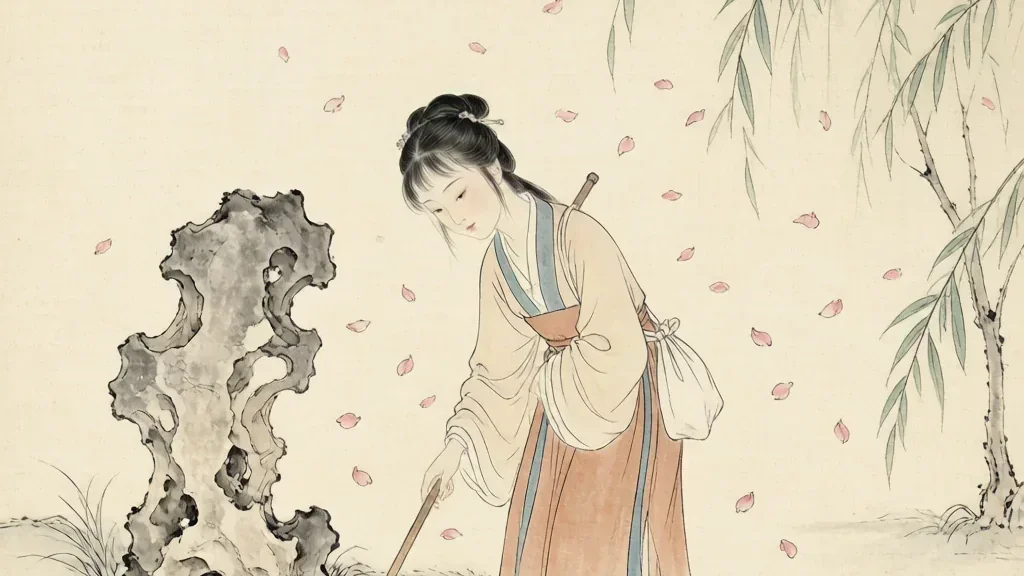
If world literature were a mountain range, Dream of the Red Chamber (红楼梦) would be its Everest. Widely considered the greatest novel ever written in Chinese, this eighteenth-century masterpiece achieves a depth of psychological realism, a richness of cultural texture, and a philosophical resonance that places it in the company of Proust, Tolstoy, and Joyce. Where other Chinese classical novels offer epic battles and supernatural adventures, Dream of the Red Chamber offers something rarer and more difficult: the inner lives of its characters, rendered with a precision that still feels revolutionary after two and a half centuries.
The novel was written by Cao Xueqin (曹雪芹, c. 1715-1763), a member of a once-wealthy banner family that had fallen into poverty — a biographical detail that echoes through the novel's central theme of decline. Cao died before completing the work, and the final forty of its 120 chapters were completed by Gao E (高鹗), though the authorship of the ending remains a matter of scholarly debate. The novel circulated in manuscript form for decades before its first print publication in 1791, and its readership has only grown in the centuries since.
A World Within Walls: The Jia Family Compound
The novel's action unfolds almost entirely within the walled compounds of the Jia family, an aristocratic clan whose wealth and prestige have begun an irreversible decline. This confinement is deliberate and meaningful: the Jia mansions — divided between the Ningguo and Rongguo branches — constitute a complete world, a microcosm of Qing Dynasty elite society. Within these walls, the novel traces the lives of over four hundred named characters, from the family matriarch to the lowest servant girls.
The choice to set the novel in a domestic space was revolutionary. Previous Chinese fiction had been expansive — journeys across empires, battles between kingdoms. Cao Xueqin demonstrated that the intimate dramas of family life could be equally epic. The novel's great conflicts are not military campaigns but arranged marriages, not political intrigues but the subtle cruelties of social hierarchy. A single conversation between a lady and her maid can carry as much dramatic weight as any battlefield confrontation.
This focus on the domestic sphere is not narrowness but profundity. Through the Jia family, Cao Xueqin anatomizes an entire civilization — its rituals, its art, its cuisine, its medicine, its architecture, its poetry, its theater, its religious practices, and above all, its treatment of women. No other work of pre-modern Chinese literature provides such a comprehensive and intimate portrait of elite life.
Jia Baoyu: The Reluctant Heir
At the novel's center is Jia Baoyu (贾宝玉), the adolescent heir of the Rongguo branch, whose name means "Precious Jade" — a reference to the magical jade stone he was born holding in his mouth. Baoyu is one of the most unusual protagonists in world literature. He despises the careerism and hypocrisy of the adult male world, preferring the company of the young women of the household. He famously declares that "girls are made of water, men are made of mud" — a sentiment that expresses both his rejection of masculine values and his idealization of feminine purity.
Baoyu's rebellion is passive rather than active. He cannot openly defy his family, but he sabotages his own future through indifference — refusing to study for the civil service examinations that are the expected path for a young man of his station. His father, Jia Zheng, sees him as a wastrel; his grandmother, the matriarch, dotes on him; the women of the household adore him. Baoyu floats through the novel in a state of sensual and emotional sensitivity, absorbing the beauty and tragedy around him without the will to change either.
The novel's psychological acuity is most evident in Baoyu's characterization. He is not a heroic rebel but a confused, privileged, often maddeningly passive young man whose genuine sensitivity coexists with a complete inability to protect the people he loves. His tragedy is that he sees clearly what is wrong — the hypocrisy, the cruelty, the waste — but can imagine no alternative.
Lin Daiyu: The Tragic Poetess
Lin Daiyu (林黛玉) is Baoyu's soulmate and the novel's most unforgettable creation. An orphaned cousin who comes to live with the Jia family, Daiyu is brilliant, proud, beautiful, and pathologically sensitive. She is also consumptive, and her illness — which manifests as a romantic fragility but is also clearly tuberculosis — hangs over her character like a death sentence from her first appearance.
The relationship between Baoyu and Daiyu is the novel's emotional core. They share a spiritual affinity — a love of poetry, a contempt for social pretense, a recognition in each other of kindred souls — that the novel suggests is karmic, rooted in a celestial pre-existence. In the novel's mythic frame story, Baoyu was originally a stone left over from the goddess Nüwa's repair of heaven, and Daiyu was a Crimson Pearl Flower that the stone watered with dew. Her earthly life is a repayment of that debt with tears.
Yet their love is doomed. The family elders choose Xue Baochai (薛宝钗), a sensible, healthy, socially adept cousin, as Baoyu's bride. The novel's climactic deception — Baoyu is led to believe he is marrying Daiyu, only to discover Baochai beneath the bridal veil — is one of the most devastating scenes in all of fiction. Daiyu, learning of the marriage, burns her poems and dies on the same night. Baoyu, discovering the truth, descends into madness.
Xue Baochai: The Other Woman
It would be easy to cast Xue Baochai as the villain of the piece, the conventional rival who steals Baoyu from his true love. Cao Xueqin refuses this simplification. Baochai is intelligent, kind, and genuinely admirable. She embodies the Confucian virtues of propriety and practicality that Daiyu rejects — and that the Jia family desperately needs. Her tragedy is different from Daiyu's but equally real: she marries a man who will never love her, and she bears the burden of being the "sensible" choice in a world that punishes sensibility.
The triangle of Baoyu, Daiyu, and Baochai has generated centuries of critical debate. The novel invites us to see that both women represent valid but incompatible values: Daiyu the spiritual and aesthetic, Baochai the ethical and practical. Baoyu's choice — or rather, his inability to choose — reflects the impossibility of reconciling these values in a world that demands one or the other.
The Decline: A Family, a Class, a Civilization
The novel's title — literally "The Dream of the Red Chamber" — contains its central metaphor. The "red chamber" refers to the luxurious inner apartments where the young women of wealthy families lived, but the "dream" suggests the illusory nature of all that wealth and beauty. The Jia family's decline is gradual, inexorable, and multiply determined.
Economic mismanagement drains the family's resources. The older generation's extravagance — epitomized by the construction of a lavish garden, the Grand View Garden (大观园), for an imperial consort's brief visit — consumes wealth that cannot be replenished. Corruption and incompetence among the family's male members invite political disaster. The younger generation, sheltered and indulged, lacks the discipline to maintain what their ancestors built.
The novel traces this decline with the precision of a naturalist observing an ecosystem in collapse. Small incidents accumulate: a servant's suicide, a gambling scandal, an imperial confiscation of property. By the novel's end, the great Jia clan has been scattered — some members dead, some in exile, some reduced to poverty. The Grand View Garden, once a paradise of poetry parties and moon-viewing excursions, stands empty and overgrown.
Buddhist and Daoist Themes
The novel's philosophical framework is explicitly Buddhist and Daoist. The frame story, in which a Daoist priest and a Buddhist monk carry the sentient stone into the human world, establishes that all the novel's events are ultimately illusory — a dream from which the characters must awaken. The novel's final chapters describe Baoyu's renunciation: having passed the imperial examinations (a final concession to filial duty), he disappears into the company of the same monk and priest, becoming a wandering ascetic.
This Buddhist frame does not negate the novel's realism but deepens it. The pain of the characters is real within the dream; the beauty of the poetry parties is real; the love between Baoyu and Daiyu is real. The novel's greatness lies in its ability to hold both truths simultaneously: that life is an illusion, and that the illusion matters. As one character remarks, "Truth becomes fiction when the fiction's true; real becomes not-real when the unreal's real" (假作真时真亦假,无为有处有还无).
The Novel's Unprecedented Achievement
What makes Dream of the Red Chamber the summit of Chinese fiction is not any single quality but their combination. It is at once a family saga of Tolstoyan scope, a love story of heartbreaking intensity, an encyclopedia of eighteenth-century Chinese culture, and a Buddhist allegory of enlightenment. Its characters — especially its women — are rendered with a psychological depth unmatched in Chinese literature before or since. Its prose, dense with poetry, allusion, and wordplay, rewards the kind of close reading usually reserved for lyric verse.
The novel has spawned an entire academic field, "Redology" (红学), devoted to its study. Scholars debate the authorship of the final chapters, the novel's autobiographical elements, its political subtext, and the interpretation of its countless symbolic details. For the general reader, however, the novel requires no scholarly apparatus. Its story — of love and loss, of beauty and decay, of a world passing away — speaks directly to the heart, in any language and any century.
Prophecy Woven Into the Plot
A striking feature of the novel is its use of foreshadowing. Early on, a group of twelve songs and a register of judgments quietly reveal how each major woman will meet her end, so the reader watches the happy present under the shadow of a known future. Poems, riddles, and dream-visions all carry this buried script, rewarding close reading with recognition. Cao Xueqin thus combines the pleasures of a family saga with the austere design of a tragedy already written. The effect is paradoxical: knowing the ending does not lessen the loss but deepens it, as every small joy reads also as a step toward its own undoing.
❓ Frequently Asked Questions
📝 Chinese Vocabulary
- 红楼梦 (Hóng Lóu Mèng) — "Dream of the Red Chamber"; the pinnacle of Chinese fiction, one of the Four Great Classical Novels
- 贾宝玉 (Jiǎ Bǎo Yù) — Jia Baoyu, the novel's protagonist; his name means "Precious Jade"
- 林黛玉 (Lín Dài Yù) — Lin Daiyu, the tragic heroine; her surname means "forest," her given name "dark jade"
- 大观园 (Dà Guān Yuán) — The Grand View Garden; the magnificent garden built within the Jia compound
- 红学 (Hóng Xué) — "Redology"; the academic field devoted to the study of the novel
🎉 Fun Facts
- The novel's author, Cao Xueqin, was the grandson of Cao Yin, a wealthy textile commissioner. After his grandfather's death, the family fell into disgrace and poverty — a reversal that directly inspired the novel's theme of decline.
- Dream of the Red Chamber contains over 400 named characters, and its elaborate system of names is packed with hidden meanings. Many characters' names are homophones for words that reveal their natures — for example, "Zhen Shiyin" sounds like "true matters concealed" (真事隐).
- The novel is so culturally significant that China launched a satellite named "Red Chamber" in its honor, and a crater on Mercury has been named after Cao Xueqin. The Chinese government has funded multiple television adaptations, the most expensive of which cost over 100 million yuan.
- The novel is famous for its embedded poetry, with more than a hundred lyric poems and riddles woven into the narrative that foreshadow each character's fate.
- Cao Xueqin is believed to have rewritten the book several times, and the surviving manuscript chapters circulated privately among friends for decades before print publication in 1791.
- The novel's detailed descriptions of food, medicine, and fashion have made it a source for historians of eighteenth-century Chinese material life.