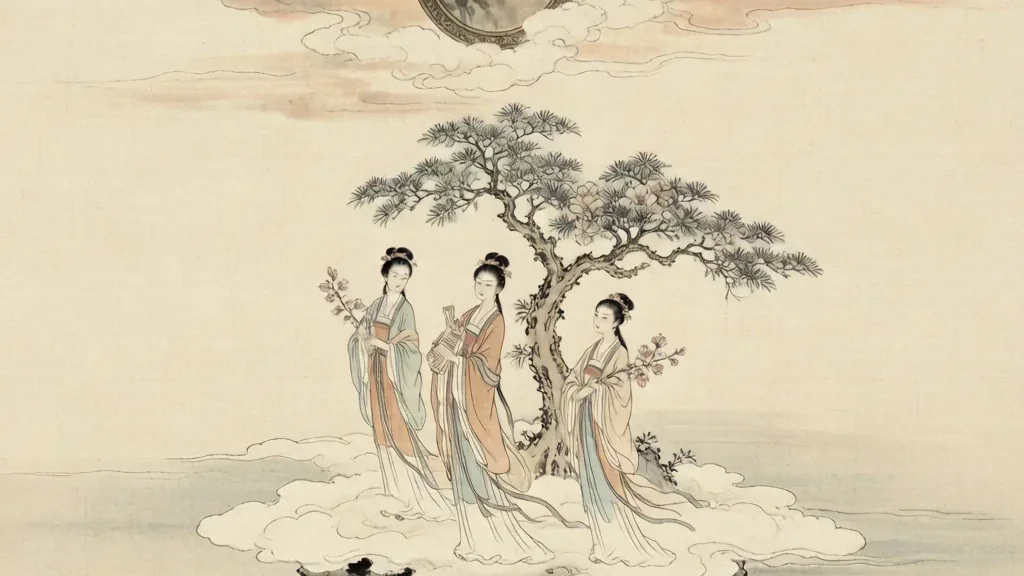
Jing Hua Yuan (镜花缘), or "Flowers in the Mirror," completed by Li Ruzhen around 1818 and published in 1828, is one of the most peculiar and delightful novels of the Qing dynasty. Ostensibly a story about a Tang dynasty scholar's overseas adventures and the reunion of 100 flower spirits reincarnated as talented women, the novel is actually a sprawling vehicle for social satire, proto-feminist polemic, and a display of the author's encyclopedic knowledge of wordplay, mathematics, phonology, and classical literature. Li Ruzhen (c. 1768–1830), a polymath from Beijing who never passed the highest civil examinations, poured his wide-ranging but unorthodox learning into a novel that defies genre: part travelogue, part utopian fantasy, part literary puzzle-box.
Li Ruzhen: The Frustrated Scholar Who Wrote a Feminist Novel
Li Ruzhen's personal biography is essential for understanding the novel's peculiar combination of satire and erudition. Born to a distinguished Beijing family, he passed the first level of the civil service examinations but repeatedly failed the provincial examinations — a pattern that would determine the course of his life. Instead of the official career he had trained for, Li worked as a private secretary and magistrate in Henan province, where he had ample leisure to pursue his diverse intellectual interests. His true passions were phonology and mathematics: he authored a comprehensive study of Chinese phonology titled Lishi Yinjian (李氏音鉴), which demonstrated the historical evolution of Chinese pronunciation. This scholarly background permeates "Flowers in the Mirror" — entire chapters are devoted to discussions of rhyme tables, dialect variations, and the classification of Chinese characters by phonetic radicals. Beyond phonology, the novel incorporates extended passages on mathematics, including problems involving magic squares, arithmetic progressions, and geometric puzzles. Li Ruzhen's decision to embed his scholarly passions within a fictional narrative was itself a political act: by making learning entertaining, he democratized knowledge that was normally restricted to the examination elite, offering common readers access to the intellectual culture from which his own repeated examination failures had excluded him.
The Hundred Flower Goddesses and the Women's Examination
The novel's frame story is one of the most ingenious in Chinese literature. In heaven, the Hundred Flower Goddesses (百花仙子) — each presiding over a different flower species — receive an imperial edict from the Empress of Heaven commanding all flowers to bloom in midwinter. The Flower Goddesses protest: flowers obey the natural seasons, and blooming out of season would violate the cosmic order. But the Empress insists, and the flowers are forced to bloom. As punishment for this disruption of cosmic harmony, all one hundred goddesses are banished from heaven and reincarnated as mortal women scattered across China. The novel's second half describes these women's accomplishments: they write poetry, solve complex mathematical problems, debate phonology, and compete in imperial examinations — an institution from which real Chinese women were categorically excluded. Li Ruzhen was unusual among Qing dynasty intellectuals in his explicit advocacy for women's education, and his novel argues seriously that women's intellectual capacities are equal to men's. The hundred flower spirits, each with a distinct personality and talent, represent the diversity of female potential that Qing society systematically suppressed.
The Country of Women: A Daring Satire of Gender Roles
"Flowers in the Mirror" contains one of the most audacious satirical passages in pre-modern Chinese literature: the visit to the Country of Women (女儿国). In this fictional kingdom, gender roles are completely reversed. Women rule as emperors, ministers, and scholars, while men manage the household, bind their feet, wear makeup, and serve as concubines. The novel's protagonist, the merchant Lin Zhiyang, is captured by the queen of this country and ordered to become her royal consort. The ensuing sequence — in which Lin is forcibly bathed, his ears pierced, his feet bound, his face powdered, and he is dressed in women's clothing — is both hilarious and devastating. Li Ruzhen describes the physical agony of footbinding in excruciating detail: the toes are bent under the sole, the arch is broken, and the bones are compressed until the foot fits into a "golden lotus" shoe measuring three inches. The victim screams in pain, but the female attendants insist this is for his own good — "Who would marry a woman with big feet?" The passage is a masterful use of defamiliarization: by forcing the reader to identify with a male character undergoing what real women endured daily, Li Ruzhen makes the cruelty of footbinding viscerally apparent to an audience that had accepted it as normal. This sequence, along with the novel's repeated arguments for women's education, establishes Li Ruzhen as a remarkably progressive voice for his time.
Satire and Social Criticism Through Fantasy
Beyond the gender-reversal satire, the novel's overseas journey visits dozens of imaginary countries, each functioning as an allegorical critique of some aspect of Chinese society. In the Country of Gentlemen (君子国), merchants insist on undercharging customers and customers demand to overpay — a comic inversion of market haggling that exposes the gap between Confucian ideals of virtue and actual commercial behavior. In the Country of Two-Faced People (两面国), inhabitants wear a benign expression on the front of their heads but hide a hideous visage behind — literally embodying the hypocrisy that Li Ruzhen saw in official life. The Country of the Great-Gutted People features inhabitants who sell their own children for profit while maintaining an appearance of respectability — a bitter commentary on the commodification of family bonds in commercial society. The Country of Noseless People, whose noses are flat because they lost them through dishonesty, satirizes the erosion of moral integrity through petty deception. These fantastic geographies, inspired by the "Classic of Mountains and Seas" (山海经) tradition, give Li Ruzhen a safe distance from which to criticize his own society — a technique that links "Flowers in the Mirror" to the great European satirical tradition of Swift's "Gulliver's Travels" (published just a century earlier, in 1726). Like Swift, Li Ruzhen used the traveler's naive perspective to expose the absurdities of his own culture, creating a work that is both entertaining and subversive.
Legacy and Modern Rediscovery
"Flowers in the Mirror" was well-received upon publication but never achieved the canonical status of the "Four Great Classical Novels." Its learned digressions and episodic structure have limited its popular appeal compared to the unified narratives of "Dream of the Red Chamber" or "Journey to the West." However, the novel has been steadily rediscovered and reassessed in recent decades. Modern feminist scholars have championed it as a rare pre-modern Chinese text that directly challenges patriarchal structures. Its gender-bending sequences in the Country of Women have inspired numerous theatrical and television adaptations. The novel's critique of footbinding was remarkably prescient — the practice was abolished within a century of the novel's publication, partly through campaigns that echoed Li Ruzhen's arguments. In an era of renewed interest in global feminist traditions, "Flowers in the Mirror" stands as evidence that Chinese literature has its own history of imagining gender equality — and that fantasy has always been one of the most powerful vehicles for social criticism.
A Novel Built From Wordplay
Unusual among Chinese novels, Flowers in the Mirror is stuffed with scholarly games. Li Ruzhen, a serious student of pronunciation, inserts whole chapters of rhyme-table discussion and dialect comparison, while elsewhere characters compete in riddles, puns, and elaborate verbal duels. To a modern reader these passages can feel like detours, but for the author they were the point: learning made pleasurable. The book assumes an educated audience and treats readerly cleverness as a form of virtue. This blend of entertainment and pedagogy is why some critics call it less a novel than a learned miscellany in narrative clothing.
The Geography of Satire
The novel's first half is a travelogue through invented countries, each a distorted mirror of Qing society. Besides the famous Country of Women, the traveler meets realms where merchants overpay, where faces hide a second self, and where people sell their own children for profit. These lands owe a clear debt to the Classic of Mountains and Seas and to the global tradition of imaginary voyages from Gulliver's Travels. By setting criticism at a safe distance, Li Ruzhen could mock hypocrisy, greed, and cruelty without naming names at home. The foreign framework turns everyday injustice into strange comedy, making the familiar suddenly visible.
A Qing Fantasy Among Fantasies
Flowers in the Mirror appeared in the same flourishing age of the novel that produced Dream of the Red Chamber and the great adventure tales, but it is stranger than most. Where the masterpiece novels dwell in domestic psychology or martial epic, Li Ruzhen wrote a discursive, idea-driven fantasy that values argument over plot. Its uneven pace and learned digressions kept it from the very top of the canon, yet its bold gender politics and playful form made it a favorite of later readers tired of conventional stories. Today it is valued precisely for the qualities that once seemed like flaws: its eccentricity, its erudition, and its conscience.
❓ Frequently Asked Questions
Key Terms
镜花水月 镜花缘 (Jìng Huā Yuán) 李汝珍 (Lǐ Rǔzhēn) 百花仙子 (Bǎi Huā Xiānzǐ) 女儿国 (Nǚ Ér Guó) 林之洋 (Lín Zhīyáng) 缠足 (Chán Zú) 才女 (Cáinǚ)Fun Facts
- Li Ruzhen was a serious phonologist who wrote a separate scholarly work "Lishi Yinjian" (李氏音鉴) on Chinese phonology — and large sections of "Flowers in the Mirror" are essentially phonology lessons disguised as fiction.
- The novel's critique of footbinding was personal: Li Ruzhen's own sister had suffered from the practice, and his fictional depiction of a man's feet being bound is one of the earliest literary protests against it.
- "Flowers in the Mirror" was one of the first Chinese novels translated into English, with an abridged version by Lin Yutang appearing in 1965 under the title "The Women's Kingdom."
- The novel was decades in the making; Li Ruzhen is said to have spent some twenty years writing and revising it.
- Because it embeds so much wordplay and scholarly puzzle-solving, the book has been called a literary game as much as a novel.
- The hundred flower-spirit women are each linked to a real flower, turning the cast into a symbolic garden of female talents.