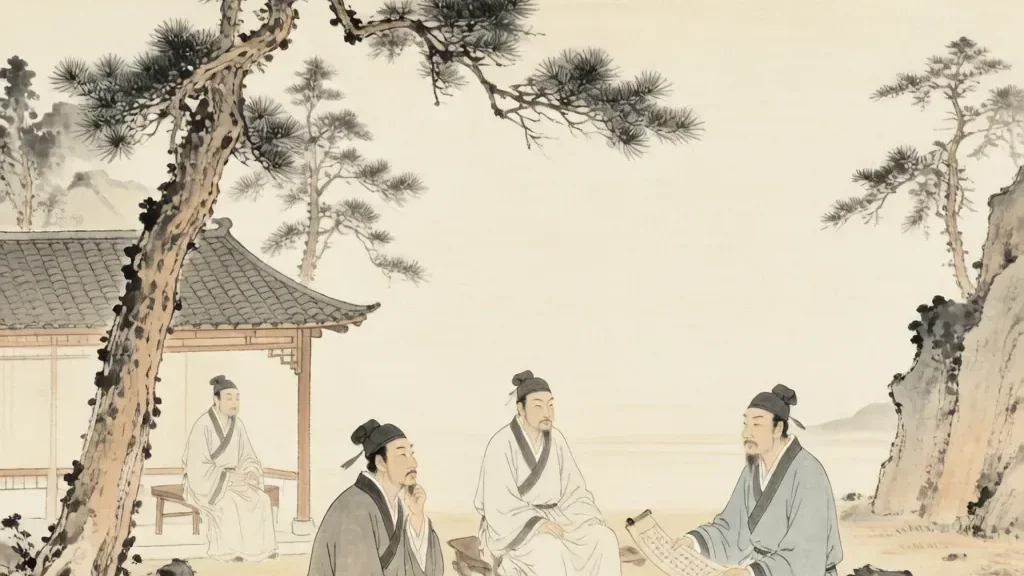
Shishuo Xinyu (世说新语), translated as "A New Account of Tales of the World" or "New Accounts of Old Episodes," is a collection of approximately 1,130 anecdotes about historical figures from the late Han through the Eastern Jin dynasty (c. 150–420 CE). Compiled around 430 CE by Liu Yiqing (403–444), a prince of the Liu Song dynasty, the book is organized into 36 thematic chapters covering everything from "Virtuous Conduct" to "Stinginess and Meanness," from "Appreciation and Praise" to "Taunting and Teasing." It is not a systematic history but a mosaic of personality — an intimate portrait of the Wei-Jin era's intellectual elite in their most human moments: witty, arrogant, melancholic, intoxicated, and often all four at once. The book became the definitive record of the "Wei-Jin style" (魏晋风度), an aesthetic and existential ideal that prized spontaneity, emotional authenticity, and cultivated eccentricity above rigid Confucian propriety.
Liu Yiqing: The Prince Who Collected Anecdotes
Liu Yiqing (刘义庆) was a prince of the Liu Song dynasty (420–479), a nephew of the founding emperor Liu Yu. Born into the imperial family during one of the most turbulent periods of Chinese history, Liu Yiqing was given the title Prince of Linchuan at a young age. Unlike many members of his family, who were consumed by the murderous power struggles that characterized the Liu Song court, Liu Yiqing preferred literature to politics. He gathered around himself a group of distinguished scholars and writers, commissioning and directing the compilation of several works. "Shishuo Xinyu" was his masterpiece, assembled by a team of editors working under his supervision. The work draws on earlier sources that are now lost — collections of anecdotes and "pure conversation" (清谈, qingtan) records from the Wei-Jin period — and shapes them into a unified artistic vision. Liu Yiqing's own voice is almost entirely absent from the text, but his eye for the telling detail, the revealing gesture, and the lapidary phrase defines the collection's aesthetic. He died young, at 41, but his compilation preserved the spirit of the Wei-Jin era more vividly than any formal history could.
Wei-Jin Style: The Spirit of an Age
The Wei-Jin period (220–420 CE) was an age of political fragmentation and intense intellectual ferment. The Han empire had collapsed, and China was divided among competing dynasties while nomadic peoples pressed in from the north. For the educated elite, public service became a dangerous occupation — court politics were lethal, and many scholars withdrew into private life, seeking meaning in philosophy, art, and friendship. This environment gave rise to "Pure Conversation" (清谈), a social practice in which groups of literati gathered to debate metaphysics, critique one another's character, and display their wit and erudition in extemporaneous repartee. The "Wei-Jin style" (魏晋风度, Wei-Jin fengdu) that emerged from this culture prized three qualities above all: ziran (自然, spontaneity or naturalness), the freedom from social convention and the authentic expression of one's true nature; fengliu (风流, literally "wind and flow"), an effortless charisma and grace that seemed innate rather than learned; and shen (神, spirit), the inner radiance of a cultivated soul visible in one's eyes and bearing. A person was judged not by their official rank or family background but by the quality of their conversation, the quickness of their wit, and the elegance of their manner. Shishuo Xinyu is the definitive record of this culture — a book that preserves the Wei-Jin ideal in its purest form and, in doing so, defines the Chinese ideal of the cultivated gentleman for all subsequent generations.
Famous Anecdotes and Their Enduring Wisdom
Many of the most famous stories in Chinese culture originate in Shishuo Xinyu. The anecdote of Cao Zhi composing the "Seven-Pace Poem" (七步诗) comes from a commentary to the text: Cao Pi, the first emperor of the Wei dynasty, jealous of his brilliant younger brother Cao Zhi, ordered him to compose a poem within the time it takes to walk seven paces or face execution. Cao Zhi instantly recited — "Beans are boiled to make soup / Beanstalks burn beneath the pot / Beans cry in the pot: / We are born from the same root / Why must you burn me so hot?" — a parable of fraternal strife that has entered the Chinese language as the definitive expression of sibling rivalry. The story of Wang Xizhi, China's greatest calligrapher, sleeping drunk on the floor of a powerful official's house, refusing to rise and pay respects, and being forgiven because of his inestimable talent, illustrates the Wei-Jin belief that genius absolves social transgression. The tale of the philosopher Xie An, playing Go (weiqi) in his garden when a messenger arrives with news of a decisive military victory — Xie An receives the news, continues playing without any visible emotion, and only after his guests depart reveals his excitement by knocking over a chess piece — exemplifies the ideal of emotional self-control. These anecdotes are not merely entertaining; they provided the Chinese educated class with a repertoire of exemplary behavior, stories to emulate or parody, and a shared cultural vocabulary that bound the elite together across regions and centuries.
The Seven Sages and the Birth of Chinese Eccentricity
No group embodies the Shishuo Xinyu spirit more than the Seven Sages of the Bamboo Grove (竹林七贤), who appear throughout the text. Xi Kang (223–262), the brilliant musician, poet, and philosopher, was the group's intellectual leader. He refused to serve the usurping Sima clan and was executed as a result — his final act was to play his zither and lament that his masterpiece, "Guangling San," would die with him. Ruan Ji (210–263) was the most flamboyant: he expressed his contempt for social convention by driving his carriage aimlessly until the road ended and then bursting into tears; by receiving guests stark naked, declaring "Heaven and earth are my house — what are you doing in my trousers?"; and by maintaining a strict rule of never discussing others' faults. Liu Ling, the group's legendary drinker, traveled with a servant carrying a shovel, with instructions: "If I die of drink, bury me where I fall." These were not mere libertines: their excesses were philosophical performances, protests against a corrupt political order that had made conventional morality seem hollow. Xi Kang's essay "On Dispelling Self-Interest" argued that the highest good is to follow one's nature without pretense — the philosophical foundation of the Wei-Jin style. The Seven Sages became the archetype of Chinese eccentricity, and their stories have been told for 1,600 years as models of integrity maintained in impossible circumstances.
From the Shishuo to Modern Chinese: The Birth of Everyday Idioms
Shishuo Xinyu is the single richest source of chengyu (成语, four-character idioms) in the Chinese language. The common expression "holding a fan in the breeze" (摇扇临风) — describing an attitude of careless elegance — originates in a description of the scholar Wang Yan. "Seeing the bamboo, one thinks of the person" (见竹思人) comes from the story of Wang Huizhi, who visited a friend's house, admired the bamboos, and left without meeting the friend — "seen the bamboos, why need I see the man?" "Dropping one's chopsticks in surprise" (掷筷惊座) describes the shocked reaction of guests when a scholar made an unexpectedly brilliant remark. Even the phrase "talking idly about the mysterious" (谈玄说妙) — which in modern Chinese means "talking nonsense" — was originally a neutral description of the Pure Conversation practice of discussing Daoist metaphysics. Beyond idioms, the book's influence on Chinese narrative art has been profound: the characteristic form of the brief, evocative anecdote concluding with a telling detail can be traced through biji literature, Pu Songling's "Strange Tales," and even modern Chinese fiction. The book also preserves some of the earliest encounters between Buddhism and the Chinese intellectual establishment, recording how Buddhist monks adapted their teachings to appeal to Daoist-influenced literati. Shishuo Xinyu remains, after 1,600 years, the most vivid portrait ever painted of the Chinese intellectual at his most brilliant, his most foolish, and his most human.
Pure Conversation and the Intellectual Climate
The Wei-Jin age was politically dangerous, and many scholars turned from office to philosophy, gathering to practice Pure Conversation. In these meetings literati debated Daoist metaphysics, critiqued one another's character, and displayed their learning through quick, allusive speech. The game was to be profound and effortless at once, and reputation rested on a single brilliant line. Pure Conversation grew from the collapse of Han orthodoxy and the rise of Neo-Daoist thought, and it gave the era its distinctive tone of ironic, freewheeling intellect. The Shishuo Xinyu preserves this world in fragments, showing how talk itself became the highest art and how a well-turned phrase could make or unmake a man's standing among the elite.
The Seven Sages of the Bamboo Grove in Context
The Seven Sages of the Bamboo Grove are the book's recurring emblem of principled eccentricity. Ji Kang, Ruan Ji, Liu Ling, and their companions drank, played music, and refused the court, treating excess as a philosophical protest against a corrupt order that had made convention hollow. Ji Kang's execution for declining to serve the Sima clan turned him into a martyr to sincerity, while Ruan Ji's tears at a road's end and Liu Ling's shovel-bearing servant became jokes with a serious edge. The Shishuo presents them not as wastrels but as men who kept their integrity when conformity meant complicity. Their stories gave later Chinese a vocabulary for integrity maintained in impossible times, repeated for sixteen hundred years.
The Shishuo Xinyu and the Art of the Anecdote
The book's lasting gift is its form: the brief, evocative anecdote that ends on a telling detail. A single scene, a sharp reply, a surprised guest dropping his chopsticks, can sum up a whole character, and the restraint invites the reader to supply the judgment. This compact mode flowed into the biji notebook literature, into Pu Songling's Strange Tales, and into modern Chinese fiction's taste for the revealing moment. Because the entries are short and quotable, they also seeded the language with idioms still in use. The Shishuo Xinyu thus taught Chinese prose how to be small and decisive at once, a lesson in narrative economy that outlasted the courtly world that produced it.
❓ Frequently Asked Questions
Key Terms
魏晋风度 清谈 (qīng tán) 竹林七贤 (Zhú Lín Qī Xián) 刘义庆 (Liú Yìqìng) 成语 (chéng yǔ) 王羲之 (Wáng Xīzhī) 嵇康 (Jī Kāng) 自然 (zì rán)Fun Facts
- Shishuo Xinyu includes the earliest Chinese reference to eating rice with chopsticks as a sign of refined manners, in a story where a man praised for his "naturalness" eats with his hands instead.
- The book's compiler, Liu Yiqing, was himself a fascinating figure — a prince who preferred literature to politics and invited scholars to his household to help compile this and other works.
- The anecdote about Cao Zhi composing a poem in seven paces to save his life comes from Shishuo Xinyu, though the famous "Seven-Pace Poem" (七步诗) appears in a later commentary to the text.
- The collection holds about 1,130 anecdotes grouped into 36 thematic chapters, from Virtuous Conduct to Stinginess and Meanness, mapping the whole range of Wei-Jin character.
- Shishuo Xinyu is the single richest source of Chinese chengyu, the four-character idioms that pack whole stories into four syllables and still pepper modern speech.
- The calligrapher Wang Xizhi appears in its pages drunk on a noble's floor, forgiven for his genius, a scene that captures the era's belief that true talent excuses social breach.