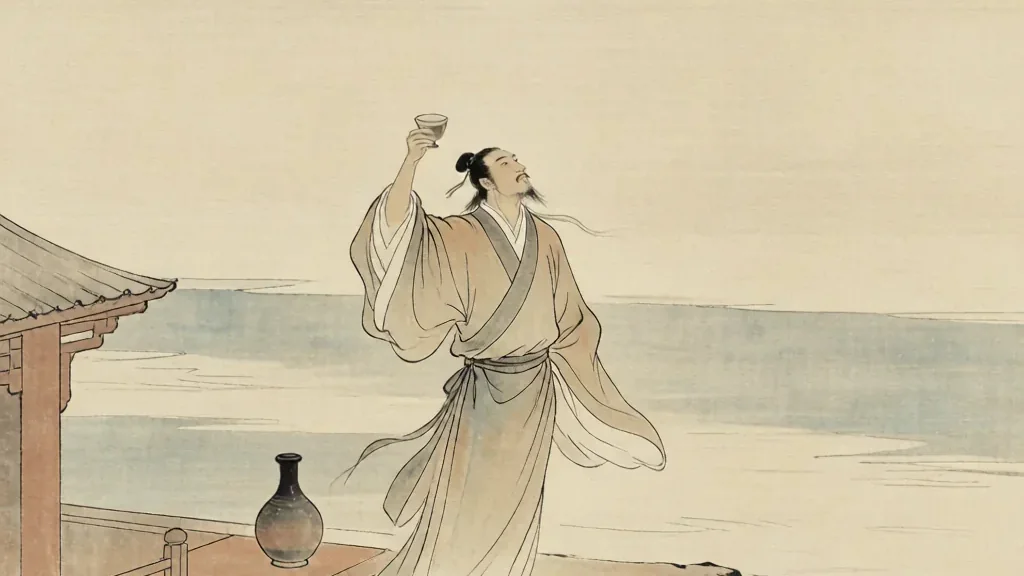
If Chinese poetry has a single face known to every household, it is Li Bai's. Born in 701 CE and dead in 762, he lived at the dazzling height of the Tang and wrote perhaps a thousand poems, of which about 900 survive. To the Chinese he is the shixian (诗仙, "Poet Immortal") — a genius who seemed to compose without effort, who drank wine with the moon for company, and who turned mountains, waterfalls, and partings into permanent images of the imagination. No other Chinese poet feels quite so much like a friend.
A Life of Wandering
Li Bai's origins are shadowy. His family may have been stationed in Central Asia (near modern Kyrgyzstan), and he grew up in the Sichuan (四川) hinterland, a region of steep gorges he later mythologized. He was largely self-taught, claimed to have slain a man in his youth to right a wrong, and mastered swordsmanship — the romance of the wandering xia (侠, knight-errant) never left his self-image.
Refusing the ordinary exam road to office, Li Bai instead cultivated fame through poetry and Daoist (道教, Dào jiào) connections, hoping a patron or the emperor would summon him directly. In 742 this happened: Emperor Xuanzong (唐玄宗) called him to the Hanlin Academy in Chang'an. The poet dazzled the capital, but his pride, his drunkenness, and court intrigue — the story goes that the powerful eunuch Gao Lishi (高力士) turned the emperor against him — ended the appointment after barely a year.
For the rest of his life Li Bai roamed: the Yangtze gorges, the north, and the company of fellow poets. When the An Lushan Rebellion (安史之乱, 755–763) convulsed the empire, he unwisely joined the staff of a royal prince whose faction lost, and he was exiled to the far south (a sentence later commuted). He died in 762, possibly of illness, possibly — as legend prefers — reaching for the moon in the water.
The Poet Immortal and Wine
Wine is Li Bai's signature. In "Drinking Alone by Moonlight" (月下独酌) he declares, "Heaven and Earth are the myriad passing inns; / time is the traveler of a hundred generations" — and resolves to make the moon and his shadow his companions, since "man and moon and shadow together become three." The poem turns loneliness into a celestial party and shows his hallmark move: dissolving the boundary between the self and the cosmos through drink.
His Daoist leanings fed this. Li Bai was drawn to the transcendence promised by the Zhuangzi (庄子) and by mountain hermits who sought immortality (仙, xiān). He received Daoist initiation in 744 and wrote of cranes, immortals, and the "primal breath." Yet he was no ascetic; his pleasure was earthly and immediate, the cup in his hand and the moon overhead.
The "Poet Immortal" label also reflects how spontaneously he seemed to write. The Tang historian Li Yangbing recorded that Li Bai "composed as if by heaven's command." Anecdotes have him dictating flawless verse while drunk, and one tale has him ordering the great Gao Lishi to pull off his boots — an image of poetic pride that Chinese painters never tired of rendering.
Mastery of Nature Imagery
Li Bai's landscapes are not quiet descriptions but overwhelming forces. "Mount Shu is hard to scale" (蜀道难) opens by asking who cut the road through the sky, then piles up cliffs, howling gibbons, and rivers that "break the mountains and swirl the whirlpools." His famous "Viewing the Waterfall at Lushan" (望庐山瀑布) compares the falling water to "the Milky Way falling from the ninth heaven" (飞流直下三千尺,疑是银河落九天) — an image so vivid it is the first thing many Chinese think of at any waterfall.
The moon is his private symbol. Beyond "Quiet Night Thought," he writes of moons reflected in lakes, moons seen from boats, moons that witness his separations. For Li Bai the moon is a silent twin, the one constant friend across all his journeys. When he says, in a farewell poem, "I send you off with the bright moon, / it will follow you to the western lands," he turns the sky itself into a courier of feeling.
His shorter jueju quatrains achieve a clarity that feels improvised yet is metrically perfect. This apparent ease is the hardest thing in Chinese poetry to fake; later poets spent lifetimes trying to catch his careless grace and usually failed.
Famous Poems (Quiet Night Thought)
The most famous Chinese poem in the world is almost certainly Li Bai's "Quiet Night Thought" (静夜思): "Bed before the bright moonlight — / I took it for frost on the ground. / I lift my head to the bright moon, / I lower my head and think of home." Twenty characters, no allusion, no difficult word — and yet it has been the first poem recited by generations of children. Its power is pure image and pure feeling.
Other landmarks include "Seeing Meng Haoran Off to Guangling" (黄鹤楼送孟浩然之广陵), which ends watching a friend's boat vanish "into the blue-empty distance where I see only the river flowing to the horizon" — a perfect image of lingering loss. "A Farewell to a Friend" (送友人) builds its parting on the metaphor of a drifting cloud and a lonely pictograph, "the sun setting, an old friend's heart."
Many of his poems are farewell (送别) verses, written because Tang officials were endlessly transferred and friends kept leaving. Li Bai made the genre intimate: not public grief but a private wish carried downriver by the moon. That is why, centuries later, people still quote him on train platforms and at airports.
Legend and Influence
Li Bai's afterlife is as large as his life. The story that he drowned embracing the moon's reflection turned his death into a poem and fixed him as a creature of the moon. Painters of every dynasty depicted him drunk, sword at side, brush in hand; the "Li Bai drunkenly answering the imperial summons" became a classic subject.
Together with Du Fu he forms the "Li-Du" (李杜) pair, the twin summits of Tang poetry — Li the immortal of feeling, Du the sage of conscience. Where Du Fu was the model of the responsible poet, Li Bai licensed freedom, intoxication, and personal voice. The great Song poet Su Shi adored him; the modern writer Lu Xun respected Du Fu more, but admitted Li Bai's hold on the popular heart.
In the 20th century Li Bai reached the West through Ezra Pound's loose translations (the "Cathay" sequence) and has never left. For Chinese readers he remains what he was: the proof that a person can be wild, drunken, and failed in office, and still speak to strangers a thousand years later as if across a wine table. That is the strange immortality the "Poet Immortal" actually earned.