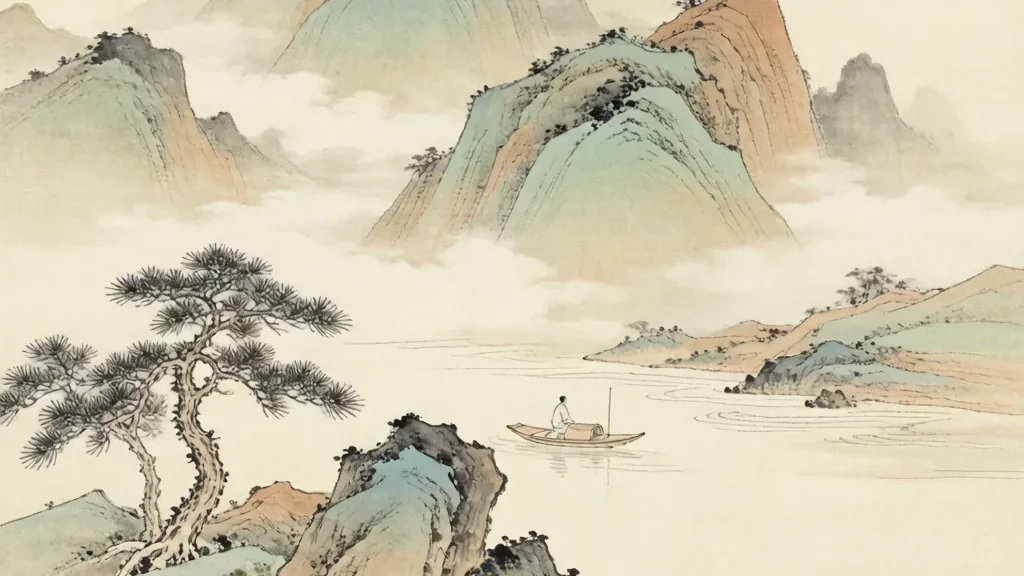
In the golden age of Tang poetry, Wang Wei (王维, Wáng Wéi, 699–759 CE) occupies a unique and serene space. While Li Bai reached for the moon and Du Fu wept over the empire's ruin, Wang Wei withdrew into the mountains — literally and spiritually. He was China's first great poet-painter, a devout Chan Buddhist, and the master of a style so quiet that his best poems seem to happen in the silence between lines. His "Wang River Collection" (辋川集, wǎng chuān jí) stands as the purest expression of landscape as inner meditation in the Chinese literary tradition.
The Scholar Who Retired
Wang Wei was born into an aristocratic Shanxi family in 699 CE. His literary talent emerged early: by age fifteen he was writing poetry in the capital Chang'an, and by twenty-one he passed the jinshi (进士) examination — one of the youngest ever to do so. He served as a court musician (his skill on the pipa was legendary) and held various official posts, but the An Lushan Rebellion (安史之乱, 755–763 CE) shattered his career. Captured by the rebels in 756, Wang Wei was forced to accept a nominal post in their puppet government. When the rebellion was crushed, he was briefly imprisoned and nearly executed — his life was spared only because his brother, who had been a loyalist general, offered his own life in exchange, and because Wang Wei had composed a poem of grief for the Tang court during his captivity.
The trauma of the rebellion pushed Wang Wei deeper into the Chan (Zen) Buddhist practice that had long sustained him. He retired to his country estate at Wang River (辋川, Wǎng Chuān), about forty miles southeast of Chang'an, where he lived as a lay Buddhist recluse for the remainder of his life. The estate became the focal point of his greatest creative work. He divided its landscape into twenty named scenic spots — places like "Deer Enclosure" (鹿柴, lù zhài) and "Bamboo Lodge" (竹里馆, zhú lǐ guǎn) — and composed one poem for each, with his friend Pei Di (裴迪) composing companion verses. These twenty poems form the "Wang River Collection," the most celebrated series of landscape poems in Chinese literature.
Stillness and Emptiness: The Poetic Style
Wang Wei's poetry is defined by what it leaves out. He strips away ornament, historical allusion, and strong emotion, leaving only the barest scene: mountains in twilight, a solitary bird taking flight, the sound of a stream in the darkness. The eight-line regulated verse (律诗, lǜ shī) and the four-line jueju (绝句) were his preferred forms. Within these tight structures, he created an almost photographic sense of presence — his poems do not describe nature so much as allow the reader to inhabit it.
Consider his most famous jueju, "Deer Enclosure" (鹿柴): "Empty mountain: no one to be seen. / Only the echo of someone's voice is heard. / Returning light enters the deep wood / And shines again on the green moss." Every line is built on negation and absence — no people, only echoes, light that briefly touches moss. The poem is a meditation on Buddhist emptiness: the mountain is full (of sounds, of light) only because it is empty (of human purpose). The reader is placed not in the scene but on its threshold, listening.
Su Shi (苏轼, 1037–1101), the great Song dynasty poet and critic, famously said of Wang Wei: "In his poems there are paintings; in his paintings there are poems" (诗中有画,画中有诗). This "poem-painting" unity was not just a compliment — it reflected a technique. Wang Wei composed visual scenes in his verse the way a painter composes a landscape: through layering, empty space, and subtle shifts of light. The line "The river flows beyond heaven and earth / The mountain colors between existence and non-existence" perfectly captures this liminal quality, where geography dissolves into metaphysics.
Painting in Ink: The Southern School
Wang Wei was as influential a painter as he was a poet. He is traditionally credited as the founder of the "southern school" (南宗画, nán zōng huà) of Chinese landscape painting, which favored monochrome ink wash (水墨, shuǐ mò), spontaneous brushwork, and expressive atmosphere over the precise, colored detail of the court painters. The Ming dynasty critic Dong Qichang (董其昌) later formalized this division, tracing a lineage of "literati painting" (文人画, wén rén huà) back to Wang Wei himself.
Though no original paintings by Wang Wei survive — the oldest extant copies date from the Song dynasty — his poetic descriptions of his own art reveal his method. He wrote of painting that "a single inch of brush should contain a thousand miles of meaning" — the same principle of compression that governs his verse. His most famous attributed painting, "Clearing after Snow on the Wang River" (辋川积雪图), survives only in later copies, but it established a compositional template: a vast white landscape, a few bare trees, a solitary figure in a boat — emptiness as the highest form of expression. This approach would influence generations of poets and painters, from the Song landscape masters to the literati of the Ming and Qing dynasties.
Wang Wei's Legacy: The Poetics of Solitude
Wang Wei's influence on Chinese poetry is profound but subtle — like his verse, it works by indirection. He established the "nature-and-retreat" (山水田园, shān shuǐ tián yuán) tradition that later poets such as Meng Haoran (孟浩然) and Wei Yingwu (韦应物) would expand. More importantly, he demonstrated that poetry could be a vehicle for religious experience without being overtly doctrinal. The Chan Buddhist concept of sudden enlightenment (顿悟, dùn wù) has a formal equivalent in Wang Wei's poetry: a poem that begins with ordinary perception and ends, in its final couplet, with a sudden opening into emptiness.
Outside China, Wang Wei's poetry has been widely translated and admired, particularly in Japan, where his Chan-inflected landscapes resonated deeply with Zen aesthetics. The Japanese haiku master Matsuo Bashō (松尾芭蕉, 1644–1694) echoed Wang Wei's combination of precise observation and meditative stillness. In the West, the Imagist poets of the early 20th century — Ezra Pound, Amy Lowell — found in Wang Wei's compact, image-driven verse a model for their own rebellion against Victorian verbosity. Today, Wang Wei remains the poet of choice for anyone who believes that the most profound statements are often made in whispers.
Wang Wei's Influence on Chinese Painting
Wang Wei's legacy as the archetypal "poet-painter" (诗画, shī huà) shaped Chinese art for centuries. His shanshui (山水, "mountain-water") poetry, with its empty space and misty distances, provided the literary template for the Southern School of landscape painting (南宗画, nán zōng huà). Ming critics traced an unbroken lineage from Wang Wei through Song literati to their own era, treating his fusion of poetry and ink-wash painting as the highest ideal. His name remains synonymous with the quiet, luminous style that defines classical Chinese landscape art.