In the literary history of Tang China, no poet reached the common heart as directly as Bai Juyi (白居易, Bái Jūyì, 772–846 CE). While his contemporaries Li Bai and Du Fu wrote for the educated elite — their allusions dense, their diction elevated — Bai Juyi purposefully composed poems that an old village woman could understand at first hearing. He was the most prolific of all Tang poets, leaving behind over 2,800 verses, and his influence extended far beyond China's borders to shape the literature of Japan and Korea. From the heartbreaking "Song of Everlasting Sorrow" to his blistering social satires, Bai Juyi remains the most approachable of China's great classical poets.
Life of a Scholar-Official
Bai Juyi was born in 772 in Xinzheng (新郑, now Henan province), into a scholarly family of modest means. He was a precocious child: by the age of five he was composing verse, and by sixteen he had written the famous "Grasses on the Plain" (赋得古原草送别, fù dé gǔ yuán cǎo sòng bié), which impressed the capital's literary establishment. The poem's closing couplet — "They burn you with wildfire, but spring winds blow you back to life" — became one of the most quoted lines in Chinese poetry.
He passed the highest jinshi (进士) civil examination in 800 CE and began his career as a government official. Unlike the romantic Li Bai, who chased wine and immortality, Bai Juyi took his bureaucratic duties seriously. He served as a Reminder (左拾遗, zuǒ shí yí) — a censor whose job was to point out the emperor's mistakes — and later as governor of several prefectures. But his habit of writing poems that exposed official corruption repeatedly got him into trouble. In 815 CE, he was exiled to a minor post at Jiangzhou (江州, modern Jiujiang, Jiangxi), a punishment that actually deepened his identification with the common people he now lived among.
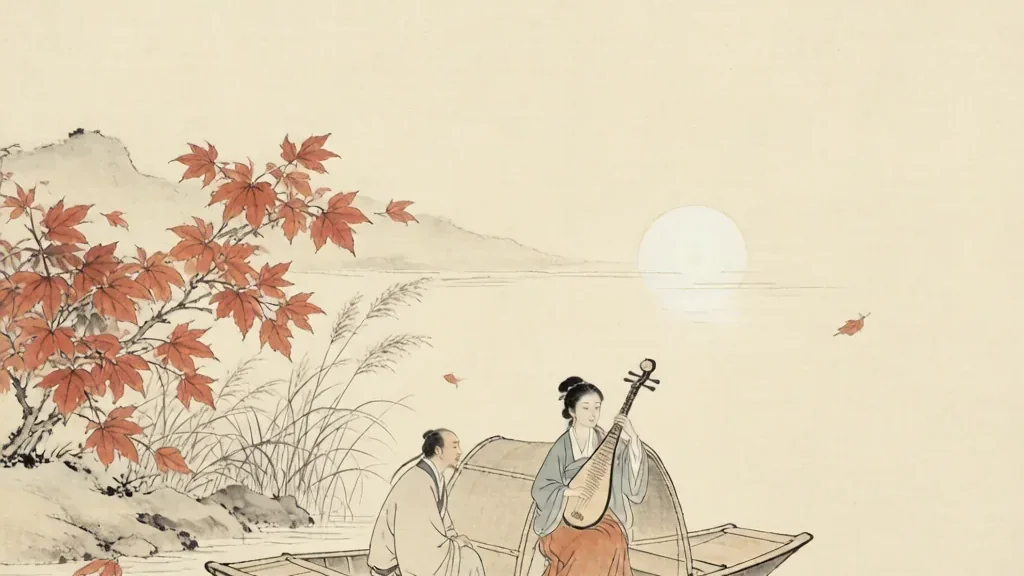
In Jiangzhou, Bai Juyi wrote what many consider his autobiographical masterpiece: "The Lute Song" (琵琶行, pí pá xíng). While seeing off a guest on the Xunyang River at night, he hears a traveling female lute player perform. Her story — once a celebrated courtesan, now a neglected merchant's wife — mirrors his own fall from imperial favor. The line "We are both fallen in this world of ours — what need to have met before?" (同是天涯沦落人,相逢何必曾相识) captures the essence of his compassionate worldview. He later returned to the capital and held high office, but he never forgot the lessons of exile.
A Poetics of Clarity
Bai Juyi's most radical innovation was his insistence on plain language. He famously said that poetry should be written so that "an old woman at the village well understands every line." This was a deliberate rejection of the ornate, allusion-heavy style that had become fashionable in the mid-Tang court. Instead, Bai Juyi looked back to the early folk songs of the Shijing (诗经) as his model, believing that poetry's true purpose was moral instruction and social commentary.
He divided his own work into four categories, but the one he valued most was the "allegorical poem" (讽喻诗, fěng yù shī) — a kind of literary protest, using everyday scenes to expose injustice. In "The Old Man of the Charcoal" (卖炭翁, mài tàn wēng), he describes an elderly charcoal seller who wakes before dawn to load his cart, only to have his precious charcoal confiscated by imperial eunuchs who "buy" it with a scrap of red silk. The poem contains no explicit moralizing — the horror lies in the simple recitation of events. Emperor Xianzong reportedly read the poem and reduced some of the palace's forced procurement, illustrating Bai Juyi's belief that poetry could change policy.
His "New Yuefu" (新乐府, xīn yuè fǔ) series of fifty poems revived the Han-dynasty Music Bureau tradition, composing new verses on old folk-song topics. Each poem targeted a specific social ill: high taxes, military conscription, the oppression of women, the extravagance of the rich. The sheer specificity of these poems gives them documentary value — they are eyewitness accounts of ninth-century Chinese society, written not from the palace but from the roadside.
The Song of Everlasting Sorrow
Bai Juyi is best known today for his narrative ballad "Song of Everlasting Sorrow" (长恨歌, cháng hèn gē), a 120-line tour-de-force recounting the doomed love of Emperor Xuanzong (唐玄宗, Táng Xuán Zōng) and his favorite consort, Yang Guifei (杨贵妃, Yáng Guìfēi). The poem begins in the decadent splendor of the imperial court, where the aging emperor neglects his duties to dote on Yang Guifei, and then pivots to the An Lushan Rebellion (安史之乱, Ān Shǐ Zhī Luàn, 755–763 CE) and Yang Guifei's forced execution by the emperor's own mutinous soldiers. The second half follows the emperor's obsessive grief and his sending of a Taoist sorcerer to seek Yang's spirit in the fairy islands of the Eastern Sea.
The poem's enduring power lies in its psychological depth and its shimmering ambiguity. Is it a love story? A cautionary tale about imperial decadence? A meditation on the impossibility of permanent attachment? The final couplet — "Heaven is long, earth endures, but sorrow lasts forever" (天长地久有时尽,此恨绵绵无绝期) — suggests all three at once. The poem was so popular that it spread by word of mouth and soon reached the wilds of Korea, where it was reportedly sung by traveling entertainers within a decade of its composition.
Cultural Legacy Across East Asia
Bai Juyi's influence abroad rivals that of any Chinese poet. In Japan, his works were imported within decades of his death and became essential reading for the Heian court. Murasaki Shikibu's "The Tale of Genji" (源氏物語, Genji Monogatari) quotes the "Song of Everlasting Sorrow" repeatedly, and the 11th-century anthology "Wakan Roeishu" (和漢朗詠集) includes dozens of Bai Juyi's poems alongside Japanese waka. The Japanese reverence for his work was so profound that the poet Sugawara no Michizane called him "the greatest poet of all time."
In China itself, Bai Juyi's accessible style made him a perennial favorite across social classes. While Du Fu was admired by scholars and Li Bai by romantics, Bai Juyi was read and recited by everyone — merchants, soldiers, innkeepers, and geishas. His poems were painted on screens, sung to pipa accompaniment, and quoted in everyday conversation. The late Qing reformer Liang Qichao credited Bai Juyi with proving that literature could serve social reform — an idea that resonated strongly in modern China's "May Fourth" literary revolution. Bai Juyi showed that the most revolutionary act a poet could perform was simply to be understood.