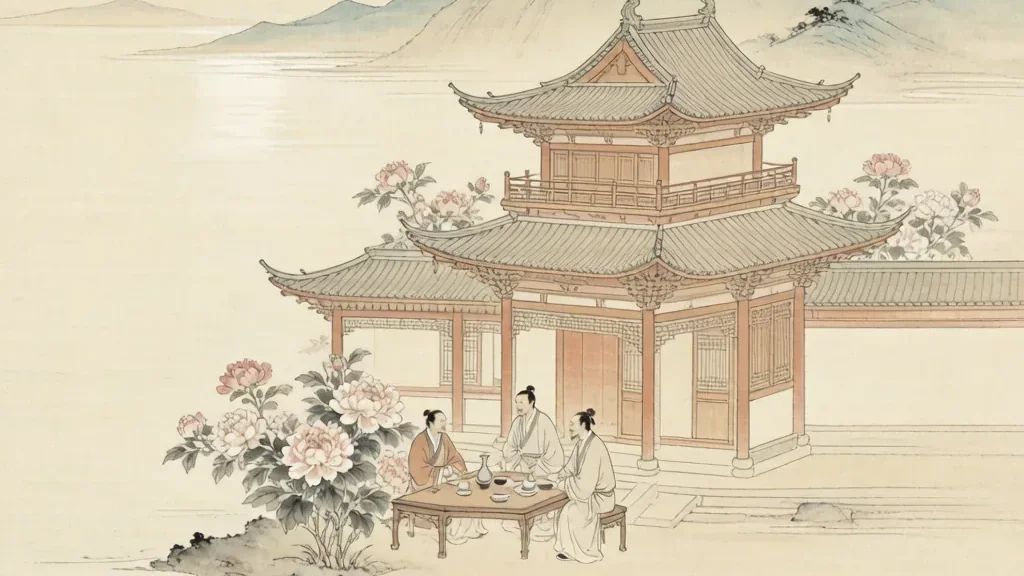
Ask any educated Chinese person which dynasty wrote the best poetry, and the answer is never in doubt: the Tang (唐, Táng, 618–907 CE). In just under three centuries the empire produced a roster of poets — Li Bai, Du Fu, Wang Wei, Bai Juyi — whose names are as familiar to Chinese readers as Shakespeare's are in English. Tang poetry is not merely "old literature"; it is the living memory of the language, recited by schoolchildren and quoted in daily speech. Understanding why this age burned so brightly explains much of Chinese culture itself.
Why the Tang?
Several forces converged. The Tang reunited China after the chaos of the Northern and Southern dynasties and gave the empire a long stretch of internal peace under the "Zhenguan" (贞观) and "Kaiyuan" (开元) reigns. The capital, Chang'an (长安, modern Xi'an), was the largest city on earth — perhaps a million inhabitants — a cosmopolitan hub where merchants from Samarkand, monks from India, and envoys from Japan mingled along the Silk Road. Wealth freed the literate class to cultivate the arts.
Just as important was a technical ripening. The tone system of Chinese — the level (平, píng) and deflected (仄, zè) pitches — had been analyzed by scholars of the Southern dynasties. By the Tang, poets had learned to arrange these tones into strict, pleasing patterns. The language had, in effect, been tuned like an instrument, and the Tang were the first to play it fully in tune.
Finally, poetry was the supreme social currency. To be witty in verse was to rise in the world; to fail at it was to be a boor. The result was a society in which composing a poem was as natural as writing a letter, and in which the best poems were copied, sung, and memorized across the empire within months of being written.
Forms — Regulated Verse and Jueju
The Tang perfected two core forms built on five- or seven-character lines. The jueju (绝句, "cut verse") is a quatrain of four lines, deceptively simple, prized for a single bright image or feeling — the form of Li Bai's "Quiet Night Thought" (静夜思). The lüshi (律诗, "regulated verse") is an octet of eight lines in which the middle two couplets must be strictly parallel, matching noun against noun and verb against verb. A perfect lüshi feels like a temple: balanced, inevitable, every tile in place.
What makes "regulated" (律, lǜ) verse regulated is its rules of tone and rhyme. In a standard eight-line poem, the tones must alternate line by line and the second and third couplets mirror each other's grammar. A single misplaced tone was a technical flaw a trained reader would notice instantly. Mastery of this discipline is why Tang poems sound so musical even in translation's absence.
There were also looser forms. The gushi (古诗, "old-style poem") ignored the new rules and allowed any length, which Li Bai used for his wild, runaway narratives. And the yuefu (乐府, "Music Bureau") style adapted old folk-song tunes to new, often social, themes. The Tang poet moved freely among strict and free forms, choosing the cage or the open field as the feeling required.
Poetry and the Imperial Examination
Nothing did more to spread poetry than the exam system. The Tang inherited the civil-service recruitment of the Sui and expanded the jinshi (进士, "presented scholar") examination as the main road to office. From the reign of Emperor Xuanzong (玄宗, r. 712–756) onward, a required section tested candidates' ability to compose a lüshi on an assigned topic within a strict time limit — sometimes inside the examination compound, guarded against cheating.
This had profound effects. It meant that for generations, the brightest men in the country spent their youth drilling metrics, diction, and allusion. It meant that nearly everyone in the bureaucracy could write competent verse, so poetry became the shared medium of friendship, farewell, and political comment. When a friend was posted to a distant province, you saw him off with a poem; when you missed home, you wrote one and sent it back.
The system also created a literary aristocracy whose status rested on talent rather than birth — at least in theory. The story of the boy prodigy who topped the exams through a single brilliant poem was a powerful social ideal, even if, in practice, connections mattered too. What is certain is that the exams made "being a poet" almost synonymous with "being a gentleman."
Themes of the Age
Tang poetry ranges across nearly all human experience. Nature and friendship: Wang Wei (王维) painted quiet mountains and empty streams where a single bird-call defines the silence. War and the frontier (边塞, biān sài): poets like Gao Shi (高适) and Cen Shen (岑参) wrote of the frozen Gobi, the beacon towers, and the soldiers who "look north to their homes" from the Jade Gate Pass (玉门关, Yùmén guān).
Court and capital life fills the work of Bai Juyi (白居易), who insisted poetry should be understood even by an unlettered old woman, and who used it to criticize the extravagance of the palace. Exile and loss dominate Du Fu's later verse, written amid the An Lushan Rebellion (安史之乱, 755–763), when the empire's golden age shattered into famine and flight. A single Tang poem might hold a moon, a friend leaving, and a quiet sorrow for the passing of time.
The dominant emotional note is lihe (离合) — the sadness of meeting and parting. Because officials were constantly transferred, farewell poems (送别诗, sòng bié shī) became a whole genre. To read Tang poetry is to hear a civilization saying goodbye, again and again, beautifully.
Tang Poetry's Enduring Fame
The scale of survival is staggering. The Qing-dynasty anthology Quantangshi (全唐诗, "Complete Tang Poems," 1705) gathers about 48,900 poems by some 2,200 authors — emperors, generals, nuns, and courtesans alike. This is surely incomplete; the rebellion, later wars, and the fragility of paper destroyed countless works. Even so, it is a vaster corpus than almost any other pre-modern literature possesses.
The Tang also set the canon. The Song critic selected "the Three Hundred Tang Poems" model that became the standard school reader, and the Qing anthology Tangshi Sanbaishou (唐诗三百首, "Three Hundred Tang Poems," 1763) is still the book a Chinese child first memorizes. Li Bai and Du Fu were enshrined as the twin peaks, the "Li-Du" (李杜) against whom all later poets measured themselves.
Beyond China, Tang poetry traveled with Buddhism and trade into Korea, Japan, and Vietnam, where it shaped classical verse in those languages for a thousand years. Today, when a modern Chinese person quotes a line under the moon or on a train platform, they are almost certainly quoting a Tang poet. The golden age never really ended; it just stopped being written and became part of how the language thinks.