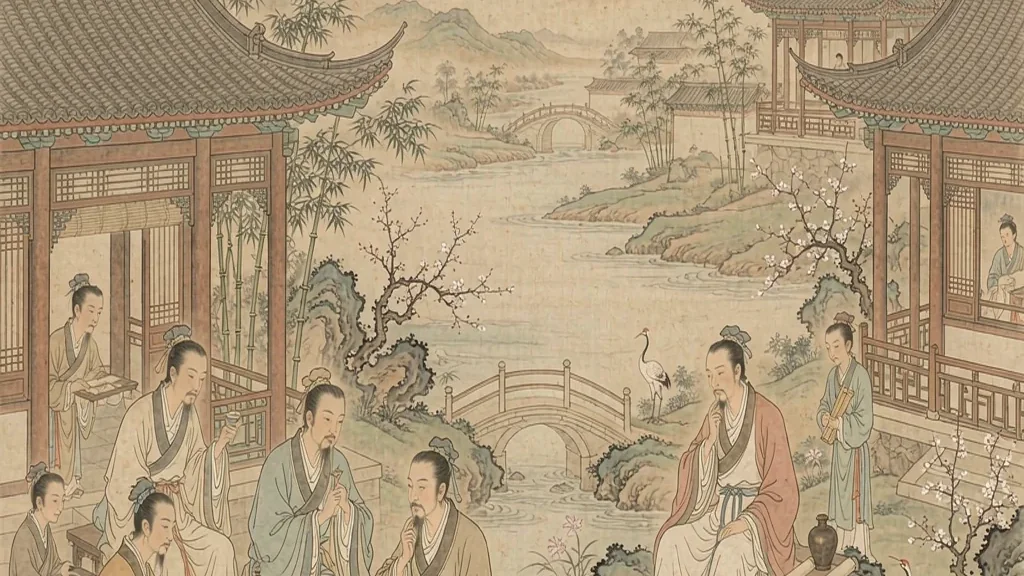
The Tang poet Jia Dao stands as the enduring emblem of poetic refinement taken to the point of devotion, the writer for whom a single character could outweigh a night of sleep and a chance encounter with a great minister could become the founding legend of a whole aesthetic. Jia Dao's reputation rests less on a large body of celebrated masterworks than on the intense, almost monastic care he lavished on wording, polishing each line until its texture satisfied him. Together with his fellow perfectionist Meng Jiao, he anchors the so-called "lean and bitter" school of Tang poetry, a style marked by austere diction, narrow emotional range, and an obsessive attention to craft. This essay examines Jia Dao's life, his method of revision, the famous anecdote of the "push" and the "knock," and the larger cultural value placed on verbal refinement in the Chinese poetic tradition.
Jia Dao's Life and the Path to Poetry
Jia Dao lived during the late eighth and ninth centuries, a period of the Tang dynasty marked by relative political instability and the slow erosion of the confident cosmopolitan culture of the high Tang. According to biography, he began life as a Buddhist monk, habitually signing his early poems with a religious name, and only later left the monastery to pursue the examination system and a minor official career. This background in monastic discipline is often cited to explain the ascetic quality of his verse, its cold imagery and its patient, almost meditative focus on small perceptual details. His career as an official was modest and occasionally troubled, and he seems to have spent much of his life in relatively humble posts far from the capital's center.
The contrast between his quiet bureaucratic life and his outsized reputation for craft is itself instructive. Jia Dao became famous not because of power or patronage but because later readers treasured the visible labor of his art, the sense that every character had been earned through struggle. In a culture that also prized effortless spontaneity, his example represents the opposite pole: poetry as grueling refinement.
The Anecdote of Push and Knock
The most famous story about Jia Dao concerns a line he was composing while riding through the capital. He could not decide whether a monk returning to his temple at night should "push" the gate or "knock" on it, and so absorbed was he in weighing the two verbs that he gestured with his hands in the street, oblivious to his surroundings, and accidentally collided with the procession of the chief minister Han Yu. Rather than punishing the distracted poet, Han Yu engaged him in discussion and reportedly endorsed "knock" as the better choice, since the sound suited the quiet of the night. The episode gave the Chinese language the compound tuiqiao, "to push and knock," which forever after meant the careful weighing of wording.
Whether the anecdote is historically precise or a later construction, its cultural work is clear. It crystallizes the ideal of the poet so committed to a single verbal decision that he loses track of the ordinary world, and it frames refinement as a collaborative, reasoned activity rather than mere inspiration. The story has been retold for a thousand years as the origin myth of careful revision.
The Method of Revision
Jia Dao's practice, as described by himself and his commentators, involved composing a line and then testing alternative characters for sound, tone, and image, sometimes preserving several drafts before settling. He is said to have muttered lines aloud while walking, and to have wept when a couplet failed him after years of effort. Such reports, whether literal or emblematic, establish refinement as a bodily, even painful discipline. The poet does not wait for the muse; he wrestles the line into shape through repetition and doubt.
This method contrasts sharply with the "celestial inspiration" model associated with Li Bai, who was supposed to compose without correction. Jia Dao represents the craftsman against the genius, and Chinese criticism valued both, but his brand of patience spoke especially to readers who themselves struggled with wording. The very difficulty of his achievement made it admirable.
The Lean and Bitter Style
Jia Dao is conventionally paired with Meng Jiao as the chief exponent of the "lean and bitter" manner, a label that captures the stripped, sometimes grim quality of their diction. Where high Tang poetry favored fullness, brightness, and confident sweep, Jia Dao favored narrow scenes: a cold river, a bare tree, a lonely traveler, an old temple bell. His emotional register tends toward solitude, poverty, and quiet endurance rather than grand passion. The effect is of a poetry pared to essentials, where the absence of ornament is itself the statement.
Critics have sometimes faulted this style as barren or overly confined, noting that its narrow range risks monotony. Yet its defenders argue that the very restraint produces a haunting precision, and that the careful reader finds in the lean line a depth that louder poetry cannot reach. The style remains a recognized option in the Chinese poet's repertoire.
Influence on Later Poetics
Jia Dao's example exerted a long shadow over later verse, particularly among poets who prized craft over display. In the Song dynasty, the cult of refinement and allusion owed something to his patience, even as Song writers broadened the scope of subject matter. The late Ming and Qing anthologists, who shaped the canon most readers inherited, tended to include a selection of his quiet quatrains, ensuring that the "push and knock" poet remained a household name. His life also fed the figure of the poor, obsessed writer, a stock character in fiction and drama.
Beyond literature, the story of Jia Dao became a general moral fable about concentration. To "push and knock" entered everyday speech as advice to weigh one's words, applicable to prose, speech, and even statecraft. The poet's private labor thus migrated into common wisdom about careful expression.
Refinement Versus Spontaneity
The Chinese tradition never resolved the tension between refinement and spontaneity, and Jia Dao sits at one end of a spectrum that also includes Wang Wei's seeming ease and Li Bai's fluent brilliance. Some critics argued that excessive polishing kills the living breath of a poem, producing a corpse of correct characters. Others countered that true spontaneity is itself the fruit of long discipline, and that Jia Dao's struggles were simply the visible part of a process all good poets undergo. This debate reflects a deeper question about whether art should conceal its labor or display it.
What is striking is that even Jia Dao's admirers admitted his limitation: he could refine a line to perfection yet sometimes lacked the architectural vision to unify a longer poem. The honest criticism of his work shows a tradition capable of valuing a poet precisely for the virtue in which he excelled, without insisting he possess every excellence.
Notable Lines and Their Craft
Among the couplets attributed to Jia Dao, several demonstrate his method: a line describing a bird perching on a tree by the pool, or the quiet of a temple where only the bell is heard, shows his gift for isolating a single acoustic or visual event and letting it stand for a whole mood. The famous "knock" line itself, situated in a poem about a secluded temple visited at night, uses the sound of a knock to deepen the silence around it, a classic refinement that turns a small verb into an instrument of atmosphere.
Reading such lines, one notices how much depends on the chosen character: the difference between a push and a knock is the difference between a poem that closes its world and one that announces a presence within it. Jia Dao's legacy is the demonstration that such differences matter, and that the poet's duty is to notice them.
Enduring Cultural Meaning
Today Jia Dao survives less as a name on a syllabus than as a symbol. The phrase born from his anecdote still teaches schoolchildren the value of verbal care, and his image as the distracted, devoted writer continues to appear in popular retellings of literary history. In an age of rapid communication, his slow, painstaking method reads almost as a quiet protest, a reminder that language can be treated as something precious rather than disposable. The "push and knock" poet thus remains relevant not because his poems are the most beloved, but because his life dramatizes a choice about how to use words.
His story invites every writer to ask which verb to choose, and to accept that the question is worth a sleepless night. In that sense Jia Dao's true composition was not any single poem but the ideal of refinement itself, handed down as a discipline for all who follow.
❓ Frequently Asked Questions
Who was Jia Dao?
A late Tang poet who began as a monk and became famous for obsessively refining his wording, anchoring the lean-and-bitter style.
What is the push-and-knock story?
While deciding whether a monk should push or knock a temple gate, Jia Dao wandered into Han Yu's procession; the minister chose knock.
What does tuiqiao mean today?
It means to carefully weigh one's wording, a phrase born from the anecdote and now common advice about precise expression.
What is the lean-and-bitter style?
A stripped, austere diction favoring narrow cold scenes and solitude, associated with Jia Dao and Meng Jiao.
How did Jia Dao revise?
He tested alternative characters for sound, tone, and image, often preserving drafts and muttering lines aloud for years.
Why does he still matter?
He symbolizes verbal care as a discipline, teaching that the choice of a single word can be worth a sleepless night.