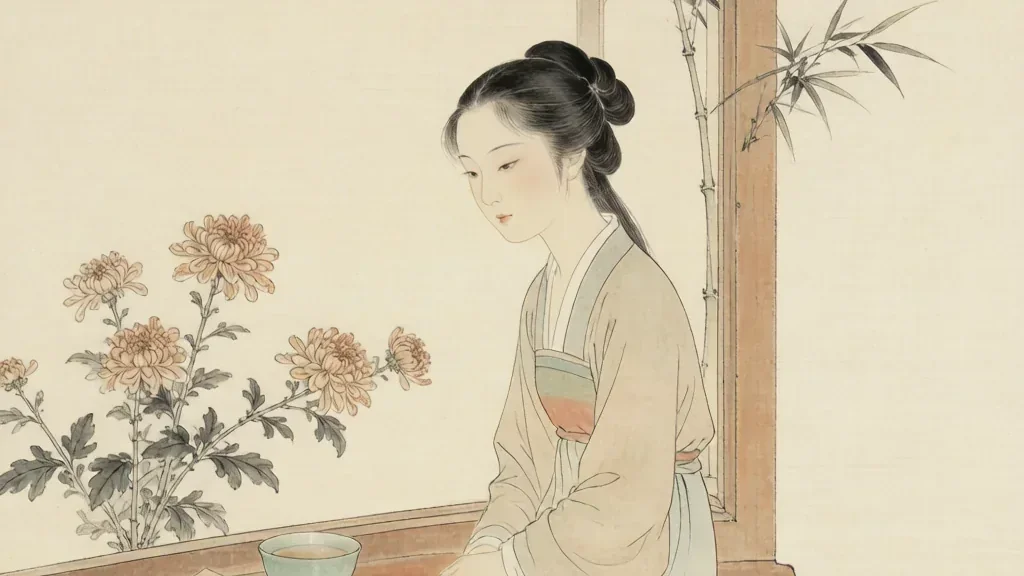
In a tradition written almost entirely by men, one woman's name sits unquestioned among the greatest Chinese poets. Li Qingzhao (1084–c. 1155 CE) was the supreme master of the ci lyric of the Song dynasty, and the only female poet whom the classical canon treats as a peer of Li Bai, Du Fu, and Su Shi. Her early verse captures young love with a precision no one had matched; her late verse, written after war destroyed her home and killed her husband, records widowhood with a bare, repeating music that still hurts to read. She is, simply, China's greatest woman poet.
A Literati Upbringing
Li Qingzhao was born in Jinan (济南), in modern Shandong, to a family at the top of the educated elite. Her father, Li Gefei (李格非), was a noted prose writer and one of the "Four Scholars of Su Men" tied to Su Shi's circle; her mother came from a family of poets. Such a household did not hide learning from daughters. She read the classics, the histories, and the poetry of the Tang as a matter of course, and was composing verse by her teens.
This was rare but not impossible. The Song dynasty's urban, book-rich culture allowed some gentry women real education, and a few — like the poet Zhu Shuzhen (朱淑真) — became known. What set Li Qingzhao apart was talent so large that male critics, usually quick to patronize, admitted her superiority. The scholar Wang Zhuo called her ci "unmatched in her generation, male or female."
Her upbringing also gave her a connoisseur's eye. She grew up among scrolls, bronzes, and stone inscriptions, the material of serious scholarship — knowledge that would later shape both her marriage and her greatest prose work.
Early Brilliance
Around 1101 she married Zhao Mingcheng (赵明诚), a young antiquarian and later prefect, who shared her passion for epigraphy — the study of inscriptions on bronze and stone. Their marriage became legendary for its intellectual companionship: they competed to recall allusions from the Classic of Poetry and the histories, and together they built one of the finest private collections of inscriptions in the realm, later described in her memoir "Record of Metal and Stone" (金石录后序).
Her early ci are love poems of startling concreteness. "Zui Hua Yin" (醉花阴, "Tipsy in the Flower Shade") tells of a Double Ninth Festival (重阳节) spent apart from her husband: she writes of a sheer curtain, a midnight chill, and chrysanthemums whose fragrance soaks her sleeves, closing with the line "the curtain of betel-nut, I am thinner than a yellow flower." The image of love-sickness as bodily thinness became a classic.
Legend has it she sent this poem to Zhao Mingcheng, who admired it so much he shut himself away for three days trying to match it with fifty of his own — and failed. Whether true or not, the story captures how her small, jeweled lyrics outclassed the more strenuous efforts of learned men.
War, Loss, and Late Work
In 1127 the Jurchen Jin (金) smashed the Northern Song, seized the capital Bianjing, and carried the emperor north. Li Qingzhao and Zhao Mingcheng fled south with their library — hundreds of cases of books and rubbings. The strain killed Zhao in 1129, and in the chaos of war and relocation most of the collection was lost to fire, flood, theft, and the demands of bribes. She was left, in her late forties, a displaced widow with a few salvaged scrolls.
Her late poetry changes completely. The play of the early work hardens into plain grief. "Wuling Chun" (武陵春) opens: "The wind has ended, the dust of flowers spent; I am late rising, too weary to comb my hair. Things are the same, but the one who mattered is gone — nothing in the world means anything." The famous line "I fear the twin skiffs at the ferry cannot bear so much sorrow" turns feeling into weight a boat might sink under.
She also wrote sharp public verse. After a brief, unhappy second marriage to a man who abused her and stole her property — which she escaped by suing him, a legally risky act for a woman — she produced satirical poems on the cowardice of Southern Song officials who had given up the north. Her "Summer Quatrain" (夏日绝句) praises a dead hero and shames the living: "You should have feared death, to be a hero among men / ... those who flee south, none is a true man."
Her Unique Voice
Li Qingzhao is the purest master of the wanyue (婉约, "graceful-restrained") manner. Her signature is the exact sensory detail — the scent of cassia, the screen's shadow, the wild goose crossing the cold sky — placed so that emotion arrives without being named. She distrusts abstraction; she shows the empty phoenix-bed, the locked window, and lets the loneliness speak for itself.
Her most admired technical feat is "Sheng Sheng Man" (声声慢, "Slow Slow Song"), which opens with seven paired characters — "Search, search, seek, seek; cold, cold, clear, clear; mournful, mournful, bitter, bitter" (寻寻觅觅,冷冷清清,凄凄惨惨戚戚) — a run of repeated syllables that, in performance, mimics catching one's breath. Scholars have called it the most difficult opening in all ci, because the tone rules must still be obeyed inside the repetition.
She was also a theorist. Her essay "Ci Lun" (词论, "On Ci") argued that ci must keep its musical, songlike nature and not be written like shi. She bluntly criticized even Su Shi for making ci too much like prose — a bold claim, since Su Shi was the giant of her father's circle. The essay is the first sustained critical manifesto on ci by any author, male or female.
Place in Literary History
Li Qingzhao's reputation has never faded. The Southern Song anthologies already ranked her first among ci writers, and the Ming and Qing collected and annotated her work repeatedly. Unlike many women writers preserved only as curiosities, she was printed, quoted, and imitated as a central figure of the canon — a status almost unique for a pre-modern woman in any literature.
Her influence is visible in later women poets, from the Ming courtesan Liu Rushi (柳如是) to the Qing noblewoman Gu Taiqing (顾太清), who all measured themselves against her. In the 20th century she became a feminist icon in China — proof that a woman could command the hardest literary forms and speak with full authorial voice, centuries before such a thing was "supposed" to be possible.
Abroad, her spare, musical lyrics survived translation better than many longer forms, and she is now the best-known Chinese woman poet in the West. To read her is to meet someone utterly specific: a Jinan girl who loved books and a husband, lost both to an empire's collapse, and turned the loss into lines so clean they outlasted the dynasty that broke her life.