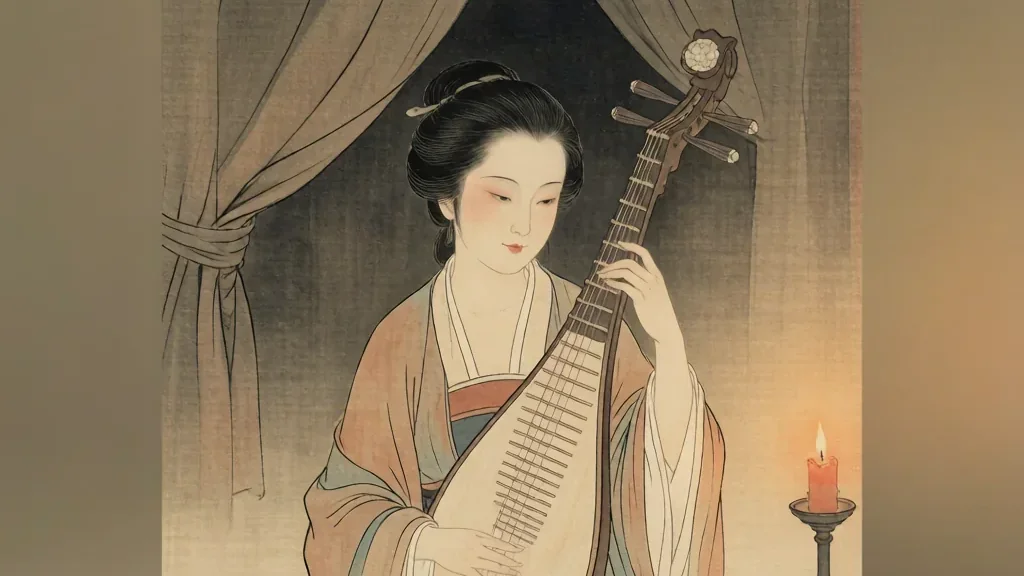
If the Tang perfected the shi (诗) — the regulated, freestanding poem — the Song dynasty (宋, Sòng, 960–1279 CE) perfected the ci (词). A ci is not a poem you recite; it is a poem you sing. Each piece was written to fit a particular tune, its uneven lines dictated by the music's rise and fall. Born in the singing quarters of the late Tang and raised to high art in the Song, ci became the most intimate and musical form in the Chinese tradition — the place where love, memory, and exile were whispered rather than declared. For many readers, ci is the truest sound of the Song.
What Is Ci?
Technically, ci means "lyric" or "song-word." Where a shi poem has uniform lines (usually five or seven characters) and a single rhyme scheme chosen by the poet, a ci is built on a cipai (词牌, "tune title") such as "Nian Nu Jiao" (念奴娇) or "Die Lian Hua" (蝶恋花). The tune fixes the number of lines, their lengths (from one to eleven characters), the tones, and where the pauses fall. The poet fills this melodic grid with new words — exactly as a songwriter writes fresh lyrics to a known melody.
Because the tune carried the emotion, the same cipai could be used for wildly different subjects, yet it always kept a recognizable shape. A ci is therefore best understood as a musical form first and a literary form second. When the original melodies were eventually lost (most had vanished by the Ming dynasty), what survived was the metrical skeleton — the pattern of syllables — which poets still obeyed as a kind of ghost of the song.
This dependence on music gave ci a flexibility that shi lacked. Its broken, songlike lines could imitate a sigh, a laugh, or a held note, which is why ci feels closer to speech and breath than the architectonic Tang octet.
Origins in Music and the Courtesan Tradition
Ci began not in the study but in the entertainment quarter. During the late Tang and the Five Dynasties (907–960), entertainers and courtesans (歌伎, gē jì) in cities like Chengdu and Yangzhou sang short lyrics set to popular tunes. Poets — among them the Southern Tang ruler Li Yu (李煜, Lǐ Yù, 937–978), later a prisoner of the Song — supplied words for these melodies. Early ci are frankly amorous because they were performed at banquets for an audience of wine and flirtation.
The great popularizer was Liu Yong (柳永, Liú Yǒng, c. 987–1053), a poet who wrote for and about the singing girls and who mastered the long, slow tunes (慢词, màn cí). Legend says that when Liu Yong died, the courtesans of the capital pooled money for his funeral and held annual memorial rites — "the poets' quarter mourning its own." His fame among ordinary singers is why his lines survive so widely.
By the Northern Song, educated men began writing ci as seriously as shi, and the form moved from the brothel to the salon. But its musical, performative DNA never disappeared: even the grandest ci was imagined as something sung, not merely read.
The Two Styles — Haofang and Wanyue
Later critics divided ci into two manners. The wanyue (婉约, "graceful and restrained") style is delicate, interior, and often about love, separation, and the passing season. Its great master is Li Qingzhao (李清照), whose lines on a withered lotus and a light boat carry an almost unbearable precision of feeling. Liu Yong too belongs here, with his lingering tunes of parting at the river's edge.
The haofang (豪放, "bold and unrestrained") style is expansive, heroic, and public. It was Su Shi (苏轼) who broke the rule that ci must be amorous, writing instead of rushing rivers, ancient heroes, and philosophical drunkenness. His "Nian Nu Jiao: Chibi" (念奴娇·赤壁怀古) summons the warrior Zhou Yu on the Red Cliff battlefield and laments that "life is a dream" — a scale of subject formerly reserved for shi. The Southern Song patriot Xin Qiji (辛弃疾) pushed haofang further, loading his ci with historical allusion and frustrated martial energy.
These labels are a later scholar's simplification; many poets wrote in both. But the haofang/wanyue distinction captures a real tension in ci — between the intimate and the epic, the whispered and the proclaimed — that gives the form its range.
Ci in Song Urban Culture
The Song was the most urban, commercial society China had yet seen, and ci was its popular art. In the Northern Song capital Bianjing (汴京, modern Kaifeng) and the Southern Song capital Lin'an (临安, modern Hangzhou), teahouses, wine shops, and pleasure boats all employed singers. A new ci could become a hit overnight; one story tells of a line so admired that it was copied onto every fan in the city.
Ci also fed print culture. The Song saw the first large-scale commercial publishing, and anthologies of ci circulated widely, letting the form reach merchants and students, not just the elite. The poet-official who wrote a fine ci at a West Lake (西湖) outing could expect it sung back to him by a courtesan before the evening ended — a tight loop between creation and performance unknown to shi.
This urban, sociable life gave ci its themes: the lantern festival crowd, the rented boat on the lake, the wine shop parting, the lonely woman at the lattice window. It is the poetry of a society comfortable, refined, and quietly anxious about the barbarian north — an anxiety that becomes explicit after the Song lost the north to the Jin in 1127.
Legacy
After the Song, ci never died; it became one of the permanent forms a Chinese poet could choose, alongside shi and the later qu (曲) drama songs. The Yuan, Ming, and Qing all produced ci masters, and the Qing in particular saw a ci revival in which scholars like Nalan Xingde (纳兰性德) wrote lyrics of haunting delicacy that still rank among the most loved in the language.
Ci also shaped how later Chinese thought about emotion. Its wanyue insistence that small feelings matter — a falling petal, a letter unsent — fed the great novels, especially the Dream of the Red Chamber (红楼梦), whose characters compose and quote ci constantly. The form taught that the lyric could be as serious as the epic.
Today ci survives both as literature and as music. Composers still set famous ci to new tunes, and schoolchildren memorize Li Qingzhao's "Sound of Rain at Night" (声声慢) for its repeated syllable-pattern and grief. To know ci is to hear the Song dynasty singing — intimate, musical, and unexpectedly modern in its attention to the inner life.