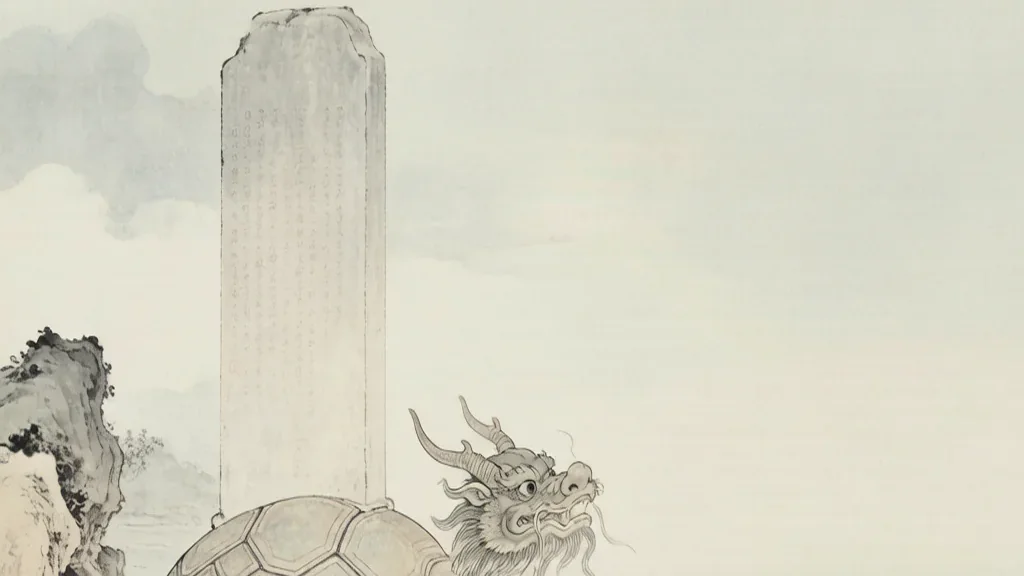
Bixi, written with the characters for "sturdy" and "carrying," is one of the most beloved and enduring figures among the Nine Sons of the Dragon in Chinese mythology. Depicted as a hybrid creature with the body of a massive tortoise and the head of a scaly dragon, Bixi is renowned above all for a single defining obsession: the urge to bear enormous weight upon its shell. Across imperial China, stone sculptures of Bixi were carved to support the heavy stone steles that recorded imperial edicts, monumental inscriptions, and the achievements of emperors, generals, and worthy officials. The creature therefore became a permanent fixture of the Chinese monumental landscape, standing silent guard at tombs, temples, bridges, and the sacred ways that led to the resting places of the great. To encounter a Bixi is to encounter a symbol of memory itself, a beast whose patient strength was believed to keep the words of the past from being lost to time.
Origins in the Legend of the Dragon's Nine Sons
The idea that the dragon fathered nine sons who each took a different form and developed a different temperament is a distinctly Chinese mythological motif that gained wide circulation during the Ming dynasty, though its roots reach back much earlier into folk religion and decorative craft. According to the popular list, each son expressed a single powerful inclination that determined where artisans placed his image. Bixi was the son whose nature inclined him toward carrying heavy objects, and so his likeness was set beneath stone tablets so that he might satisfy his instinct forever. The number nine here is less a precise count than a conventional way of expressing "many," and different texts preserved slightly different rosters of the sons, yet Bixi appears in nearly every version as the weight-bearing tortoise dragon.
Scholars note that the "nine sons" framework allowed craftsmen and scholars to organize a dizzying variety of hybrid creatures into a single tidy family headed by the dragon, the supreme benevolent force of Chinese cosmology. By assigning each son a role, the tradition turned decorative animals into a kind of visual glossary of virtues and functions. Bixi, the carrier, embodied endurance and the honoring of remembrance, which is why his form was considered especially appropriate for the steles that commemorated ancestors and rulers.
Physical Description and Symbolic Form
In sculpture, Bixi is unmistakable. His shell is that of a great river tortoise, often deeply carved with the hexagonal plates of a real carapace, but his head rises on a thick neck with the features of a dragon: a blunt snout, prominent eyes, horns or antlers, and sometimes a fringe of mane. His four legs are usually shown as clawed and powerful, braced as if pushing against the earth, and his tail curls behind him. The overall impression is one of immovable, deliberate strength. The dragon head signals his noble lineage, while the tortoise body connects him to one of the four spiritually significant animals of Chinese tradition, the tortoise being associated with longevity, stability, and the northern direction of the cosmos.
The contrast between the dragon above and the tortoise below is meaningful. The dragon represents heaven, movement, and imperial authority, whereas the tortoise represents earth, stillness, and endurance. Bixi unites the two, suggesting that true commemoration requires both the authority to command remembrance and the patience to sustain it across centuries. This union made him an ideal foundation for the inscriptions through which the state declared its values.
Role in Supporting Stone Steles
The principal function of Bixi in the built environment was to serve as the pedestal for a stele, a tall upright stone slab engraved with text. The stele would be fitted into a shallow socket on the creature's flattened shell, and the whole composition would be placed at the head of a spirit way or within the precinct of a temple or tomb. Because the beast appeared to be straining beneath the inscription, viewers read the scene as a living metaphor: the past is heavy, and only a creature of mythic patience can hold it aloft for the living to read. Many surviving examples still stand today, weathered but legible, in the cemetery complexes of the Ming and Qing dynasties and in the courtyards of ancient academies.
Some Bixi bases are immense, carved from a single block of stone weighing many tons, and the steles they support can rise higher than a person. The engineering required to transport and raise such stones reflected the importance the state attached to the messages they bore. A stele atop Bixi was not a casual marker but a deliberate monument meant to outlast dynasties, which is precisely why the dragon's patient son was chosen for the task.
Placement Along the Spirit Way
The spirit way, or sacred road, was a processional avenue lined with stone statues that led visitors toward the tomb of an emperor or high official. Bixi typically anchored the beginning of this avenue, paired with other guardian figures such as winged horses, camels, lions, and civil and military officials carved in stone. His position at the threshold announced to all who approached that this was a place of memory and respect, and that the person commemorated within had earned a monumental record. The arrangement of the spirit way followed conventions that varied by era, but the presence of a stele-bearing tortoise dragon was a recurring and recognizable element of imperial burial culture.
Beyond tombs, Bixi also appeared at bridges, where his weight-bearing nature was invoked to suggest stability against the flow of water, and at temples, where steles recorded donations, repairs, or imperial grants of honor. In each setting the creature performed the same quiet service: he made the inscription feel permanent, grounded, and worthy of trust.
Relationship to the Tortoise and Longevity
The tortoise had long been honored in China as one of the creatures symbolizing longevity, alongside the crane and the deer, and Bixi inherited this association through his shell. In a culture that prized the continuity of family and state, a creature that could carry weight for a thousand years without complaint was a natural emblem of faithful memory. Folk sayings sometimes invoked the tortoise's steadiness as a model for patient endurance, and the dragon-tortoise fusion elevated that everyday symbolism into something imperial and sacred. The result was a being who was at once a protective guardian and a moral example.
Because Bixi combined the dragon's celestial authority with the tortoise's earthly permanence, he was also thought to ward off misfortune from the site he guarded. Placing a stele on his back was therefore both an act of respect for the inscribed person and a ritual means of securing the location against disorder, a double function that made him doubly welcome in the landscapes of the living and the dead.
Evolution Through Dynasties
Early prototypes of the weight-bearing tortoise can be traced to the stone funerary art of the Han dynasty and even to earlier practices of marking graves with carved beasts, but the fully developed dragon-headed Bixi became standard during the later imperial period. By the Ming and Qing dynasties, the form was codified: rules of ceremony specified when and where a stele-bearing tortoise dragon could be used, and workshops produced them in large numbers for the tombs of emperors and the memorials of meritorious subjects. Regional styles emerged, with northern carvings tending toward blocky mass and southern ones toward finer detail, yet the essential conception remained constant across the empire.
In popular lore, the creature's appetite for burden was sometimes explained with a humorous touch: it was said that the young Bixi loved to swim and play, and that the sage who tamed him gave him stones to carry so that he would stay still and behave. Whether or not such tales were believed, they helped ordinary people relate to an imperial symbol, turning a remote monument guardian into a familiar character of the storytelling world.
Bixi in Temple and Tomb Complexes
Visitors to the great tomb complexes near the former capitals can still walk past rows of Bixi, each shouldering its slab of carved history. These sites functioned as open-air museums of state ideology, where the beast's labor anchored the official narrative of a reign or a life. Within temples, Bixi often carried steles that recorded the founding of the monastery, the names of patrons, or the text of a sutra granted by imperial favor. The creature thus bridged the sacred and the political, reminding worshippers that religious institutions flourished under the protection and recognition of the throne.
The durability of the stone ensured that Bixi outlived the regimes that commissioned him. Today he stands as an unintentional historian, his shell still bearing the names of officials and emperors whose courts have long dissolved, offering modern observers a direct material link to the ceremonial life of imperial China.
Modern Cultural Legacy
In contemporary China, Bixi survives as a recognizable cultural motif rather than a living cult object. Reproductions appear in parks, in front of museums, and as decorative elements on bridges and gates, where they evoke a sense of heritage and stability. Calligraphers and designers borrow his silhouette for logos and souvenirs, and he features in illustrated books that introduce children to the Nine Sons of the Dragon. The creature's appeal endures because he answers a timeless human need: the desire to build something that will carry the memory of the present into the uncertain future.
Scholars of material culture study Bixi sculptures to learn about workshop practice, regional stone, and the changing scripts carved on the steles above him. Each surviving example is a small archive, and the patient dragon-tortoise at its base is the silent curator of that archive, holding the weight so that the words may remain readable for whoever comes next.
Comparison With Other Dragon Sons
Bixi belongs to a crowded family of dragon offspring, each with a distinct taste. Where Bixi loves weight, his brother Yazi loves combat and appears on sword hilts, while Bi'an loves litigation and adorns prison gates, and Suanni loves smoke and fire and sits upon incense burners. Seeing the sons together reveals a folk taxonomy of human concerns: war, law, memory, fragrance, music, and water, each assigned its own mythic specialist. Bixi's specialty, remembrance, is among the quietest yet most essential, for without a keeper of memory the achievements of the other spheres would fade.
This division of labor also explains why the dragon, though a single powerful symbol, was represented in so many fragmentary forms throughout Chinese art. The emperor and the cosmos were imagined as too vast to be captured by one image, so the dragon was dispersed into sons, each guarding a slice of worldly order, with Bixi holding the heaviest slice of all.
❓ Frequently Asked Questions
What is Bixi in Chinese mythology?
Bixi is one of the Nine Sons of the Dragon, usually shown as a dragon-headed tortoise who loves to carry heavy loads, especially stone steles.
Why is Bixi shown carrying a stone tablet?
His nature was said to incline him toward bearing weight, so artisans placed inscribed steles on his shell to honor his role as keeper of memory.
Where can Bixi sculptures be found?
They stand along spirit ways, in temple courtyards, at bridges, and before tombs, particularly from the Ming and Qing periods.
Is Bixi a tortoise or a dragon?
He is a hybrid, with the shell and legs of a tortoise and the head and lineage of a dragon, uniting earth and heaven.
How does Bixi relate to the other dragon sons?
Each son had a specialty; Bixi's was carrying weight, while brothers governed combat, law, fire, and water among other concerns.
What does Bixi symbolize today?
He remains a popular emblem of endurance, heritage, and faithful memory, reproduced in parks and museums across China.