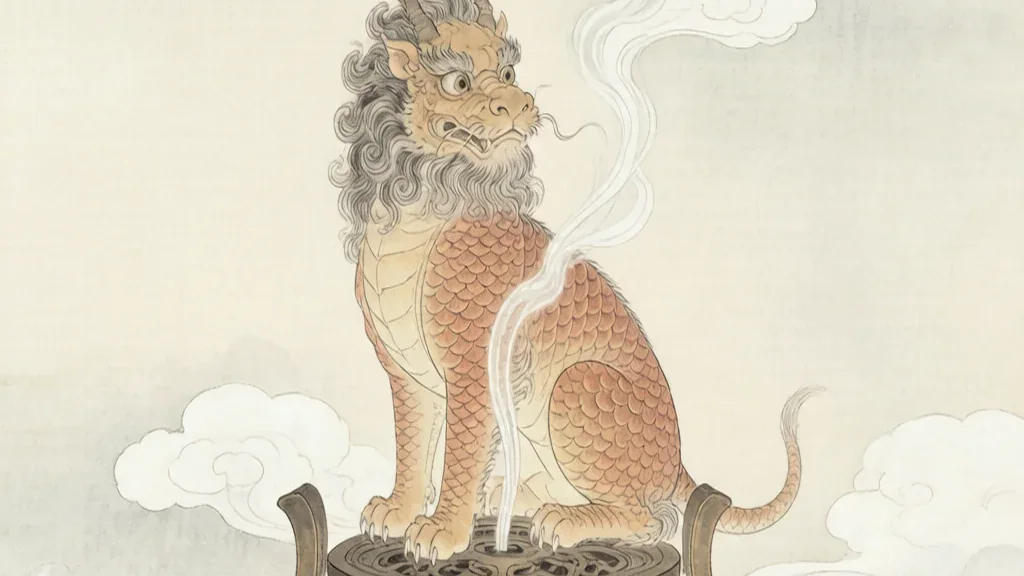
Suanni (狻猊), one of the Nine Dragon Sons (龙生九子), is the lion-like son of the dragon who loves two things above all: sitting perfectly still and breathing in the smoke of burning incense. For that reason his image crowns Buddhist incense burners and the lion thrones of the Buddhas, a calm, seated guardian whose feline body and dragon head bridge the Chinese dragon family and the Buddhist lion of India.
A Son of the Dragon
The Nine Dragon Sons (龙生九子) is a late-medieval Chinese tradition — assembled by Ming scholars such as Yang Shen (杨慎) — listing nine offspring of the dragon, each with a single defining "liking" (好) that determines where its image is placed. Suanni is a constant member of the list. His defining tastes are "好坐" (loves to sit) and "好烟火" (loves smoke and fire), which is precisely why he is stationed on incense burners and seats rather than, say, on bridges or stelae like his brothers.
The framing is the charm of the whole tradition. Each dragon son is not a personality so much as a disposition turned into a placement rule: one son guards stelae, another swords, another bells. Suanni's disposition — stillness plus smoke — sends him straight to the temple censer, where both conditions are perfectly met. The logic is decorative but also quietly theological: put the right dragon in the right place and the object fulfills its nature.
Lion Body, Dragon Head
Physically the suanni is drawn as a lion with a dragon's features: a powerful feline body, a curling mane, clawed paws, and a head that is part dragon, often with small horns and a scaled brow. This is no accident of imagination. The very word 狻猊 (suanni) originally meant "lion" in classical Chinese — the Erya (尔雅) dictionary glosses it as a beast that "eats tigers and leopards" — and only later, when the borrowed word 狮子 (shizi) arrived from Central Asia along the Silk Road, did 狻猊 shift from "the lion" to "the lion-dragon son." The suanni is thus the dragon family's memory of the real lion.
That etymology explains why the suanni looks so much like the familiar Chinese guardian lion (石狮). Both descend from the same animal and the same Indian Buddhist image; the suanni is simply the dragon-blooded version, given a place inside the Nine Sons because the lion was too important to Chinese art to be left out of the dragon's family.
The Lover of Smoke and Sitting
Because he delights in stillness and in the curl of incense smoke, the suanni is the standard ornament of the censer (香炉). On a bronze or cloisonné (景泰蓝) incense burner the lid is often pierced in the shape of a suanni, so that fragrant smoke streams from the creature's mouth and nostrils as if the lion-dragon were breathing it in. He also appears as the footed base of larger burners and as a seated figure at the center of the bowl, turning a utilitarian object into a small theological scene of contemplation.
The effect is exactly the one the tradition intends. A scholar lighting incense before calligraphy, or a monk before prayer, looks down at a suanni inhaling the same smoke — a mute companion in stillness. The censer is therefore the suanni's natural home, and the suanni is the censer's natural face.
The Buddhist Lion Throne
The suanni's love of sitting links him directly to Buddhism, which brought the lion (and the "lion throne," 狮子座, of the Buddha) into Chinese art. The seated Buddha or Bodhisattva rests on a lion throne, and the guardian lions (石狮) that flank temple and palace gates descend from the same lineage. The suanni, being both lion and dragon-son, was a natural choice to crown the seats of enlightened beings and to sit in meditation at temple doorways — a calm, watchful presence suited to the contemplative life.
This is why the suanni threads through both Buddhist and court art. At a Buddhist site he guards the seat of the law; at a scholar's desk he guards the ritual of concentration. In both settings his job is the same: to sit, to watch, and to breathe the smoke of devotion without moving.
Suanni Across the Decorative Arts
Beyond censers, the suanni appears on the bases of Buddhist and Daoist statues, on pillar bases (柱础), on the corners and handles of scholar's objects, and in jade and bronze sculpture of the Ming and Qing dynasties. His seated, smoke-loving nature made him a favorite for the scholar's studio, where an incense burner was both a tool of concentration and a mark of refinement. In furniture and architecture his curled, bearded form reads instantly as a benign guardian.
Because his pose is so distinctive — haunches folded, head up, mouth open to the smoke — the suanni is easy to spot once you know him. He is the dragon son you are most likely to meet sitting down, which is exactly the point of the whole Nine Sons system: every son is doing what he loves, in the place where that love belongs.
Legacy in Modern Craft
The Nine Dragon Sons remain a living decorative vocabulary in China, and the suanni is among the most visible of them. You will still find him on cloisonné and bronze incense burners sold in temple precincts and tourist markets, on modern censers used in tea ceremony and meditation, and in the guardian-lion pairs at the gates of renewed temples. In contemporary games and fantasy art he is routinely reimagined as a smoke-breathing lion-dragon, carrying the old "loves to sit and smoke" personality into new media.
What has not changed is the essence recorded centuries ago: a creature whose only desires are a steady seat and a thin column of incense. In a mythology crowded with violent and hungry monsters, the suanni is the dragon son who simply sits, breathes, and watches — and is honored for it.
The Logic of the Nine Sons' Placements
The Nine Dragon Sons are a placement system before they are a story. Each son has one defining liking that decides where its image belongs: one guards stelae, another swords, another bells, another bridges. The suanni's likings are loves to sit and loves smoke, which send him straight to the incense burner and the seat of the Buddha, where both conditions are perfectly met. The charm of the system is that it turns temperament into architecture, put the right dragon in the right spot and the object fulfills its nature. The suanni is simply the son whose nature is stillness, so he is the one you meet sitting down, inhaling the thin column of incense, exactly where his disposition says he should be.
Suanni in Cloisonne and Collecting Today
The Nine Dragon Sons remain a living decorative vocabulary, and the suanni is among the easiest to find. Cloisonne and bronze incense burners with pierced suanni lids are still made in temple precincts and craft markets, used in tea ceremony and meditation as they were centuries ago. Collectors value Ming and Qing examples for their padded, bearded modeling and the fine openwork of the smoke holes. Modern fantasy art reimagines the suanni as a smoke-breathing lion-dragon, carrying the old personality into games and animation. What has not changed is the essence recorded long ago: a creature whose only desires are a steady seat and a wisp of incense. In a bestiary of hungry and violent monsters, the suanni is the dragon son honored precisely for sitting still.
❓ Frequently Asked Questions
📝 Chinese Vocabulary
狻猊 — : Suanni; the lion-like son of the dragon.
龙生九子 — : The Nine Dragon Sons; Suanni is one of them.
香炉 — : Incense burner; the suanni's natural home.
狮子座 — : Lion throne; the Buddha's seat, linked to the suanni.
好坐 — : Loves to sit, the defining taste of the suanni that places its image on seats and censers.
好烟火 — : Loves smoke and fire, the suanni's other defining taste, fulfilled by rising incense.
杨慎 — : The Ming-dynasty scholar credited with systematizing the list of the Nine Dragon Sons.
石狮 — : The stone guardian lion, the suanni's look-alike cousin that guards temple and palace gates.
🎉 Fun Facts
- The word 狻猊 originally meant "lion" in classical Chinese; 狮子 (shizi) was borrowed later from Central Asia.
- The Nine Dragon Sons were first systematized by Ming scholars such as Yang Shen (杨慎).
- The suanni is why many Chinese incense burners have a pierced animal lid.
- He is the only one of the Nine Dragon Sons usually shown sitting down.
- On large bronze censers the suanni is sometimes shown not only on the pierced lid but also as a ring-bearing beast on the body, so the vessel seems guarded and breathed upon from several points at once.
- In the scholar's studio of imperial China, a cloisonne suanni censer was both a source of fragrance and a quiet display of refinement, a standard piece of a gentleman's reception room.