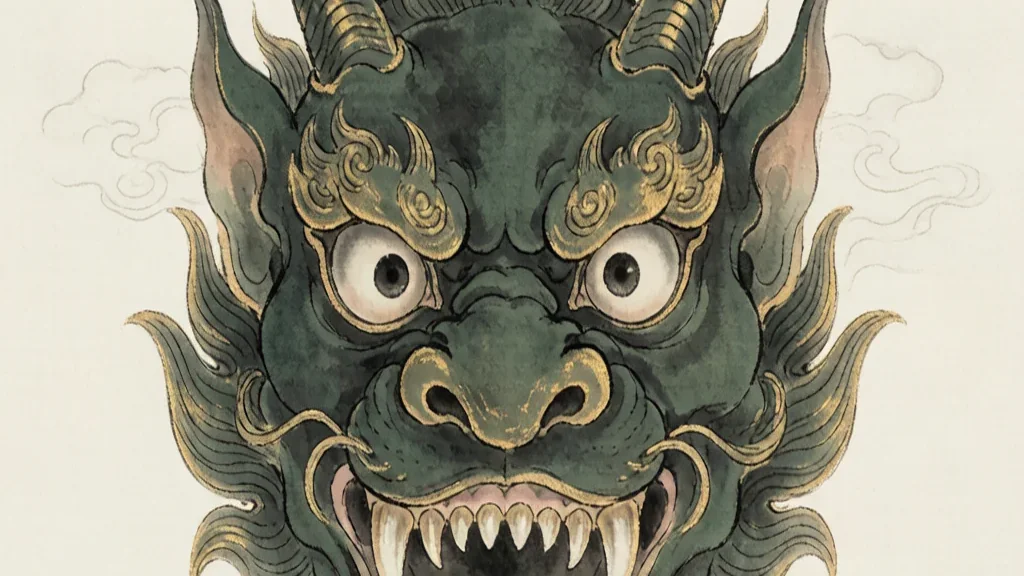
Yazi, a dragon son whose name conveys a narrow-eyed glare of resentment, is among the most martial figures in the family of the Nine Sons of the Dragon. In Chinese myth he is portrayed as a creature resembling a wolf or a small dragon with a fierce temperament, and his defining trait is a love of combat and killing, which is why his image was carved upon the hilts, scabbards, and fittings of swords and other weapons. Where his brother Bixi quietly bore the weight of memory, Yazi loudly announced the readiness for violence, and together the dragon sons mapped the full range of human concern from remembrance to war. To study Yazi is to see how the Chinese decorative tradition turned the appetite for battle into a guarded, almost respectful emblem carried at the side of the warrior and the official alike.
Position Among the Nine Sons
The Nine Sons of the Dragon form a symbolic roster in which each offspring expresses one consuming inclination that dictates where artisans place his likeness. Yazi was the son whose nature turned toward strife, and so his figure was fixed to weapons, where his ferocious aspect was thought to lend the blade both awe and a kind of sanctioned ferocity. The lists of the sons varied between writers and eras, yet Yazi's martial role was stable wherever he appeared, and his name entered the language as a metaphor for the unwillingness to forget a slight or to shrink from a fight. In the visual vocabulary of the dragon family, he was the specialist in the business of the edge.
The number nine, as ever, was less a literal count than a way of saying "many," and the sons together functioned as a catalog of human preoccupations rendered as mythic characters. Yazi represented the preoccupation with honor and vengeance, the conviction that some injuries must be answered. His presence on a weapon thus carried a moral charge: the blade was not merely a tool but an instrument of settled resolve.
Fierce Appearance and Wolflike Form
Yazi is most often described as looking like a wolf or a compact dragon with a pronounced, glaring expression, the very "narrow-eyed" look that his name suggests. Some renditions give him a reptilian dragon's head with a bristling mane and bared teeth, while others lean toward the lupine, emphasizing a lean predatory body. Either way the impression is of a creature primed for aggression, all tension and edge. The carver's task was to make the small figure radiate threat, so that the sword it adorned would seem to carry not only steel but the will to use it.
This fierce look was not gratuitous. A weapon in traditional society was both a practical instrument and a statement of status and intent, and the Yazi at its hilt declared that the bearer was prepared to defend honor and order. The glaring dragon son was the visual equivalent of a challenge and a promise at once, and his small size on the hilt belied the large meaning he carried.
Why Yazi Adorns Weapons
The logic of placing Yazi on weapons follows the principle that a creature should be set where its nature belongs. Just as Bixi belongs under a stele and Bi'an over a court, Yazi belongs on the instrument of combat, because combat is what he loves. Sword hilts, scabbard mounts, and the guards of blades were natural homes for his image, and high-quality weapons, especially those of officers and nobles, frequently bore his carved or cast likeness in bronze, jade, or lacquer. The effect was to sanctify the weapon with the dragon's authority, lifting it from mere iron to a cosmic instrument of force.
In a culture that valued restraint as a virtue, the open celebration of martial ferocity in Yazi might seem contradictory, yet it was understood as bounded aggression. The dragon son loved battle, but he was placed on the weapon of the authorized bearer, the soldier or the magistrate, not on the brigand. His ferocity thus served order rather than chaos, a necessary violence kept on a leash by office and ritual.
Symbol of Martial Resolve
Beyond the literal weapon, Yazi became a literary symbol of unbending determination and the refusal to suffer insult. Idioms built around his name spoke of a person who remembers a grievance and means to answer it, and historical writers used him to characterize commanders of fierce reputation. The symbol allowed praise of martial courage without applauding mere bloodthirst, since Yazi's anger was conceived as principled, directed at the enemy and the dishonorable rather than at the innocent. He was, in this sense, the patron of the just warrior.
The aura of resolve he lent was useful to regimes that needed both civil and military virtue. By honoring Yazi on the arms of officers, the state acknowledged that peace must sometimes be defended by force, and that the dragon's family included a son devoted to exactly that necessity. The martial son completed the dragon's portfolio, balancing the scholar's stele and the judge's glare with the soldier's edge.
Connection to the Culture of the Sword
The sword held a special place in Chinese culture as a weapon of the gentleman, associated with the scholar-official who might also need to act in defense of right. A fine sword was a treasure, often named, praised in poetry, and passed down as an heirloom, and the Yazi on its hilt was part of that prestige. The decorative fitting was not incidental ornament but a claim about the character of the blade and its owner, linking personal honor to the mythic fierceness of the dragon's son.
In martial arts and ritual, the sword also carried symbolic weight as a tool of correction and protection, cutting through disorder both literal and spiritual. Yazi's presence reinforced this symbolism, marking the sword as an instrument aligned with the dragon's cosmic authority. The small guardian thus stood at the intersection of craft, status, and myth.
Evolution in Decorative Art
Over the Ming and Qing dynasties, as the iconography of the dragon sons was codified, Yazi's placement on weapons became a recognized convention taught in workshop manuals and reflected in surviving blades and fittings. Beyond the hilt, his image migrated into other martial and masculine contexts, appearing on belt hooks, armor decorations, and the furnishings of military households. Regional carvers added local accents, but the essential glaring wolf-dragon remained constant, a stable sign of martial temperament across the empire.
With the spread of printed illustrated guides to the dragon's sons, Yazi entered the home as a known character rather than a purely functional fitting. Readers learned to identify him by his glare and his post on the sword, and the martial son took his place in the popular bestiary alongside his more peaceful brothers, a reminder that the dragon's family contained both the keeper of steles and the keeper of blades.
Modern Legacy
Today Yazi survives chiefly as a heritage motif, studied by those interested in Chinese arms, decorative arts, and mythology. Reproductions of traditional sword fittings and illustrations of the Nine Sons keep his glaring face before the public, and he appears in modern retellings of the dragon-son legends for general readers. Though the age of the ornate blade has passed, the idea he embodies, that preparedness and resolve deserve their own emblem, remains intelligible, and his small fierce figure continues to speak for the necessary face of force.
Scholars of material culture read Yazi as evidence of how premodern China visualized the justified use of violence, embedding it in a mythic framework that tied the sword to cosmic order. His image shows that even aggression, in this tradition, was given a place and a meaning rather than left as formless rage, a lesson encoded in the narrow eyes of the dragon's martial son.
Yazi in Literature and Idiom
The name of Yazi entered the Chinese linguistic stock as a metaphor for the unwillingness to forgive or forget a slight, and writers invoked him when characterizing figures of fierce and unrelenting temper. Historical biographies used the image to describe commanders whose resolve was absolute, and moralists cited him as a warning that even justified anger, if unchecked, could curdle into obsession. The idiom built around his narrow-eyed glare thus did double duty, praising martial courage while cautioning against the pride that refuses reconciliation.
This literary life extended the dragon son beyond the hilt of the sword into the realm of character judgment. To call a person Yazi-like was to say that they carried the warrior's edge in their soul, a description that could be compliment or rebuke depending on context. The figure's migration from ornament to idiom shows how thoroughly the nine sons were woven into the fabric of expression.
❓ Frequently Asked Questions
What is Yazi in Chinese myth?
Yazi is a dragon son who loves combat, shown as a wolflike or small dragon, placed on swords and weapons.
Why is Yazi on weapons?
His nature inclined him toward battle, so artisans set his image on hilts to lend the blade ferocity and authority.
What does Yazi look like?
He is described as resembling a wolf or compact dragon with a glaring, narrow-eyed expression.
Is Yazi a symbol of mere violence?
No, his ferocity was understood as principled, serving the authorized warrior rather than chaos.
How does Yazi relate to other dragon sons?
While brothers governed weight, law, or fire, Yazi governed combat and the resolve to answer insult.
Where is Yazi seen today?
He appears in heritage studies of Chinese arms, reproductions of sword fittings, and myth retellings.