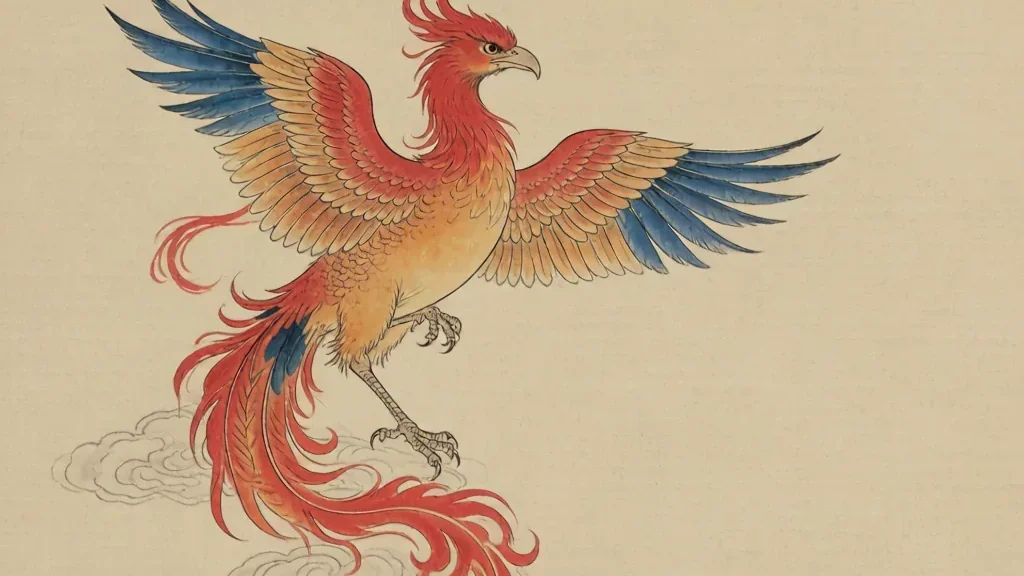
High above the southern sky, a bird of crimson plume and eternal fire spreads wings that never tire. The Vermillion Bird, known as 朱雀 (), is the celestial guardian of the south in Chinese mythology. It is not merely a robin or a sparrow but a majestic phoenix-like creature of flame and song, bound to summer, to the element of fire, and to the warmth that makes life possible. As one of the Four Symbols it completes the quartet of guardians that watch over the directions of the world. To meet the Vermillion Bird is to meet the Chinese idea of vitality itself: brilliant, generous, and forever renewing. This article follows the bird from its starry origin to its place on palace roofs and imperial robes.
The Vermillion Bird Among the Four Symbols
The Vermillion Bird is the southern member of the Four Symbols, the group of celestial guardians that also includes the Azure Dragon of the east, the White Tiger of the west, and the Black Tortoise of the north. Each guardian commands a direction, a season, an element, and a host of stars. The Vermillion Bird commands the south, the season of summer, and the element of fire. Its color, vermillion or cinnabar red, is the color of the midday sun and of festive banners.
Like the others, the bird began as a constellation. Ancient astronomers grouped a set of stars in the southern sky into the shape of a bird, and over time that bird became a living guardian. The southern seven lodges of the twenty-eight lunar mansions form its body in the heavens. To look south on a summer night was, in the traditional view, to see the great red bird wheeling overhead, a fiery calendar that announced the height of the year.
Fire, Summer, and the Sun's Warmth
Fire is the element of the Vermillion Bird, and summer is its season. Where the White Tiger's metal brings the crisp discipline of autumn, the bird's fire brings the lush, generous heat that ripens grain and opens flowers. The south in Chinese geography was the warm, sunny region, and the bird's red glow matched the climate associated with it. The creature therefore stands for growth, visibility, and the outward expression of energy.
This link to fire also gives the bird a connection to the sun. In many cultures a solar bird carries the light across the sky, and the Vermillion Bird plays a similar role in the imagination. It is a creature of dawn-to-dusk brilliance, never dim, never hidden. Its song was said to be so lovely that it could draw other birds to listen, and its appearance was a sign that the ruler's virtue warmed the people as the sun warms the earth.
The Bird and the Phoenix: Clearing the Confusion
Many Western readers call the Vermillion Bird a phoenix, and the comparison is natural, yet the two are not identical. The Chinese phoenix is the 凤凰 (), a separate and very ancient bird of harmony and imperial grace. The Vermillion Bird is a distinct celestial guardian with its own constellation and its own duties. Over the centuries the two images blended in popular art, and a red bird on a roof might be read as either, but in strict myth they keep their own identities.
The difference matters because it shows how Chinese myth loves to layer its symbols. The Fenghuang is a bird of earthly harmony and married virtue, often paired with the dragon as a symbol of emperor and empress. The Vermillion Bird is a creature of the sky's south, a guardian of a direction rather than a emblem of a couple. Knowing the distinction lets a reader enjoy both without confusing the guardian of summer with the king of birds.
Appearance and the Five Sacred Colors
Classical descriptions give the Vermillion Bird a body marked with the five sacred colors and a voice like a flute. It is said to eat the seeds of bamboo and to perch only on the finest trees, so that its presence marks a place of peace and refinement. Its feathers carry the red of fire on top, but the old texts also dress it in the other ritual colors, making it a small encyclopedia of Chinese color symbolism worn as plumage.
The bird's beauty was never merely decorative. In a culture that read meaning into every hue, a creature clothed in all the proper colors was a creature in perfect proportion. The Vermillion Bird thus embodied the ideal that splendor and order are the same thing, that to be radiant is to be correct. When artisans painted it on a beam or embroidered it on a robe, they were not showing off but declaring that the south, and the fire it stood for, were in their rightful place.
The Bird on Roofs, Robes, and Banners
The Vermillion Bird appears across Chinese material culture. It rides the southern slopes of temple roofs, where the four guardians are sometimes placed at the four corners or four sides to protect the building. It appears on royal garments as a mark of southern or summer rites, and on banners carried in ceremonies that honored the directions. Its red figure was a way of inviting the energy of the south into a space without speaking a word.
In the layout of the imperial city, the south was the direction of honor, since the emperor faced south to receive his officials. The Vermillion Bird therefore had a special closeness to the throne. A southern gate, a southern altar, or a southern robe might carry its image, reminding all who entered that they stood in the warm, watched-over quarter of the realm. The bird was at once cosmic and courtly, a star and a seal of state.
Why the Vermillion Bird Still Matters
The Vermillion Bird endures because it names something everyone needs: the faith that warmth and life will return and renew. In an agricultural society summer was the moment of abundance, and the red bird was its emblem, a promise that the sun's work would be done. Today the bird survives in festivals, in the names of places, in dance costumes, and in the visual language of Chinese design, where a sweep of red wings still signals celebration.
More than decoration, the Vermillion Bird teaches that fire is a guardian, not only a destroyer. The south's heat, channeled and honored, feeds the world. To keep the bird in mind is to keep a balance: to let energy show itself, to let summer be summer, and to trust that the brilliant creature wheeling in the southern sky is watching over the warm half of the year. That trust, repeated for two thousand years, is why the Vermillion Bird has never fallen from the sky.
The Vermillion Bird in Poetry and Music
Chinese poets have long used the Vermillion Bird as a shorthand for southern splendor and ardent feeling. Tang and Song lyricists invoked the red bird when describing summer palaces, crimson sunsets, and the flush of love, borrowing its fire to heat up a line. Musicians, too, found the bird useful: the classical string repertoire includes pieces named for the phoenix and the red bird, played on the pipa and guqin to evoke a bright, ascending mood. In the imperial court, ceremonial music for the summer rites was meant to mirror the bird's character, brisk and brilliant. Because the bird stood for visible vitality, it suited any art that wanted to sound or read as alive. Even today, the phrase to rise like the Vermillion Bird appears in songs and slogans about renewal and confident self-expression.
The Bird as a Symbol of Renewal
Beyond its role as a guardian, the Vermillion Bird carries a second meaning that has kept it popular for two millennia: renewal. Fire destroys, but the southern fire also gives life, ripening grain and waking the natural world each year. The bird therefore became an emblem of cycles that end only to begin again, much like the phoenix of other traditions that is reborn from ashes. At weddings and New Year, red bird imagery wished couples and households a fresh start full of energy. In Daoist thought, the creature's seasonal death and return mirrored the breath of the cosmos renewing itself. To keep the Vermillion Bird in mind was to trust that warmth would always come back, that no winter was final, and that every ending in the southern fire prepared the way for a brighter rising.
❓ Frequently Asked Questions
📝 Chinese Vocabulary
朱雀 — : the Vermillion Bird, guardian of the south.
四象 — : the Four Symbols, the four celestial guardians.
凤凰 — : the Fenghuang, the Chinese phoenix of harmony.
南方 — : the south, the direction ruled by the Vermillion Bird.
朱 — : vermillion or cinnabar red, the bird's sacred color.
七宿 — : The seven southern lodges of the twenty-eight lunar mansions that form the bird's constellation.
夏 — : Summer, the season ruled by the Vermillion Bird and the element of fire.
火德 — : The virtue or phase of fire, the cosmic force the Vermillion Bird embodies.
🎉 Fun Facts
- The Vermillion Bird is said to sing so sweetly that all other birds gather to listen, making it a kind of king of songbirds in myth.
- Its constellation forms the seven southern lodges of the twenty-eight lunar mansions used by ancient Chinese astronomers.
- Classical texts say the bird eats bamboo seeds and rests only on the noblest trees, a sign of its refined nature.
- Because the emperor faced south to rule, the Vermillion Bird was the guardian closest to imperial authority.
- In traditional cosmology the Vermillion Bird is the guardian of the south and the element of fire, and its red color was linked to the heart, the organ associated with summer and warm vitality.
- During summer rites such as the Duanwu Festival, red banners and images of the bird were displayed to welcome the height of the year's warmth and to honor the southern quarter of the sky.