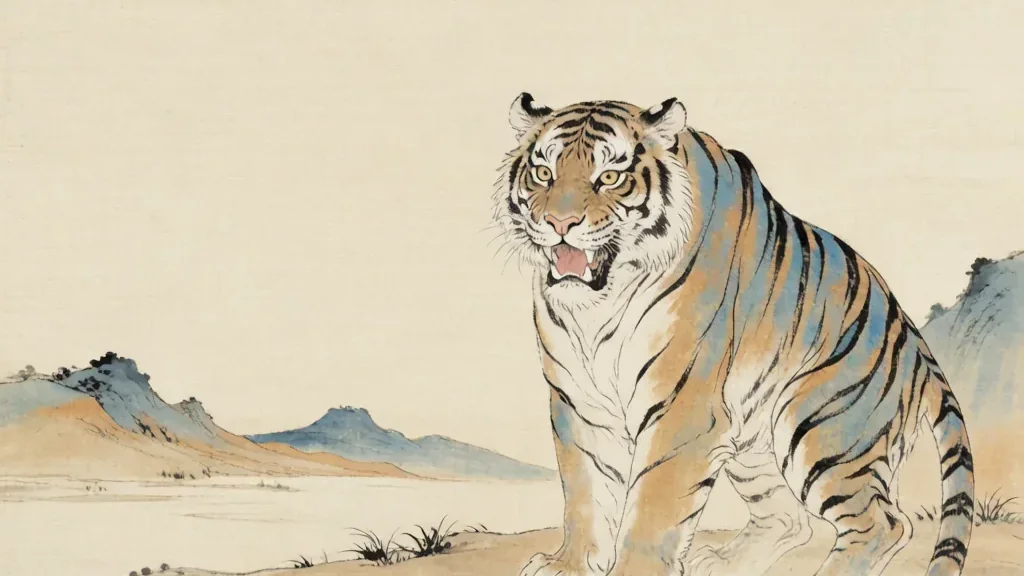
In the Chinese imagination the four directions are guarded by four powerful creatures, and the ruler of the west is a great white beast with stripes like cloud and eyes like cold stars. The White Tiger, called 白虎 (), is one of the most revered animals in Chinese myth. Unlike the familiar orange tiger of the forests, this celestial tiger is a being of metal, of autumn, and of the setting sun. It stands as a protector against evil and a symbol of righteous strength. To explore the White Tiger is to enter the heart of Chinese cosmology, where animals are not mere animals but living signs of the order of the universe, and where the west is a place of both endings and honored rest.
The White Tiger Among the Four Symbols
The White Tiger belongs to a group known as the Four Symbols, the four celestial guardians who divide the sky and the earth into regions. The White Tiger rules the west; the 青龙 (), the Azure Dragon, rules the east; the Vermillion Bird rules the south; and the Black Tortoise rules the north. Each guardian is tied to a season, an element, a color, and a constellation. The White Tiger's season is autumn, its element is metal, and its color is white, the color of the bright, shortening days and of polished bronze weapons.
These four were not invented as decoration. They grew from the practice of dividing the night sky into quarters, each marked by a pattern of stars. Over centuries those star patterns became animals, and those animals became guardians of the realms below. The White Tiger therefore lives twice: once as a constellation in the western sky and once as a spirit who walks the western lands, keeping watch over the boundary where light gives way to dusk.
Element, Season, and the Power of Metal
In the system of the Five Elements the White Tiger is bound to metal, the element associated with the west and with autumn. Metal suggests sharpness, clarity, and the harvest that must be cut and gathered. Autumn is the season of gathering in, of reaping what was sown, and of preparing for the cold. The tiger's nature fits this perfectly: it is a hunter, precise and decisive, and its white coat reflects the pale light of autumn afternoons.
The metal association also connects the tiger to weapons and to the virtue of justice carried out without flinching. Where the dragon of the east brings the rain of spring, the tiger of the west brings the clean, bracing edge of discipline. In art the two are often shown together, dragon and tiger, as a pair of balanced forces, the one rising and the other steadying, the one soft and the other hard. Together they express the Chinese love of contrast held in harmony.
Protector Against Evil and the Army's Emblem
Above all the White Tiger is a guardian. It was believed to drive away evil spirits and to defend the home, the tomb, and the state. Soldiers and generals took the tiger as an emblem of courage, and commands and tallies of authority were sometimes made in the shape of a tiger, a "tiger tally" that proved an order came from the throne. To carry the tiger's sign was to carry the right to act in the name of order.
This protective role made the White Tiger a natural figure for graves and temples. Carved tigers guarded the paths of the dead so that wandering spirits could not disturb their rest, and painted tigers watched over the gates of important buildings. The beast's terrifying beauty was not meant to frighten the worthy but to warn the wicked. In this sense the tiger is less a monster than a policeman of the cosmos, appointed to keep the peace of the west.
The Tiger in Han Tombs and Star Lore
Archaeologists have found the White Tiger represented in the frescoes and carved tiles of Han dynasty tombs, where it often appears alongside the other three symbols marching across the walls of the burial chamber. These images were not simply pretty; they mapped the universe around the dead person, ensuring that the four guardians enclosed the tomb as they enclosed the world. To be buried within the four symbols was to be placed safely at the center of creation.
The constellation of the White Tiger, known as the seven western lodges, was one of the twenty-eight lunar mansions used by astronomers to track the moon and the seasons. Each lodge had its own name and animal, but together they formed the tiger's shape in the sky. Farmers and officials alike could look west on an autumn night and find the great cat stretched among the stars, a calendar written in light that told them when to reap and when to rest.
The White Tiger Versus the Azure Dragon
No discussion of the White Tiger is complete without its great counterpart, the Azure Dragon of the east. The two appear together so often that they seem like two halves of a single thought. The dragon is associated with water, spring, wood, and the rising sun; the tiger with metal, autumn, and the setting sun. One is sinuous and yielding, the other solid and abrupt. In martial arts and in alchemy the pair stands for the balance that a practitioner must achieve, neither force conquering the other but each keeping the other honest.
This balance is the deeper message of the White Tiger. It is not celebrated because it is the strongest of the four, but because it knows its place. It governs the west as the dragon governs the east, and neither trespasses. The Chinese cosmos is a council of powers, not a hierarchy of one, and the tiger's white stillness complements the dragon's blue motion. To honor the tiger is to honor the discipline that lets any system, from a body to an empire, hold together.
A Symbol That Endures
The White Tiger remains alive in Chinese culture today. It appears in festivals, in the names of athletes and businesses, in movies about gods and demons, and in the familiar New Year prints pasted on doors to keep the household safe. The year of the tiger in the zodiac, though it refers to the ordinary tiger, draws on the same reservoir of awe. The celestial white version, with its autumn light and its watchful gaze, continues to stand for protection earned through strength used rightly.
What makes the White Tiger endure is that it answers a need older than any dynasty: the need to believe that somewhere a power watches the dark and will not let chaos in. Whether carved in a Han tomb or printed on a modern poster, the white beast with the striped coat tells the same story. The west has its guardian, the autumn has its king, and the boundary between order and disorder is defended by a creature who asks only that we, too, stand our ground.
The White Tiger in Later Art and Opera
After the Han dynasty, the White Tiger moved from tomb walls into the full repertoire of Chinese visual and performing arts. Painters of the Tang and Song periods set the beast among autumn maples and cold streams, using its white body to balance the warm reds of the Vermillion Bird on the same scroll. In Sichuan and Shaanxi, shadow-puppet troupes staged stories of the tiger guardian defending the western gate against demon armies. Operatic generals entering in white face paint and tiger-motif armor invoked the creature's disciplined ferocity before a battle scene. Folk carvers placed small white tigers at the corners of wooden chests and door lintels to carry the guardian's protection into daily objects. Across these forms the tiger kept one role: the quiet, watchful power that stands at the boundary and lets nothing harmful cross.
Warding Evil at the Threshold
The White Tiger's most enduring job is guardian of the threshold. In traditional homes, a pair of stone or painted tigers often flanked the main gate, their gazes turned outward to meet any approaching misfortune. Unlike the cheerful New Year door gods, the tiger's protection was meant to be constant, not seasonal, a year-round ward against thieves, illness, and wandering spirits. Graves received the same care: a tiger carved at the tomb's western side reminded the dead that the guardian of the west was on watch. Even today, in parts of north China, families hang a small tiger charm at the door for a newborn, trusting the beast to keep the child safe. The logic is old and simple: evil flees from strength it cannot bribe, and the White Tiger is strength made into a sentinel.
❓ Frequently Asked Questions
📝 Chinese Vocabulary
白虎 — : the White Tiger, guardian of the west.
四象 — : the Four Symbols, the four celestial guardians.
青龙 — : the Azure Dragon, guardian of the east.
虎符 — : the tiger tally, a token of military command.
西方 — : the west, the direction ruled by the White Tiger.
金 — : Metal, the element linked to the White Tiger and the west.
秋 — : Autumn, the season ruled by the White Tiger.
西宫 — : The Western Palace, the celestial quarter guarded by the White Tiger.
🎉 Fun Facts
- The White Tiger is one of the twenty-eight lunar mansions, a constellation system ancient astronomers used to track the moon across the seasons.
- In Han dynasty tombs the four guardians were often painted on the chamber walls to enclose the dead safely within the order of the universe.
- The tiger and dragon pairing is so central that it appears in Chinese martial arts as a model of balanced internal energy.
- A white tiger is extremely rare in nature, which may be why the celestial white version feels so special and portentous in myth.
- Farmers once read the White Tiger constellation in the western autumn sky as a calendar, using its rising and setting to know when to harvest and when to rest, long before printed almanacs existed.
- In some regional folk beliefs, seeing a white tiger in a dream was taken as a sign of an approaching noble visitor or a turn of martial fortune, since the beast was both a warrior's patron and a guardian of the west.