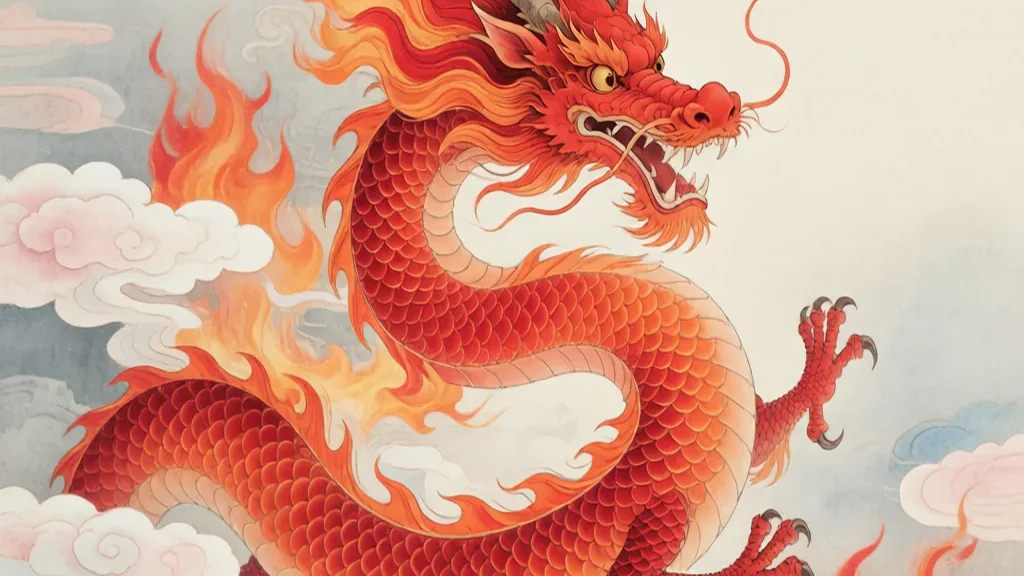
The chi dragon, written in Chinese as 螭龙 and commonly romanized as chi long, is one of the most distinctive and enduring dragon forms in the long history of Chinese art and mythology. Unlike the familiar sinuous imperial dragon with branching horns, the chi is conventionally described as a hornless dragon, usually shown with a flattened, coiling body, a broad blunt head, and a lively arched profile. For more than two thousand years this creature has served as a favorite decorative motif on jade ornaments, bronze vessels, roof tiles, and stone architecture, where it is most often associated with water, rainfall, and protection. The chi dragon occupies an important place in the classical Chinese vocabulary of dragon kinds, sitting alongside such forms as the jiao, the qiu, the pan, the ying, and the azure and yellow dragons. Although it is sometimes confused with the so-called nine sons of the dragon, the chi is better understood as a separate visual and symbolic category: a water-loving, hornless dragon whose appeal lay in its graceful scrolling shape and its reassuring role as a guardian of buildings, tombs, and precious objects.
What the Chi Dragon Looks Like
The most recognizable feature of the chi dragon is the absence of horns. Where the fully developed imperial long is equipped with a pair of antler-like horns, the chi is depicted with a smooth head, a short muzzle, and large round or almond-shaped eyes that give it an alert, almost playful expression. Its body is typically rendered as a series of tight C-shaped or S-shaped coils, more compact and less elongated than the winding celestial dragon of later painting. Early examples often show the creature with a single visible foreleg hooked over the edge of a jade disc or the rim of a bronze vessel, as though it were clambering along the surface.
Art historians note that the chi dragon shares many traits with the related gong dragon and with the early coiled dragon motifs of the Neolithic period, but it developed its own canonical look during the Warring States and Han dynasties. The creature frequently appears in profile with an open mouth, a curled upper lip, and a tail that terminates in a small spiral. These conventions were so stable that a viewer familiar with Han jade can usually identify a chi dragon at a glance even when the carving is only a few centimeters across.
In three-dimensional works the chi is sometimes shown with small wings or with a ridged spine, but the defining cue remains the head without horns. This visual shorthand let craftsmen signal "dragon" without invoking the full apparatus of the supreme celestial beast, a useful distinction when decorating objects meant for the elite but not for the throne.
Hornless Versus Horned Dragons
Classical Chinese writing preserves a whole taxonomy of dragon types distinguished by physical features, and the presence or absence of horns is central to that system. The chi is the hornless member of the family, contrasted with forms such as the jiao, which is described in commentaries as bearing horns, and with the mature heavenly dragon that carries the full horned and whiskered appearance. The Erya, an early Chinese dictionary, and later lexicographers record these distinctions, and medieval scholars used them to explain puzzling passages in poetry and ritual texts.
This taxonomy was never perfectly consistent across centuries, and different authors assigned the hornless label to slightly different creatures, sometimes to the qiu or to juvenile dragons. What remained stable was the broader idea that dragons came in graded forms, from the hidden and limbless to the fully manifested and horned, with the chi occupying the elegant middle ground of a water dragon that had not yet grown its horns. That gradation reinforced a common mythological theme: dragons as beings capable of transformation and growth.
The hornless status also carried symbolic weight. A horned dragon could stand for heavenly authority and imperial majesty, while a hornless chi could stand for the gentler, more approachable powers of water and fertility that ordinary people might hope to attract into their homes and fields.
Early Appearances in Jade and Bronze
The chi dragon first becomes abundant as a motif during the Eastern Zhou, Warring States, and Han periods, when jade workers and bronze casters adopted it with enthusiasm. Jade bi discs, huang arcs, and pendant ornaments were carved with chi dragons creeping around their edges, and the creature's coiling shape proved ideal for filling the curved borders of circular and semicircular forms. The hardness of jade and the difficulty of the scrolling design made chi-dragon jades prestigious objects, often placed in tombs as signs of status and as protective companions for the dead.
On bronze ritual vessels of the same era the chi appears as a low relief band, sometimes so abbreviated that it reads almost as abstract cloud scroll. Cast bronze mirrors of the Han dynasty frequently carry a chi dragon among their decorative fields, paired with a tiger or with auspicious beasts, and the creature's role there is apotropaic: it guards the shiny surface that was thought to reveal hidden truths and to ward off malign influences.
These early appearances established the chi dragon as a creature of refinement rather than of raw cosmic force. It belonged to the visual world of the aristocracy and the literate, and its presence on an object signalled both wealth and good taste.
The Chi Dragon in Architecture
As Chinese architecture matured, the chi dragon migrated from small objects to large surfaces. Carvers placed chi dragons on the sloping ends of roof ridges, on stone door knockers, on the faces of monumental gateways, and on the balustrades of bridges and terraces. In these settings the creature usually appears in low relief or in the round, half hidden among scrolling waves, evoking its identity as a master of water who could be asked to control floods and to bring timely rain.
A particularly common architectural use is the water-spouting or sill dragon, a carved beast set at the corners of drains and eaves so that rainwater appears to pour from its mouth. By giving the outflow a dragon's head, builders turned a practical drainage feature into a miniature ritual: the building itself seemed to exhale water through a friendly guardian rather than merely leaking. The chi was a natural choice for this role because of its long association with rivers and rainfall.
In garden design the chi dragon also appears coiled around the bases of steles and around the columns of pavilions, where it continues the old function of protecting valued structures and the inscriptions they carry.
Water, Rain, and Fertility
The chi dragon's deepest mythological identity is as a creature of water. Chinese dragons in general are masters of seas, lakes, rivers, and rain, and the hornless chi is especially linked to the moving, useful waters of rivers and irrigation rather than to the distant ocean palaces of the great long. Farmers and local communities could appeal to such water dragons for rain during drought and for restraint during flood, and the chi's image on a well, canal, or field shrine served as a constant petition.
This watery role explains why the chi so often coils among wave motifs and why it pairs naturally with lotus, fish, and frog imagery in decorative schemes concerned with abundance and growth. The dragon that commands rain is also, by extension, a patron of the crops and of human fertility, and small chi-dragon charms were sometimes kept by women or placed in nuptial contexts as quiet symbols of prosperity and many descendants.
The link between the chi and water also made it a fitting ornament for scholar-official culture, since control of water was a cardinal test of good government in the Confucian political imagination. A well-governed realm, like a well-drained building, let the dragon's water flow where it was wanted and nowhere it was not.
The Chi Dragon and the Nine Dragon Sons
Modern writers sometimes list the chi dragon among the nine sons of the dragon, but this is a later simplification that the evidence does not fully support. The celebrated list of the dragon's nine sons, a medieval and late-imperial compilation, names creatures such as the bixi, the chiwen, the pulao, the bi'an, the yazi, the suanni, the jiaotu, the gongfu, and the taotie, almost none of which is identical with the classical chi. The confusion arises because several of the nine sons are themselves dragon-like water or roof guardians, and because popular books have blurred the boundary between "a dragon form" and "a dragon's offspring."
It is more accurate to say that the chi belongs to the broader bestiary of dragon kinds, while the nine sons are a separate, partly humorous catalog of hybrid creatures placed on buildings and objects to perform specific jobs. The chiwen that caps a roof ridge, for example, is a dragon-child devoted to swallowing flames and protecting against fire, a different job and a different iconography from the coiling hornless chi of jade and bronze.
Recognizing the distinction matters for anyone studying Chinese material culture, because it prevents the false assumption that every small dragon ornament is a reference to the nine sons. Many are simply chi dragons doing the work they have done for two millennia: looking after water and guarding precious things.
Imperial and Elite Patronage
Although the fully horned five-clawed dragon became the near-exclusive emblem of the emperor in the Ming and Qing periods, the hornless chi remained available to a much wider range of patrons. Its lesser status, paradoxically, made it useful: officials, merchants, and gentry could decorate their homes and possessions with chi dragons without overstepping the strict sumptuary laws that reserved the grand imperial dragon for the throne and its immediate circle.
This social flexibility helps explain the chi's extraordinary persistence. While the great long was bound up with sovereignty and was therefore politically sensitive, the chi could appear on a scholar's brush pot, a lady's hairpin, a temple railing, or a tomb brick without attracting censure. It became a kind of universal decorative currency, understood by everyone yet claimed by no single rank.
At the same time, the chi was not merely common. Its appearance on high-quality jade and on imperially commissioned architecture shows that it retained elite cachet; it was simply a safer and more versatile dragon than its horned cousin.
Chi Dragons in Decorative Arts
Beyond jade, bronze, and architecture, the chi dragon spread into nearly every decorative medium of the late imperial craft economy. Porcelain painters of the Ming and Qing drew scrolling chi dragons in underglaze blue, often chasing or flanked by flaming pearls across the curved walls of jars and bowls. Lacquer workers carved the creature into cinnabar trays, and ivory and bone carvers used its coiling body to animate the handles of small implements.
In textiles the chi appears among the auxiliary dragons that fill the ground of robes and hangings, smaller and less formal than the central imperial dragon yet clearly part of the same family. Furniture makers in the south carved chi dragons into the crestrails of chairs and the panels of cabinets, where the creature's looping line suited the joined and curved members of fine woodwork.
The chi also lent its name and shape to utilitarian objects such as the chi dragon inkstone and the chi dragon water dropper used by painters and calligraphers, linking the water dragon directly to the arts of the brush and reinforcing its association with the cultivated life.
The Chi Dragon in Later Folklore
By the late imperial and modern period the chi dragon had faded as a focus of active worship but remained vivid in visual habit and in language. The term chi long survived in the names of objects and patterns, and craftsmen continued to carve and paint the form long after the cosmological theories that first explained it had become the concern of specialists. In popular building practice the hornless dragon was simply "the little water dragon," a benign presence rather than an object of prayer.
Folklorists collecting in the nineteenth and twentieth centuries found that many villagers could name the dragon but could no longer say why it lacked horns, a reminder that decorative motifs often outlive their original theology. The chi persisted because it was useful and beautiful, not because anyone enforced belief in it.
Today the chi dragon enjoys a quiet revival as a heritage motif, reproduced on jewelry, souvenirs, and museum merchandise, where its compact coiling shape reads clearly even at small scale and where its hornless, friendly look suits a modern taste for auspicious but approachable symbols.
❓ Frequently Asked Questions
What is a chi dragon?
A chi dragon is a hornless, coiling Chinese dragon form traditionally associated with water, rain, and protection, widely used as a decorative motif on jade, bronze, and architecture.
How is the chi different from other dragons?
Its defining feature is the absence of horns, and its body is usually shown in compact scrolls rather than as a long winding celestial dragon.
Is the chi one of the nine sons of the dragon?
Not really; the nine sons are a separate catalog of hybrid guardian creatures, and the classical chi is better treated as its own dragon kind.
Why was the chi used on buildings?
As a water dragon it was thought to control flooding and bring rain, and its image on drains and ridges turned practical features into protective charms.
Could common people use the chi dragon?
Yes, because sumptuary laws reserved the horned imperial dragon for the throne, the hornless chi was available to officials, merchants, and gentry.
Where do we see chi dragons today?
They survive on museum jades and bronzes, on heritage architecture, and on modern jewelry and souvenirs inspired by traditional motifs.