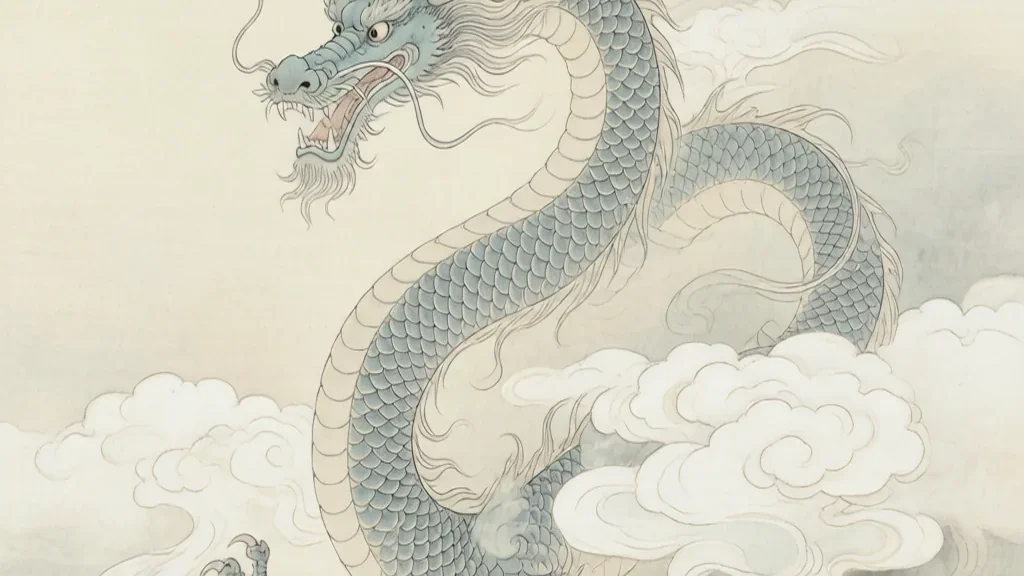
The Azure Dragon of the East — known in Chinese as Cang Long (苍龙) or Qing Long (青龙) — is the celestial guardian of the eastern quadrant of the sky, the embodiment of spring, the wood element, and the rising, life-giving force of yang. Unlike the familiar imperial dragon of legend, the Azure Dragon is first and foremost a constellation: a band of stars whose slow turning across the heavens marked the seasons for early Chinese astronomers and whose coiling form became one of the four great protective powers of the cosmos.
A Constellation, Not Merely a Beast
The Azure Dragon is built from the eastern group of the Twenty-Eight Mansions (二十八宿), the ancient Chinese system of lunar lodges used to map the sky. Its body is formed by seven mansions: Horn (角 Jiao), Neck (亢 Kang), Root (氐 Di), Room (房 Fang), Heart (心 Xin), Tail (尾 Wei), and Winnowing Basket (箕 Ji). Together these star groups trace the outline of a coiling dragon stretched along the spring sky.
The Heart mansion (Xin, 心), also called the "Great Fire" (大火, Da Huo), is the brightest and most important of the seven — the red giant star Antares, which early astronomers watched closely because its heliacal rising in early summer announced the proper time for planting. Both the Records of the Grand Historian (史记·天官书) by Sima Qian and the Huainanzi describe these eastern lodges as the dragon's body, fixing the Azure Dragon firmly in the astronomical literature.
One of the Four Symbols
The Azure Dragon is the eastern member of the Four Symbols (四象), the four mythological guardian beasts that divide the sky and the cosmos into quarters. It is paired with the Vermilion Bird (朱雀, south/fire/summer), the White Tiger (白虎, west/metal/autumn), and the Black Tortoise-and-Serpent (玄武, north/water/winter). A fifth guardian, the Yellow Dragon (黄龙), is sometimes added at the center as the earth element.
In this scheme the Azure Dragon governs the east, the wood element, and the spring season. It personifies the yang energy that surges upward at the start of the year — growth, germination, rain, and renewal. Tomb murals of the Han dynasty (206 BCE–220 CE) routinely show the Azure Dragon painted on the eastern wall of a burial chamber, facing the White Tiger on the west, so that the deceased rested between the two protective cosmic powers.
The Seasonal Turning of the Sky
Because the eastern dragon's stars rise and set across the year, they served as a celestial calendar. In the second month of spring the dragon's "horn" mansion (Jiao) first becomes visible at dawn — an event still celebrated as "the dragon raises its head" (龙抬头, Long Tai Tou) on the second day of the second lunar month, when people cut their hair and eat noodles shaped like dragon whiskers.
By midsummer the Heart mansion dominates the southern sky; by autumn the dragon has sunk below the western horizon, "hiding its head," a signal that the work of the fields should give way to harvest. This astronomical rhythm is exactly why the Azure Dragon is so tightly bound to weather, rainfall, and the fertility of the land.
Yang, Rain, and the Dragon Kings
As a yang creature of the wood element and the east, the Azure Dragon is naturally associated with clouds, rain, and thunder — the forces that make the spring growing season possible. It stands at the head of the long Chinese tradition of dragon-rain imagery, the dragon as the sky-borne mover of storms.
Over the centuries the cosmic Azure Dragon blended with the popular figure of the Dragon King (龙王), the local river and sea deities who control rainfall. While the Dragon Kings are a later, more folk-religious development, the Azure Dragon remains their noble ancestor in the celestial hierarchy — the original heavenly dragon (天龙) whose movement summons the rains that awaken the year.
In Art, Architecture, and Ritual
The Azure Dragon appears on Han dynasty stone reliefs and tomb tiles, on Tang and Song dynasty murals, and as a carved or painted figure on the east-facing walls and eaves of temples, city gates, and imperial buildings. It is most often shown coiling, blue-green (qing/azure) in color, sometimes clutching a flaming pearl between its claws.
In feng shui the Azure Dragon is the "Green Dragon" who sits on the left (east) side of any site. The classic ideal holds that the dragon side should be slightly higher and more vigorous than the White Tiger on the right, so that protective yang energy embraces the dwelling. This left-dragon, right-tiger arrangement has shaped the siting of traditional courtyards, villages, and graves for two thousand years.
Legacy in Modern Culture
The Azure Dragon survives today as the eastern sign among the Chinese cosmos's four guardian beasts and as a recurring motif of spring festivals. It lends its name to the "Azure Dragon" posture in martial arts and to place names scattered across China, from streets to mountain passes.
In popular culture — films, animated series, games, and novels about Chinese mythology — the Azure Dragon frequently appears as the eastern guardian of the four directions, a role that keeps this ancient constellation alive in the modern imagination long after its stars first told farmers when to plant.
Mapping the Dragon Stars
Chinese astronomers divided the eastern sky into seven mansions whose stars were imagined as a coiled dragon: Horn, Neck, Root, Room, Heart, Tail, and Winnowing Basket. By noting which mansions were visible at dusk each month, court astronomers tracked the seasons and advised the emperor on rituals. The Heart mansion, called the 'fire star,' was especially watched for drought omens, linking the celestial dragon to practical state weather forecasting. The system was so precise that the official calendar, issued each winter, could name the exact night a given mansion would stand due south. Star charts in tombs such as that of the Marquis of Dai show the Azure Dragon painted along the eastern wall, proving the scheme was already fixed by the Han. For two thousand years this dragon map stayed the backbone of Chinese sky-watching.
From Sky to Festival
The Azure Dragon's yearly cycle survives in folk custom as the Long Tai Tou festival on the second day of the second lunar month, when the dragon's head is said to lift from the earth. People cut their hair for luck, eat dragon-themed foods, and perform dragon dances to invite rain. Though originally an astronomical event, the symbol now anchors one of the most widespread spring celebrations in northern China. Villages stage long dragon processions with paper and cloth bodies borne on poles, while children wear dragon-head hats to share the beast's vitality. Agricultural almanacs still mark the day as the proper time to repair wells and start spring ploughing. The festival thus carries the old star-calendar into modern rural life, reminding farmers that the dragon who rules the eastern sky is also the power that wakes the fields after winter.
❓ Frequently Asked Questions
📝 Chinese Vocabulary
苍龙 — : Azure Dragon; the eastern celestial dragon of the Four Symbols.
青龙 — : Green/Blue Dragon; an alternative name for the Azure Dragon.
四象 — : Four Symbols; the four directional guardian beasts of Chinese cosmology.
东方七宿 — : Eastern Seven Mansions; the stars that form the dragon's body.
角宿 — : the Horn lunar mansion, marking the dragon's horns
东方 — : the east direction ruled by the Azure Dragon
春分 — : the spring equinox, when the dragon rises in the sky
七宿 — : the seven eastern mansions forming the dragon's body
🎉 Fun Facts
- The Heart mansion (Xin) of the Azure Dragon is the star Antares, one of the brightest stars visible from China.
- The "dragon raises its head" (Long Tai Tou) festival on the 2nd day of the 2nd lunar month celebrates the Azure Dragon's horn star rising at dawn.
- Han dynasty tombs placed the Azure Dragon on the eastern wall and the White Tiger on the western wall to guard the dead between them.
- The Azure Dragon is the only one of the Four Symbols directly tied to a seasonally rising constellation used as an agricultural calendar.
- The Azure Dragon's body is traced across seventeen stars of the eastern sky, and its head 'lifting' at the spring equinox marked the time to begin plowing in early China.
- The saying 'the dragon raises its head on the second day of the second month' (Long Tai Tou) refers to the reappearance of the Azure Dragon's stars, still celebrated with haircuts and spring festivals.