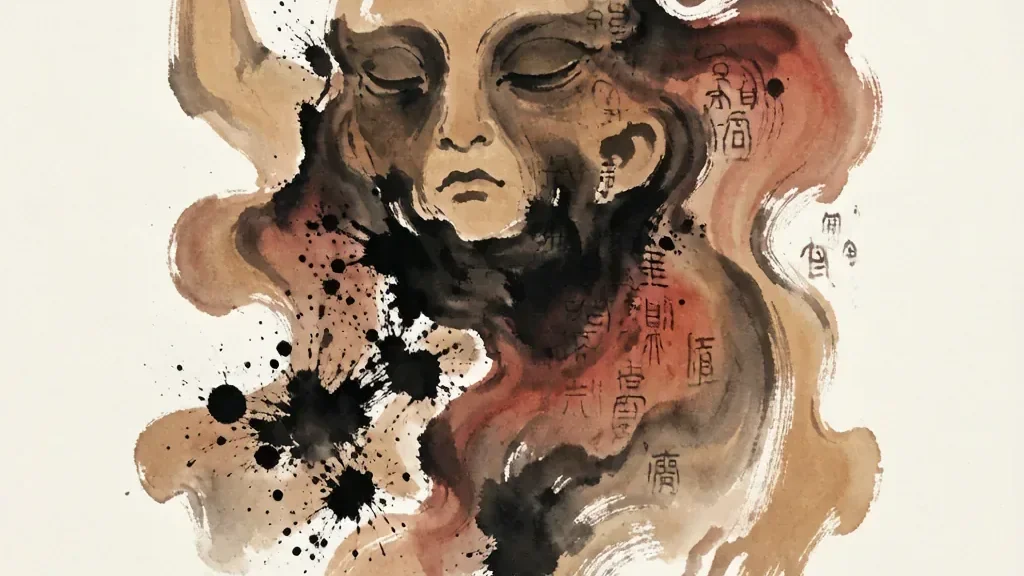
Hundun (混沌, hùn dùn) is the primordial chaos that existed before heaven and earth, before yin separated from yang, and before the first distinctions of creation appeared. In Chinese cosmology, mythology, and Daoist philosophy, Hundun is not a monster to be slain but the undifferentiated wholeness from which all things emerge — a being without face, without sensory openings, without the categories that define ordinary existence. The most famous telling comes from the Zhuangzi, where Hundun, the Emperor of the Center, dies the very day that well-meaning friends bore seven openings into his formless body. That short parable captures a central Daoist insight: to carve order into the primal unity is also to destroy it. Across two thousand years, Hundun has appeared as a cosmic egg, as one of the Four Fiends, and as a living metaphor for the return to undifferentiated truth.
Hundun in the Zhuangzi Parable and Daoist Philosophy
The best-known literary treatment of Hundun appears in Chapter 7 of the Zhuangzi (应帝王, "Responses of the Emperors and Kings"), a foundational Daoist text compiled around the 3rd century BCE. The parable is brief but haunting. The Emperor of the South Sea was named Shu (倏, "Swift"), the Emperor of the North Sea was Hu (忽, "Sudden"), and the Emperor of the Center was Hundun (混沌, "Chaos"). Shu and Hu often met in Hundun's realm and were treated with open generosity. Wishing to repay him, they said: "All men have seven openings so they can see, hear, eat, and breathe — Hundun alone has none. Let us bore some for him." Each day they drilled one opening, and on the seventh day Hundun died.
The sinologist A.C. Graham read the parable as an allegory of the Dao itself: the ineffable unity that cannot be grasped through the senses or carved into words without being annihilated in the process. The very names matter — Shu (swift) and Hu (sudden) represent the hurried, differentiating activity of ordinary cognition, while Hundun stands for the patient, undivided source. For later Daoists, the story became a warning against forcing artificial order onto what should remain whole, and a quiet endorsement of the "uncarved block" (朴, pǔ) as the highest state of being.
Cosmological Context: Hundun and Chinese Creation Myths
The Hundun concept sits at the heart of several Chinese accounts of how order arose from formlessness. The Huainanzi (淮南子), compiled in 139 BCE under Prince Liu An of Huainan, describes the world before heaven and earth took shape as a "deep and dark abyss, a chaotic mass" called the Great Beginning (太始), from which the dual forces of yin and yang slowly coalesced. The third-century CE text Sanwu Liji (三五历纪), attributed to Xu Zheng, gives the related myth of Pangu (盘古), who grew for 18,000 years inside a cosmic egg ensconced within Hundun before splitting it apart to fashion heaven and earth from its two halves.
In these narratives Hundun is the womb-like precondition of creation rather than a creator with a will. It is the "uncarved" antecedent state — neither good nor evil, neither bright nor dark — out of which polarity and then the ten thousand things unfold. This makes Hundun fundamentally different from the personal creator-gods of many other traditions: it is a condition, a matrix, almost a grammatical subject that precedes subjects and objects alike.
Hundun Among the Four Fiends
Paradoxically for a figure of such philosophical elegance, Hundun is also listed as one of the Four Fiends (四凶, sì xiōng) — the quartet of chaos-bringers that includes Taowu (梼杌), Qiongqi (穷奇), and Taotie (饕餮). In the Shanhaijing (山海经, "Classic of Mountains and Seas") and in later historical moralizing, Hundun appears as a destructive, disorderly power that the sage-king Shun is said to have exiled to the four frontier regions to keep the world in order. The scholar Yuan Ke, in his Dictionary of Chinese Myths and Legends (中国神话传说, 1985), treats this "fiend" Hundun as a separate strand from the Daoist "cosmic whole" Hundun — evidence of how one name gathered contradictory meanings over the centuries.
This dual identity is itself instructive. The same word can denote both the sacred primordial unity treasured by Daoists and the antisocial disorder feared by Confucian administrators. The difference lies entirely in perspective: what is wholeness to the mystic is anarchy to the ruler. Hundun thus became a kind of mirror in which each school of thought saw its own attitude toward order and spontaneity reflected back.
Hundun in Comparative Mythology and Religious Studies
Primordial chaos is nearly universal in world mythology, and Hundun invites revealing comparisons. Hesiod's Theogony (circa 700 BCE) opens with Chaos, the yawning void from which Gaia and everything else emerged — a generative matrix much like Hundun. The Babylonian Enuma Elish describes the primordial waters of Tiamat, a chaos-monster whose body is split to make heaven and earth, structurally close to the Pangu myth. The Norse Ginnungagap, the yawning gap between fire and ice, offers another parallel. What sets Hundun apart is its specifically Daoist framing, which elevates chaos from a problem to be overcome into a state to be cherished.
The American scholar Norman Girardot, in his 1983 monograph Myth and Meaning in Early Daoism, argued that Hundun encodes a "myth of return" — the Daoist aspiration to go back to undifferentiated wholeness, free from the artificial distinctions of society and language. The French sinologist Marcel Granet, in La Pensée Chinoise (1934), used the Zhuangzi parable to contrast Chinese correlative thinking with Western analytical logic. These readings turned a cryptic fable into a cornerstone of how the West came to understand Chinese thought.
The Hundun Motif in Literature, Art, and Popular Culture
Beyond philosophy, Hundun has inspired a long tradition of expression. The Tang poet Li Bai (701–762) invoked Hundun imagery in his "Hard Roads in Shu," describing the primordial landscape of Sichuan as "Hundun not yet opened" to convey its rugged, untamed character. The Ming novel Journey to the West (1592) has the Monkey King meditate on the nature of Hundun during his training under the Daoist sage Subhuti. In painting, Song artist Mi Fu (1051–1107) developed a misty, indistinct landscape manner that later critics read as a visual meditation on the Hundun aesthetic — form dissolving into cloud.
Modern Chinese science fiction has reclaimed the term with striking literalness. Liu Cixin's Three-Body Problem trilogy uses "hundun" (乱纪元 / chaotic eras) for the unpredictable periods of the Trisolaran world, and contemporary physics popularizers have drawn explicit analogies between ancient Chinese cosmology and models of the early universe. A 2018 proposal by mathematician Shing-Tung Yau and physicist Andrew Strominger even sketched a "Hundun" model for the initial conditions of the Big Bang, deliberately echoing the classical name for the formless beginning.
The Parable of the Holes
The fullest version appears in the Zhuangzi: Hundun, emperor of the center, warmly hosted Shu (South) and Hu (North). Grateful, they decided he lacked the seven openings others enjoy, so day by day they drilled one, and on the seventh Hundun died. The story is a Daoist critique of forced improvement and of 'opening' what is whole by nature. It teaches wu-wei, that not everything benefits from being made more like everything else. Read plainly, the fable warns reformers that good intentions can kill the very thing they wish to help, a point the Zhuangzi makes with deadpan comedy. Later commentators saw in it a defense of natural spontaneity against rigid ritual, and of the undivided mind against the scattering of the senses. Few parables in the Chinese tradition compress so much philosophy into a single quiet disaster caused by kindness.
Chaos Before Creation
Beyond the fable, Hundun names the undifferentiated primal state before the world took form, a cloudy oneness from which the separation of heaven and earth emerged. The Huainanzi and later cosmologies place this chaos at the root of time, sometimes equated with the material Pan Gu woke within. As 'central emperor' Hundun also anchors the four directions, the quiet hub whose stillness lets the world turn. In this cosmic role the being is less a person than a principle: the unbroken source that must be left partly intact for order to be meaningful. Daoist poets returning from busy courts longed for a return to Hundun, the state before names and distinctions, and painters evoked it with blank mist where forms had not yet appeared. The concept thus supplied both a beginning of the universe and a goal of contemplative life.
Hundun in Later Culture
The idea of Hundun survived as a term for confusion and the pre-cosmic source, reused by poets and painters to suggest the mist before form. In some ghost and demon tales 'Hundun' labels a faceless monster, softening the philosophical beast into folklore. Modern writers invoke Hundun for the creative potential of the unshaped, so the ancient chaos remains a living image for beginnings before order. A child's picture book may show Hundun as a round, smiling blob who becomes the world, while a sci-fi novel uses it for the raw data of a new universe. The word also lives in daily speech for a muddle or a poorly organized plan, proving how naturally the myth settled into ordinary language. From the Zhuangzi's solemn parable to a slang complaint about a messy desk, Hundun keeps its double identity as both origin and disorder.
❓ Frequently Asked Questions
📝 Chinese Vocabulary
混沌 — : primordial chaos; the undifferentiated state before creation.
庄子 — : Zhuangzi, the Daoist sage whose parable of Hundun is the most famous telling.
淮南子 — : the Huainanzi, a 2nd-century BCE compendium describing the cosmos emerging from chaos.
盘古 — : Pangu, the giant who hatched from the cosmic egg within Hundun to create the world.
倏 — : Shu, the emperor of the South who visited Hundun
忽 — : Hu, the emperor of the North who visited Hundun
七窍 — : the seven openings: eyes, ears, nostrils, and mouth
无为 — : non-action, the Daoist lesson of the tale
🎉 Fun Facts
- The modern Chinese word for wonton (馄饨, húntun) shares the same phonetic root as Hundun (混沌), and some food historians argue that wontons were originally symbolic representations of the primordial chaos, filled with a mixture of ingredients representing the undifferentiated universe.
- The Hundun concept entered Western academic discourse through the French sinologist Marcel Granet, whose 1934 book La Pensée Chinoise (Chinese Thought) used the Zhuangzi parable as a key example of Chinese correlative thinking distinct from Western analytical logic.
- In 2018, mathematician Shing-Tung Yau and physicist Andrew Strominger proposed a "Hundun model" for understanding the initial conditions of the Big Bang, drawing an explicit parallel between ancient Chinese cosmology and modern theoretical physics.
- In the Zhuangzi tale, Hundun had no eyes, ears, or mouth; when his friends Shu and Hu bored seven holes to thank him, he died on the seventh day, a warning that 'improving' natural wholeness can destroy it.
- Hundun is sometimes identified with the central emperor, the still point around which the four directions turn, making him a cosmic hinge rather than a monster.
- The word hundun also names the primal chaos before creation in many Chinese cosmologies, the undifferentiated stuff from which the world unfolded.