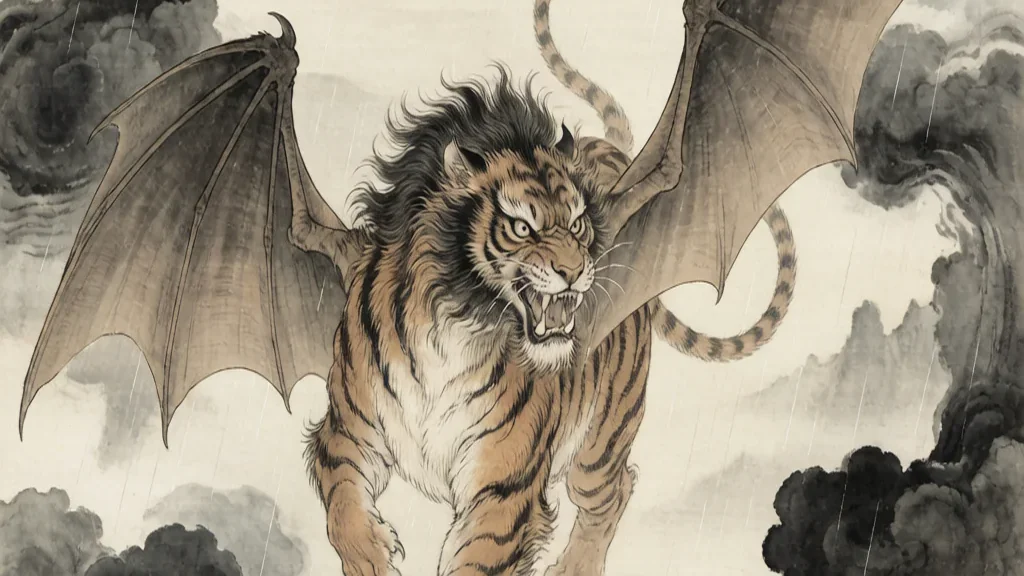
Qiongqi (穷奇, qióng qí) is one of the Four Fiends (四凶, sì xiōng), the monstrous embodiment of perverted justice — a beast that rewards the wicked and punishes the good. Described in the Classic of Mountains and Seas as a man-eating creature with the power of flight, it stands in Chinese myth as the chilling inverse of the righteous guardian: a being that knows right from wrong and deliberately inverts it.
One of the Four Fiends
The Four Fiends are a fixed quartet of evil creatures in classical myth, named alongside the Four Benevolent Animals (the dragon, qilin, phoenix, and tiger) as their dark mirror. According to the Zuo Zhuan (左传) and the Records of the Grand Historian (史记·五帝本纪), the sage-king Shun "banished the four evil clans" (流四凶族) — Huan Dou, Gonggong, Gun, and the San Miao — who were posthumously stamped with the names of the four monsters: Hundun (混沌), Qiongqi (穷奇), Taowu (梼杌), and Taotie (饕餮). In this genealogy Qiongqi is the bestial form of Gonggong, the rebellious water-official who fought the cosmic order.
So Qiongqi is not a free-roaming wilderness beast but a condemned prince of chaos, exiled by civilization's founder — a political parable dressed as monster lore.
Two Faces in the Classic of Mountains and Seas
The Classic of Mountains and Seas actually gives Qiongqi two different bodies, and both are worth knowing. In the "West Mountains" chapter it is "like an ox, with the fur of a hedgehog, named Qiongqi, whose voice is like a barking dog, and it eats people" (其状如牛,猬毛… 是食人). In the "Inland North" chapter it is "like a tiger, with wings, eating people starting from the head" (穷奇状如虎,有翼,食人从首始). The winged-tiger version is the one that entered later art and imagination, but the ox-with-quills description shows how unstable the creature's image was even in the earliest source.
Either way, the eating of humans — and especially "starting from the head," the seat of judgment — underscores Qiongqi's hatred of human reason and morality.
The Beast That Inverts Justice
Qiongqi's true horror is moral, not physical. Later texts such as the Classic of the Strange (神异经, Shenyi Jing) explain its perverse habit: when it hears of a loyal, upright person, it flies down and bites off that person's nose; but when it hears of a violent criminal, it kills a wild beast and brings it to the wrongdoer as a gift. In other words, it punishes virtue and rewards vice — the cosmos turned upside down.
This makes Qiongqi the patron monster of slander and framed injustice: the creature that ensures the good are humiliated and the guilty are rewarded. To call a corrupt official or a false accuser a "Qiongqi" was to accuse them of exactly this inversion of right and wrong.
Qiongqi Among the Four Fiends
The four are a set with distinct sins. Taotie (饕餮) is greed, the glutton who devours everything including himself. Taowu (梼杌) is obstinate stupidity, a creature that will not learn. Hundun (混沌) is primal chaos, mindless and undifferentiated. Qiongqi is the perversion of justice — the one who knows the good and chooses the opposite. Together they map the failures of a well-run realm: appetite without limit, ignorance without remedy, formlessness without order, and judgment without fairness.
In the Zuo Zhuan these four are also linked to the "three trusts and four evils" (三凶四凶) that a good ruler must remove, so Qiongqi functions as a cautionary category as much as a creature.
Why an Evil Beast Guards the Gate
Paradoxically, Qiongqi was sometimes put to use against evil. In Han-dynasty apotropaic practice, images of the Four Fiends — including Qiongqi — were carved on doors and gateways and on "peach-wood charms" (桃符) to frighten away malicious spirits. The logic was simple and a little grim: set a known devourer of the wicked at the threshold, and it will eat the evil that tries to enter. A beast that "knows" good from bad could be trusted to snap at the bad.
This reuse shows the flexibility of Chinese demonology: a monster banished by Shun could still be recruited as a night watchman, its horror redirected toward protection.
The Meaning of the Name and Later Lore
The name itself is suggestive. 穷 (qióng) means "exhausted" or "uttermost," and 奇 (qí) means "strange" or "odd," so Qiongqi can be read as "extreme strangeness" or "utterly bizarre." The word also became a literary term for a person who confuses good and evil, so that to say someone "has the nature of Qiongqi" was a settled insult for a corrupt judge or traitor.
Medieval and late-imperial collections retold the "bites the loyal, feeds the criminal" story as a stock example of inverted morality, keeping Qiongqi alive as a moral label long after his mythic origins faded.
Qiongqi in Modern Imagination
Qiongqi remains a recognizable name in modern Chinese fantasy. He appears as a boss or summoned beast in video games and web novels, usually rendered as a winged tiger-beast and cast as a force of treachery or calamity. The "Four Fiends" framing also lets contemporary writers stage him against the benevolent creatures of the court — a ready-made villain from two thousand years of tradition.
His staying power lies in a truth older than any game: every culture needs a name for the authority that punishes the innocent and rewards the guilty, and Qiongqi is China's.
Textual Roots in the Zuo Zhuan and Shiji
Qiongqi's earliest firm biography comes from the Zuo Zhuan and the Shiji's Basic Annals of the Five Emperors. There the sage-king Shun banishes the four evil clans, Huan Dou, Gonggong, Gun, and the San Miao, whose characters were later stamped with the names of the monsters Hundun, Qiongqi, Taowu, and Taotie. In this genealogy Qiongqi is the beast-form of Gonggong, the rebellious water-official who fought the cosmic order, recast as a condemned prince of chaos rather than a free wilderness beast. The Shiji frames the banishment as statecraft: remove the corrupt and the realm prospers. Read this way Qiongqi is less a creature of the mountains than a political parable about rebellion and exile, a monster invented to explain why a bad clan was sent to the edge of the civilized world.
❓ Frequently Asked Questions
📝 Chinese Vocabulary
穷奇 — : Qiongqi; the winged fiend that inverts justice, one of the Four Fiends.
四凶 — : The Four Fiends; the quartet of evil creatures banished by the sage-king Shun.
山海经 — : Classic of Mountains and Seas; the earliest source describing Qiongqi's two forms.
共工 — : Gonggong; the rebellious water-official whose evil nature Qiongqi embodies.
左传 — : The Zuo Commentary, an ancient chronicle that names Qiongqi among the evil clans banished by the sage-king Shun.
神异经 — : The Classic of the Strange, the later text that describes Qiongqi biting the loyal and rewarding the criminal.
桃符 — : Peach-wood charms hung at gates, sometimes inscribed with fiend images to ward off malicious spirits.
舜 — : Shun, the sage-king who banished the Four Fiends, including Qiongqi, to the borders of the world.
🎉 Fun Facts
- The Classic of Mountains and Seas describes Qiongqi twice — once as an ox with hedgehog fur, once as a winged tiger that eats people from the head down.
- In the Records of the Grand Historian, Qiongqi is the beast-form of Gonggong, the rebel banished by the sage-king Shun.
- Qiongqi "knows" right from wrong and deliberately reverses it: biting the loyal, rewarding the criminal.
- Despite being a Fiend, Han-dynasty door carvings used Qiongqi to ward off evil spirits at the threshold.
- Classical political essays treated Qiongqi as the textbook example of the corrupt minister who must be dismissed, because his defining sin is the perversion of justice rather than open violence.
- Over the centuries the winged-tiger Qiongqi blended in popular lore with other man-eating beasts of the Classic of Mountains and Seas, so that in folk retellings he reads as both a moral monster and a dangerous wilderness predator.