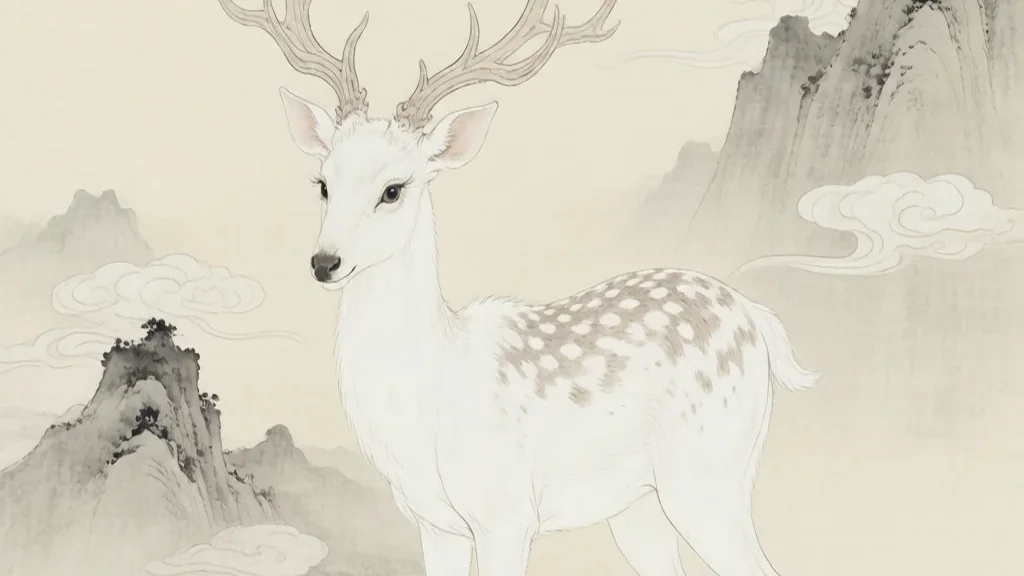
Lu (鹿, lù) — the deer — is one of the most beloved auspicious animals in Chinese culture, prized as a symbol of long life, gentle prosperity, and the rank of the scholar-official. Because its name is a perfect homophone of 禄 (lù, "salary" or "official rank"), the deer came to stand for worldly success as well as longevity, and it wanders through Chinese poetry, painting, medicine, and festival art as a creature that carries good fortune on its antlers.
The Deer and the Sound of "Rank"
The single most important fact about the deer's symbolism is a pun. 鹿 (lù, deer) sounds exactly like 禄 (lù, emolument, salary, official rank). In the popular trio of the Three Stars — Fortune (福, Fú), Rank (禄, Lù), and Longevity (寿, Shòu) — the middle star, Lùxīng, is the god of career success, and the deer is his animal emblem. A picture of a deer therefore wishes the viewer not just long life but a flourishing official career and steady income.
This wordplay runs deep in Chinese decorative art. Deer appear on birthday scrolls, on the robes of hoping-to-be-promoted officials, and in New Year prints where a deer beside a bee or a bat completes a rebus of good wishes. The creature's gentleness makes the ambition seem gracious rather than grasping.
Deer as a Beast of Longevity
The deer is a charter member of China's "three longevity symbols" (三寿), grouped with the crane (鹤) and the pine (松). The Star Lord of Longevity, Shòuxīng (寿星), is almost always shown with a deer nearby or at his side, often accompanied by a crane and a peach. Because deer were believed to live for centuries and to forage for the magic mushrooms of immortality, they became natural attendants of the gods of long life.
A favorite motif is "deer and crane welcoming spring" (鹿鹤同春, lù hè tóng chūn). Read aloud, 鹿鹤 (deer-crane) sounds like 六合 (liù hé, "the six directions" or "the whole world"), so the image quietly puns on universal peace and renewal. The pairing sums up the deer's double promise: a long life lived in harmony with the cosmos.
The White Deer and the Auspicious Omen
The white deer (白鹿, bái lù) holds a special place as a portent of sage rule. Classical texts say a white deer appears only when a virtuous emperor sits on the throne, and it is counted among the "auspicious beasts" (瑞兽) that signal heaven's approval. The Classic of Mountains and Seas lists white deer among the benign wonders of blessed regions, and later anecdote collections record them turning up at the courts of good rulers.
White deer were also linked to the Queen Mother of the West and to the immortals, who were said to keep them in the gardens of paradise. To meet a white deer was, in folk belief, to brush against the edge of the immortal world — a meeting that itself conferred blessing.
Deer in the Earliest Texts
Long before its symbolic career, the deer was a familiar of Chinese poetry and ritual. The Book of Songs (诗经, Shījīng), compiled over two thousand years ago, opens one of its sections with "the deer call, calling oh-oh" (呦呦鹿鸣, yōu yōu lù míng), a poem of hospitality sung at aristocratic feasts. From the Han onward, the "Deer Call" (鹿鸣) ode was performed at official banquets to honor worthy guests, and a "Deer Call feast" (鹿鸣宴) became a standard celebration for successful examination candidates — tying the deer directly to scholarly rank.
The Classic of Mountains and Seas meanwhile peoples its mountains with variously colored and magical deer, establishing the animal as a creature of the wild sacred landscape rather than only a domestic symbol.
Deer in the Gardens of the Immortals
In Taoist legend the deer is the favored mount and companion of immortals (仙人). Hermits ride deer through misty peaks, and the beasts graze the orchards of the Queen Mother of the West, nibbling the leaves that confer longevity. This role makes the deer a bridge between the human and immortal realms: a mortal who treats a deer kindly in the hills may, in folktale, be rewarded by the spirit world.
The milu or Pere David's deer (麋鹿, mílù) — the "four-not-like" (四不像, sì bù xiàng, "like none of the four") — occupies a comic footnote here: in the novel Investiture of the Gods (封神演义), the sage Jiang Ziya's mount is a "four-not-like," a creature modeled on this strange, long-faced deer.
The Nine-Colored Deer and Buddhist Art
One of the most famous deer stories in Chinese art is not native myth but a Buddhist Jataka tale, the Nine-Colored Deer (九色鹿, jiǔ sè lù). In the story, a luminous multicolored deer rescues a drowning man who then betrays it to a greedy queen; the tale ends with the betrayer punished and the deer revealed as a bodhisattva. The narrative was painted on the walls of the Mogao Caves at Dunhuang (notably Cave 257), where it remains a masterpiece of medieval Chinese Buddhist art.
Its popularity shows how readily the deer — already a Chinese symbol of purity and good omen — was adopted to carry a Buddhist moral about gratitude and karma, blending two traditions into a single beloved image.
The Deer in Medicine and Modern Festive Life
The deer's auspicious status is not only symbolic. Deer antler velvet (鹿茸, lù róng) is one of the most valued ingredients in traditional Chinese medicine, taken as a tonic for vitality and longevity — a literal extension of the animal's life-giving reputation. Deer sinew and horn appear in classical pharmacopeias from the Divine Husbandman's Materia Medica (神农本草经) onward.
Today the deer remains a staple of birthday and New Year imagery, appearing on scrolls, paper-cuts, and porcelain as a wish for a long, prosperous life. It is not a zodiac animal, but its homophone with 禄 keeps it permanently useful whenever Chinese art wants to wish someone both years and rank.
The Deer in Hermit and Landscape Poetry
Beyond emblems of rank, the deer became a beloved figure in Chinese poetry about retreat and nature. Tang dynasty landscape poets placed deer in quiet mountain scenes as companions to the solitary scholar, most famously in a short poem set in a Deer Park, where the creature moves unseen among the trees and the listener hears only faint voices in the deep wood. In such verses the deer is not a career symbol but a sign of the peaceful, self-sufficient life away from court. Hermits and painters adopted the animal as a token of the free, unworldly mind, and gardens were designed with shaded groves where a deer might wander. This literary deer balances the official one: together they show the animal serving both ambition and its refusal.
❓ Frequently Asked Questions
📝 Chinese Vocabulary
鹿 — : Deer; the auspicious animal of longevity and gentle fortune.
禄 — : Rank, salary, emolument; the homophone that makes the deer a symbol of career success.
寿星 — : Star Lord of Longevity; usually shown with a deer.
白鹿 — : White deer; an omen of a virtuous ruler and of the immortal realm.
福 — : Fortune, the first of the Three Stars, often paired with the deer's Rank and Longevity stars.
寿 — : Longevity, the third of the Three Stars, the quality the deer most directly embodies.
鹤 — : Crane, a longevity bird frequently shown with the deer as a paired omen of long life.
松 — : Pine, an evergreen tree grouped with the deer and crane as a symbol of enduring life.
🎉 Fun Facts
- 鹿 (deer) and 禄 (rank/wealth) are exact homophones, which is why the deer wishes you both a long life and a promotion.
- The phrase 鹿鹤同春 (deer and crane welcome spring) is a pun on 六合, "the whole world."
- "呦呦鹿鸣" (the deer call) from the Book of Songs was sung at official banquets for centuries, and a "Deer Call feast" honored examination successes.
- The milu or Pere David's deer is the "four-not-like" (四不像) used as the mount of Jiang Ziya in Investiture of the Gods.
- The deer appears on birthday scrolls and New Year prints as a quiet wish for both long life and a successful career, blending the Longevity Star with the Rank Star.
- In some regional folktales a hunter who spares a deer in the hills is later rewarded by the spirit world, so the animal became a gentle test of human kindness.