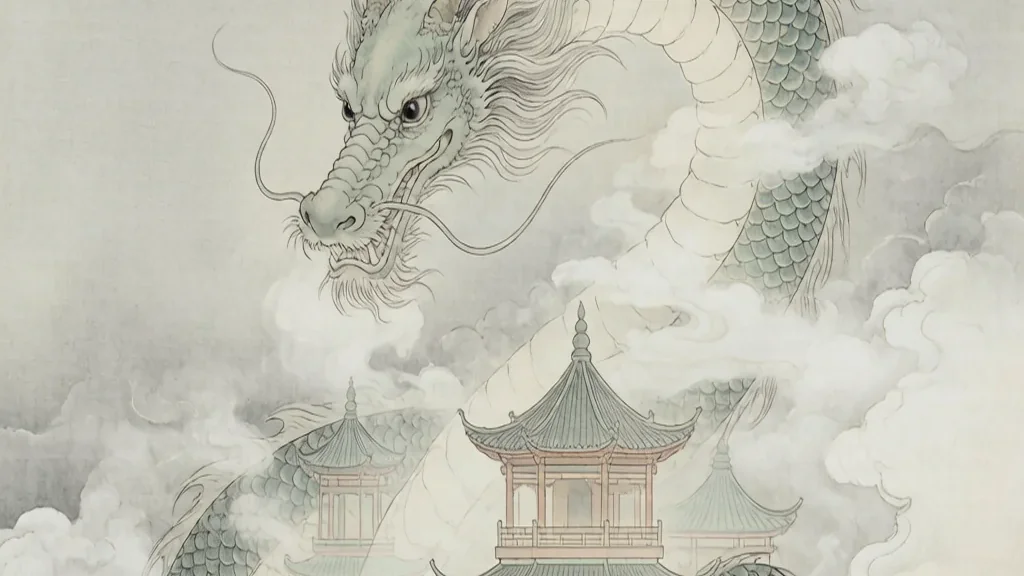
Shenlong (神龙), the Divine Dragon, is the celestial dragon of Chinese myth that governs the wind and the rain and rides the clouds above the mortal world. Unlike the dragon kings who rule the seas or the coiled flood dragons of rivers and lakes, the shenlong belongs to the open sky, a creature of weather rather than of water, and the highest and most purely spiritual member of the dragon family.
A Dragon of the Sky, Not the Waters
In traditional Chinese lore, dragons are classed by the realm they inhabit. Early and medieval writings distinguish the tian long (heaven dragons that attend the gods), the shen long (divine or spirit dragons that command wind and rain), the di long (earth dragons that rule rivers and streams), and the fu cang long (hidden dragons that guard buried treasure). The shenlong sits at the top as the weather-working sky dragon. This rank matters because it separates the shenlong from the localized water officials of popular religion and marks it as a force of the atmosphere itself.
The point is reinforced by the Dragon Kings (龙王) of the four seas. Those kings are rulers of specific bodies of water — the East, South, West, and North Seas — and are closer to regional administrators than to cosmic weather. The shenlong, by contrast, is the generic celestial power behind storms and rainfall, the dragon of the whole sky rather than of any one shore. The phrase most often attached to it, 行云布雨 (xíng yún bù yǔ, "to move the clouds and spread the rain"), names its single defining office.
Master of Wind and Rain
Because the dragon's command of rain made it central to an agricultural society, the shenlong stood close to survival itself. In the Huainanzi (淮南子) and other Han-era compilations the dragon is bound to the rising yang vapor and to thunder and rain, the creature through which heaven waters the earth. A late-classical saying, echoed in Han writings, notes that "the divine dragon rides the clouds and mist; when it loses its place it is no different from the earthworm" — a reminder that even the sky dragon's power depends on its right cosmic position.
That dependence shaped real practice. In times of drought, communities performed rain-prayer rites (祈雨) to summon the shenlong, sometimes erecting a clay "earth dragon" (土龙) as a focus for the ceremony, and imperial courts staged elaborate rain sacrifices when the fields cracked. The dragon's cooperation was read as a sign of harmony between heaven and the ruler; a failed harvest was, in part, a failed relationship with the weather dragon above.
How the Divine Dragon Looks
The standard form of the fully realized sky dragon was codified by the Han scholar Wang Fu (王符) in his Qianfu lun (潜夫论), which describes the dragon through "nine resemblances" (九似): the horns of a stag, the head of a camel, the eyes of a demon, the neck of a snake, the belly of a clam, the scales of a carp, the claws of an eagle, the soles of a tiger, and the ears of a cow. Images of the shenlong follow this convention — a long, sinuous, bearded serpent with a mane of wind-blown whiskers and a flaming pearl often shown near its jaws.
The number of claws carries social meaning. The five-clawed (五爪) dragon is the imperial variant, reserved by Ming and Qing sumptuary law for the throne, while four-clawed and three-clawed forms appear on lesser garments and popular art. The shenlong is therefore drawn both as the generic celestial serpent of myth and, in its five-clawed form, as the specific emblem of the emperor's heavenly mandate.
The Dragon and the Son of Heaven
From the Han dynasty the Chinese ruler styled himself the 真龙天子 (zhēn lóng tiān zǐ, "True Dragon Son of Heaven"), and the dragon became the exclusive emblem of imperial authority. The twelve-symbol imperial robe (龙袍) arranged dragons — often ascending and descending in pairs — around the wearer's body, so that the sovereign was quite literally clothed in the sky dragon's image. On thrones, screens, and bridge rails the five-clawed dragon announced the presence of heaven-appointed power.
This imperial reading built directly on the shenlong's weather role. Just as the dragon "spreads rain" over the land, the virtuous ruler "spreads blessing" over his people; the two acts rhyme in Confucian political metaphor. The shenlong thus did double duty in Chinese thought: it was both the literal master of storm clouds and the symbolic master of the state.
Sayings, Festivals, and Ritual
The shenlong lives on in everyday language. The idiom 神龙见首不见尾 (shén lóng jiàn shǒu bù jiàn wěi, "the divine dragon shows its head but not its tail") describes a person or thing that appears briefly and elusively, like a sky dragon glimpsed through parting clouds and then gone. It is still used in modern Chinese to praise — or tease — experts and masters who never show their full hand.
The dragon's weather office also fed the calendar of festival. The dragon-boat races of the Duanwu festival and the New Year dragon dance (舞龙) both descend from rites meant to awaken or summon the rain dragon, and temple courtyards still display dragon carvings oriented to catch the rain-bearing winds. The shenlong is, in this sense, the invisible guest at the oldest of China's seasonal celebrations.
Shenlong in Art and Modern Life
Chinese art places the shenlong everywhere sky meets architecture: on palace roof ridges as a guardian of the peak, on scroll paintings of storm and cloud, on embroidered robes, and in the Green Dragon quarter of garden and feng shui layout (related to, but distinct from, the directional Azure Dragon Canglong of the Four Symbols). As a motif it signals heavenly favor and protective weather rather than mere decoration.
Today the Divine Dragon survives in New Year parades, in corporate and sports logos, in film and animation, and in the popular self-image of "descendants of the dragon" (龙的传人). What began as the sky dragon that moves the clouds has become one of the most durable symbols of Chinese identity — still, at root, the master of wind and rain looking down from above.
The Dragon Family and the Sky Dragon's Rank
Chinese lore sorts dragons by the realm they rule, and the shenlong sits near the top. Early and medieval writings name the tian long who attend the gods, the shen long who command wind and rain, the di long who govern rivers and streams, and the fu cang long who guard buried treasure. The shenlong is the weather-working sky dragon, distinct from the four Dragon Kings who are merely local rulers of the seas. This hierarchy matters because it separates a cosmic atmospheric power from a provincial water official. The shenlong's single office, move the clouds and spread the rain, made it the dragon closest to survival itself in an agricultural society, and the one most often addressed in prayer. To know the shenlong is to know where, exactly, the dragon belongs in the order of heaven and earth.
The Shenlong in Temple and Garden Art
The shenlong appears wherever sky meets human craft. On palace roof ridges it crowns the highest point as a guardian of the peak, its body coiling among the tiles. Scroll paintings set it amid storm clouds and lightning, a long serpent with a flaming pearl near its jaws. In gardens and feng shui layouts it is the Azure Dragon of the east, paired with the White Tiger of the west to balance a site. Temple courtyards orient dragon carvings to catch the rain-bearing winds, keeping the weather dragon present at worship. As a motif the shenlong signals heavenly favor and protective weather rather than mere decoration, and its image was reserved, in five-clawed form, for the throne. Across these settings the same sky dragon that waters the fields also ornaments the buildings humans raise beneath it.
❓ Frequently Asked Questions
📝 Chinese Vocabulary
神龙 — : Divine Dragon; the celestial dragon of wind and rain.
行云布雨 — : "Move the clouds and spread the rain"; the shenlong's office.
龙王 — : Dragon King; ruler of one of the four seas.
真龙天子 — : True Dragon Son of Heaven; the emperor.
九似 — : The nine resemblances, the classical formula describing the dragon's composite body.
祈雨 — : Rain-prayer rites performed in drought to summon the sky dragon's rain.
五爪 — : Five-clawed, the dragon form reserved by law for the emperor.
土龙 — : The earth dragon, a clay figure erected in rain rites to attract the shenlong.
🎉 Fun Facts
- The classical "nine resemblances" of the dragon were set down by the Han scholar Wang Fu (王符) in his Qianfu lun.
- The idiom 神龙见首不见尾 is still used in modern Chinese for elusive masters who never show their full hand.
- Dragon-boat racing and the New Year dragon dance both descend from rites meant to summon the rain dragon.
- The five-clawed dragon was reserved by law for the emperor from the Ming dynasty onward.
- Folk weather belief held that the first thunder of spring was the shenlong stirring from its winter rest, and many farming communities took that thunder as the signal to begin plowing.
- Because the shenlong was a creature of the open sky rather than any one place, passing rain showers were sometimes called the dragon's passage, and travelers would salute a sudden storm as a sign of its favor.