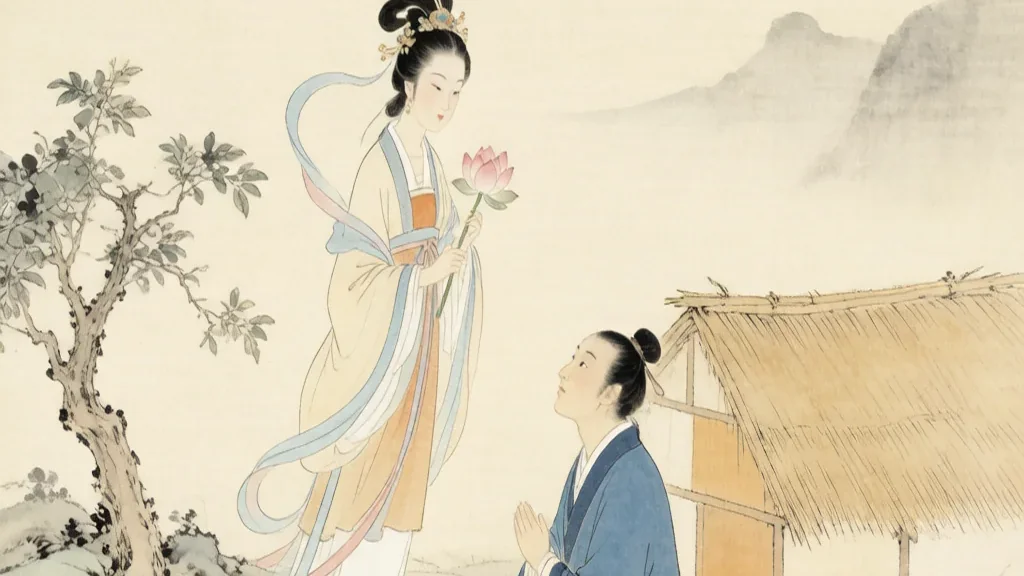
The legend of Dong Yong is one of the most beloved stories of filial devotion and unlikely romance in Chinese folklore, a tale in which a poor son's grief for his father moves the heavens themselves to intervene. Dong Yong is remembered as a man so destitute yet so dutiful that, unable to afford a proper burial for his parent, he sold himself into bonded service to a wealthy household in order to pay the funeral costs. His sincerity attracted the pity of a celestial maiden, usually identified as the seventh daughter of the Jade Emperor, who descended to earth, married the mortal out of sympathy for his virtue, and used her divine skill at weaving to earn his freedom. The story belongs to a family of Chinese narratives about the boundary between heaven and the human world, sharing themes with the famous Cowherd and Weaver Girl but distinct in its emphasis on filial piety as the force that bridges the realms. Preserved in early anthologies, elaborated in opera, and still performed on regional stages, the legend of Dong Yong celebrates the idea that genuine goodness can summon grace from above.
Origins in Early Tales of Filial Piety
The earliest kernel of the Dong Yong story appears in a compiled collection of strange and marvelous accounts from the late Han and early medieval period, where he is listed among exemplars of filial conduct rather than as a romantic hero. In that austere form the tale is almost entirely about his willingness to enslave himself for the sake of his father's rites, a deed that marks him as a model son in a culture that placed ancestral duty at the center of morality.
This filial core is crucial, because it explains why a god or goddess would notice him at all. In the logic of Chinese piety, extreme devotion to parents is itself a kind of virtue that radiates outward and attracts heavenly attention, so Dong Yong's suffering is not random misfortune but the very quality that sets the miracle in motion. The romance is, in origin, a reward for filial courage.
Over time the bare anecdote accumulated supernatural ornament: the self selling, the funeral debt, and the heavenly wife who weaves for his release became a unified narrative arc. The early records thus supplied the spine of the story, while later performers and storytellers padded it with emotion, dialogue, and the pathos of separation that audiences came to cherish.
Dong Yong the Filial Son and the Funeral Debt
At the heart of the legend stands the act of self enslavement. When his father dies, Dong Yong has no means to perform the burial with the dignity the rites demand, and rather than leave the parent uninterred he contracts himself to a rich man as a bonded laborer, accepting years of servitude in exchange for the funeral funds. This transaction is the moral engine of the tale, establishing his character before any goddess appears.
The detail of the debt matters because it gives the heavenly wife a concrete task: she must repay the rich household to free her husband. The bondage is not merely background suffering but a problem the story must solve, and the solution arrives through her weaving, which links the themes of poverty, duty, and divine craft into a single economy of rescue. His servitude becomes the stage for her mercy.
In performance traditions the moment of his decision is treated as the emotional peak of the opening, a son choosing degradation to honor a parent, and singers dwell on his tears and his resolve. The audience is meant to feel the weight of the funeral debt not as plot mechanics but as the measure of his love, which is precisely why the heavens respond.
The Descent of the Heavenly Maiden
The celestial figure who comes to Dong Yong is most often named the Seventh Fairy, the youngest of the Jade Emperor's daughters, though some versions call her simply a weaving maid of heaven. She descends because she has heard of his filial sorrow and wishes to reward it, a motif that casts divine intervention as a response to human virtue rather than as arbitrary fate. Her descent is the pivot from tragedy toward wonder.
She proposes marriage to the astonished mortal, an element that transforms the tale from a solo story of duty into a romance across the worlds. The union is presented as compassionate rather than romantic in the modern sense at first; she marries him to legitimize her help and to share his burden, though later opera naturally sweetens this into mutual love. The cross worldly marriage is the story's distinctive signature.
Her identity as a weaver is essential, because weaving is the skill that will buy his freedom and also ties her to the broader mythology of heavenly textile workers like the Weaver Girl of the star Vega. By making Dong Yong's savior a weaver, the legend knots itself into the larger fabric of Chinese sky lore while keeping its own focus on filial rescue.
Weaving for Freedom: The Brocade of Release
Having married Dong Yong, the Seventh Fairy sets to work at the loom and produces brocade of such supernatural quality that it astonishes the wealthy master who holds Dong Yong's contract. In most versions she weaves a hundred bolts of fine silk or a single wondrous length within a miraculously short time, using powers no mortal weaver could possess, and the master accepts this output as payment for the son's release.
The weaving episode is rich with symbolic meaning. Silk and cloth were among the most valued products of the traditional economy, and a woman's skill at the loom was a real measure of household prosperity, so the heavenly wife asserting value through weaving speaks to deep social truths even as it works a miracle. Her labor literally purchases the man's liberty, joining domestic craft to liberation.
The episode also sets up the inevitable loss, because a goddess who bends heavenly time to weave cannot remain on earth forever. The very power that frees him also marks her as otherworldly and therefore temporary, so the brocade of release is simultaneously the cause of their separation. The loom gives and the loom takes, a quiet tragedy woven into the happy rescue.
The Opera Tradition of the Heavenly Match
The legend found its most famous artistic home in regional opera, especially the Huangmei opera of Anhui and Hubei, whose version titled the Heavenly Match became one of the most performed and filmed stories in modern Chinese theater. In this form the Seventh Fairy is vivid, playful, and deeply affectionate, and the comic and lyric scenes of the mortal immortal marriage won enormous popular affection.
The operatic treatment expanded the romantic and domestic details, showing the couple's brief happiness, the wife's cleverness in outwitting the rich master, and the heartbreak when heavenly command compels her return. These additions turned a terse folktale into a full emotional drama with songs that audiences could hum, embedding the story in living performance rather than only in printed pages.
Film and television adaptations in the twentieth century carried the opera further, making Dong Yong and the Seventh Fairy familiar to people who might never read the old tale collections. Each medium preserved the core of filial piety and woven rescue while adjusting the tone, proving the legend's adaptability across forms and its persistent appeal to viewers across generations.
Themes of Filial Piety and Heavenly Reward
The dominant theme is xiao, filial piety, the cardinal virtue that bound Chinese family life and state ideology alike. Dong Yong embodies xiao to the point of self sacrifice, and the legend insists that such devotion does not go unnoticed by the cosmos. His reward is not wealth for its own sake but the restoration of his freedom through a helper sent from above.
A second theme is the permeability of the boundary between heaven and earth. The Jade Emperor's daughter can step down into a mortal courtyard, suggesting a universe in which the highest powers remain responsive to human goodness. This is reassuring theology for ordinary listeners: the distant heavens are not indifferent, and virtue can draw down grace.
A third theme is the temporary nature of cross worldly joy. Even a union blessed by heaven is subject to celestial law, and the couple must part, a melancholy note that keeps the story honest about loss while still affirming that the love and the rescue were real. The legend thus balances reward with restraint, joy with inevitable sorrow.
Relationship to the Cowherd and Weaver Girl
Dong Yong's tale is frequently confused with the separate but neighboring legend of the Cowherd and the Weaver Girl, and the confusion is understandable, since both involve a heavenly weaving woman who loves a mortal and is parted from him. Yet the two stories differ in emphasis: the star lovers center on romantic separation across the sky, while Dong Yong centers on filial debt and rescue through weaving.
The Seventh Fairy of Dong Yong's story is sometimes identified with or paralleled to the Weaver Girl of the heavens, and regional tellers blur the lines freely, but the canonical versions keep them distinct, with the Weaver Girl tied to the altair and vega stars and the Seventh Fairy tied to the Jade Emperor's household. The overlap shows how one mythic motif radiates into many local forms.
Scholars note that these tales together express a single cultural preoccupation with the weaver as mediator between realms, a figure whose labor links heaven to earth just as her love links god to mortal. Dong Yong's legend is best understood as one branch of this wider mythic tree, distinguished by its rootedness in filial rather than purely romantic feeling.
Regional Variations and Local Attachments
Different provinces claim Dong Yong as their own, attaching his story to local hills, wells, and temples where the heavenly wife is said to have woven or wept. Such localization is typical of Chinese legend, which tends to root floating tales in specific soil so that a village can say the miracle happened here, on our ground, among our ancestors.
In some retellings the rich master is a comic villain who gets his comeuppance, while in others he is merely a creditor obeying custom, and the moral weight shifts accordingly from class grievance to simple piety. These variations show the legend functioning as a flexible vessel into which communities pour their own emphases without breaking the basic shape.
Certain localities maintain small shrines or staged sites associated with the tale, and festival performers may reenact the weaving or the parting, keeping the story tactile and communal. The persistence of place bound versions ensures that Dong Yong is not only a bookish exemplar but a neighborhood presence, prayed to or remembered by people who walk past his supposed landmarks.
Symbolism of Silk, Loom, and Bondage
The loom in this legend is a potent symbol. It is the instrument of both economic bondage and spiritual freedom, since the same act of weaving that signifies a woman's domestic role also generates the wealth that breaks the husband's contract. Silk here is not luxury but salvation, the medium through which heaven pays earth's debts.
Bondage itself is reframed: Dong Yong's servitude is voluntary and filial, a noble constriction, while his release comes through a thread spun by a goddess, implying that the right kind of tie, the tie of love and duty, can unwind the wrong kind, the tie of debt. The imagery of binding and unbinding runs beneath the whole narrative like a warp under weft.
The rich man's household represents the mortal economy that traps the poor, and the heavenly wife's intervention suggests that true value exceeds what markets measure. By having a goddess outperform the richest loom on earth, the tale quietly critiques mere wealth while affirming that devotion outweighs coin, a gentle moral wrapped in a wonder story.
Modern Legacy and Cultural Memory
In the contemporary era the Dong Yong legend survives chiefly through opera recordings, television costume dramas, and school textbooks that cite him as an exemplar of filial piety, often alongside other paragons in illustrated volumes of traditional virtue. His story thus functions both as entertainment and as moral instruction, a dual role it has played for over a millennium.
The figure of the Seventh Fairy has also entered broader popular culture as a symbol of devoted, proactive love, appearing in cartoons, songs, and tourism branding for regions that claim the tale. She is sometimes recast as an independent heroine who chooses her own fate, a modern gloss on the obedient daughter of older tellings, showing how the legend is continually reinterpreted.
What keeps Dong Yong alive is the simplicity of his core: a son who loved his father enough to sell himself, and a heaven that answered. In an age suspicious of easy happy endings, the story's mixture of miracle and melancholy, rescue and parting, feels strangely complete, and continues to draw audiences who recognize in it the cost and the grace of family love.
Why the Story Still Speaks to Us
The legend endures because it addresses two enduring human concerns at once: the duty we owe to those who raised us, and the hope that goodness is not futile even in poverty. Dong Yong's willingness to suffer for his father answers the first; the descent of the weaving maiden answers the second, proposing that virtue can summon help from beyond the visible world.
It also models a love that is active rather than passive, in which the heavenly wife labors to free the one she marries, an image of partnership that resonates across changing attitudes toward marriage. The tale refuses to separate affection from effort, showing devotion as something one weaves day by day rather than merely feels.
Finally, the necessary parting at the end teaches acceptance without cynicism: not every grace lasts, but the rescue was real and the love left its mark. That bittersweet wisdom, more than the miracle itself, is why the legend of Dong Yong and the Seventh Fairy continues to be sung, staged, and remembered wherever Chinese stories are told.
❓ Frequently Asked Questions
Who was Dong Yong?
Dong Yong is a legendary filial son who, unable to afford a proper burial for his father, sold himself into bonded service to a wealthy household to pay the funeral costs. His devotion became so renowned that a heavenly maiden descended to help him.
Who is the Seventh Fairy?
She is the celestial maiden, usually the seventh daughter of the Jade Emperor, who heard of Dong Yong's filial sorrow and came to earth to marry him and weave brocade that would buy his freedom. She is the heavenly counterpart and rescuer in the tale.
How did the weaving free him?
Using divine skill, the Seventh Fairy produced brocade of such quality and quantity that the rich master accepted it as payment for Dong Yong's contract, releasing him from bondage. Her loom literally purchased his liberty.
Is this the same as the Cowherd and Weaver Girl?
No, though they share a heavenly weaver who loves a mortal. The Cowherd tale centers on star crossed romantic separation, while Dong Yong centers on filial debt and rescue. The two are related branches of one mythic motif but distinct stories.
What opera made the legend famous?
The Huangmei opera version titled the Heavenly Match became the most famous adaptation, expanding the romance and the parting into beloved songs and later films and television dramas that carried the story to wide audiences.
What is the main moral of the legend?
The central lesson is filial piety: genuine devotion to parents can move heaven to intervene. Secondary themes include the permeability of the human and divine realms and the bittersweet truth that even heavenly joy may be temporary.