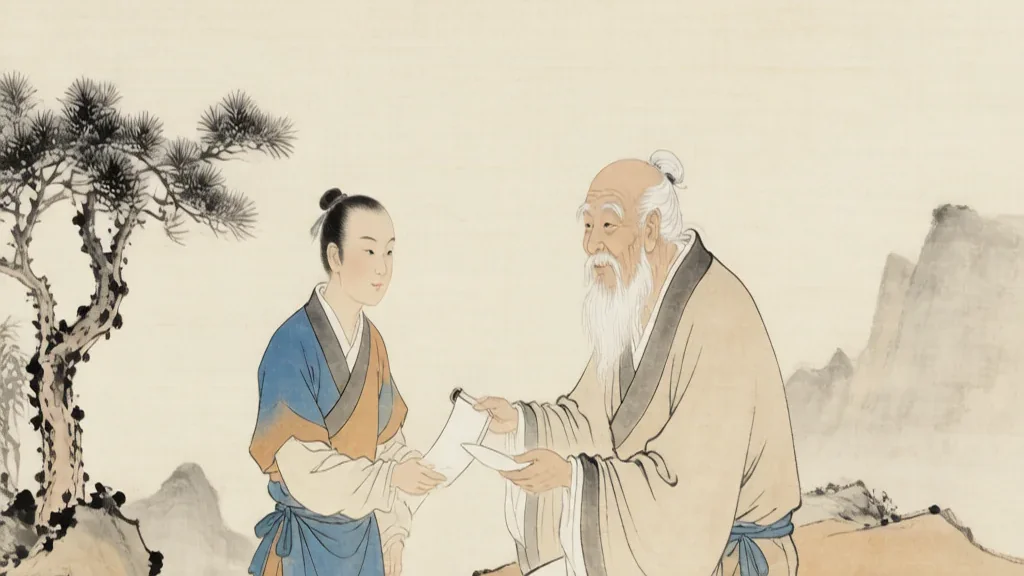
Huang Shigong, often rendered as the Old Man of the Yellow Stone, is a semi legendary figure of the late Warring States and early Han period who appears in the Shiji as the mysterious mentor of Zhang Liang, the strategist who helped Liu Bang found the Han dynasty. The tale turns on a famous test of character: the old man deliberately drops a shoe from a bridge and commands the young Zhang Liang to fetch it, then to put it on, rewarding the youth's patience and respect with a secret manual of warfare. Huang Shigong thus embodies the Daoist ideal of the hidden master who appears in disguise to test the worthy and to transmit wisdom that shapes the destiny of empires.
Identity and the Meaning of the Name
The name Huang Shigong literally suggests an elder associated with yellow stone, and later tradition identifies him with the spirit of a yellow stone cliff or with a transcendent being who had outlived ordinary time. Sima Qian presents him without genealogy or origin, emphasizing his Otherness and his role as a vehicle of fate rather than a historical personage with a biography.
In the Shiji narrative he meets Zhang Liang by chance at a bridge over the Yi River, behaving at first like an irritable elder and then like a profound teacher. The anonymity is deliberate: the master who transmits the art of ruling must remain unknown, because the teaching, not the teacher, endures. Later commentators sometimes equated him with the mythological Huangdi or with a river deity.
The yellow stone motif reappears at the end of Zhang Liang's life, when the strategist asks to be buried with a yellow stone bearing the old man's likeness, suggesting that the mentor was venerated almost as a tutelary spirit. This circular closure strengthened the legend's claim that Huang Shigong was no ordinary mortal.
The Bridge Test and the Three Appointments
The core episode unfolds across three dawn appointments. On the first meeting the old man drops his shoe and says, fetch it, and Zhang Liang, though offended, complies and even kneels to put it on his foot. The man says merely that the youth is teachable and arranges to meet him at dawn. When Zhang Liang arrives late twice and is dismissed, he finally arrives before the old man and is given a book with the promise that it will make him a teacher to a king.
This structure of testing through humiliation and patience is a classic motif of Chinese lore about masters and disciples. The point is not the shoe but the temper of the student: only one who subdues pride and endures insult is fit to receive statecraft. The three appointments dramatize the discipline of punctuality, humility, and perseverance.
The episode has been read for two thousand years as a parable of self cultivation. Generations of scholars and officials cited it to argue that true ability is proven in small obedience before it is entrusted with great power, and that wisdom is granted to the patient rather than the merely clever.
The Secret Manual of Strategy
The book the old man bestowed is traditionally identified with the Huang Shigong San Lue, the Three Strategies of Huang Shigong, a Warring States military and political treatise preserved among the received texts of the Seven Military Classics. It teaches the ruler how to employ men, read circumstances, and win without constant bloodshed.
Zhang Liang is said to have mastered the book and to have used its counsel in the campaigns that established the Han. The Strategems emphasize flexibility, the cultivation of virtue, the use of spies, and the alignment of policy with the natural order, reflecting a Daoist inflected view of warfare as the art of harmony rather than mere force.
Whether the historical Zhang Liang actually received such a text from a mysterious elder is less important than the literary function of the gift. The manual legitimates Han rule by tracing it to a transcendent source, and it frames Zhang Liang not as a mere cunning adviser but as the heir of an ancient wisdom tradition.
Zhang Liang and the Founding of Han
Zhang Liang was a descendant of the Korean nobility of the Han state who swore vengeance against Qin after his homeland fell. He plotted an assassination of the First Emperor, failed, and later joined Liu Bang, becoming his chief strategist. His counsel at decisive moments, from entering the passes to managing rivals, is credited with the Han victory over Xiang Yu.
The Shiji portrays Zhang Liang as frail in body but supreme in insight, a man who won battles by calculation rather than command. His association with Huang Shigong explains this disproportion: his strength came from the hidden book, not from personal might. The legend thus elevates the strategist above the warrior.
After the Han was founded, Zhang Liang grew distant from power, practicing Daoist breathing and withdrawal, a trajectory consistent with his mysterious tutelage. His retirement confirmed the ideal that the true adept serves the realm and then returns to tranquility, unlike the officials who clung to office and perished.
Daoist and Immortalist Interpretations
Because of the supernatural framing, later Daoist schools claimed Huang Shigong as one of their perfected beings and Zhang Liang as a quasi immortal. Hagiographies describe the old man ascending in daylight or revealing himself as the spirit of a cliff, blending the historical anecdote with the cult of transcendence.
The Daoist reading stresses that the bridge test was a lesson in wu wei, effortless action through yielding. By fetching the shoe without resistance, Zhang Liang practiced the soft overcoming the hard, the female overcoming the male, the central paradox of Daoist strategy. The manual then systematizes what the test enacted.
In this light Huang Shigong is less a general than a sage who uses war only to end war, and who chooses a student capable of restraint. The tradition thereby reconciles the violence of founding an empire with the peace loving ethos of the Daoist adept.
The Three Strategies as a Received Text
The San Lue attributed to Huang Shigong survives as a short but dense treatise divided into three sections dealing with the ruler's authority, the management of subordinates, and the conduct of campaigns. It is noted for pragmatic aphorisms about rewarding merit, concealing intentions, and adapting to the enemy.
Medieval military academies ranked it beside Sunzi and Wuzi, and Tang and Song emperors commissioned commentaries that treated it as essential instruction for princes. Its inclusion among the canonical military writings shows how thoroughly the legend of the old man on the bridge entered the institutional curriculum of statecraft.
Modern textual scholarship questions the attribution, noting that the surviving San Lue likely accreted over centuries, but the linkage to Huang Shigong persisted because it supplied the text with charismatic origin and moral authority. A book given by a yellow stone immortal carried weight no anonymous manual could.
Influence on Later Strategy and Culture
The image of the hidden master testing a future hero became a template reused across Chinese fiction and drama. From the Three Kingdoms to the Ming novels, mentors who appear as beggars or old women to confer scrolls upon the destined protagonist descend directly from Huang Shigong and Zhang Liang.
The bridge episode in particular entered the visual arts, painted and carved as an emblem of filial and deferential conduct, and it was excerpted in moral primers for youth alongside tales of patience and respect. The shoeless old man on the bridge is one of the most recognizable vignettes in classical illustration.
In strategy literature the legend supplied a vocabulary for the relationship between顾问 and ruler: the true adviser speaks plainly, tests the ruler's character, and withdraws once the task is done. This ideal of the retiring counselor shaped the self image of scholar officials for millennia.
Shrine, Memory, and the Yellow Stone
Sites in Jiangsu and Henan associated with Zhang Liang's life later enshrined the yellow stone as an object of worship, and folk religion absorbed Huang Shigong as a patron of strategists, gamblers, and those awaiting a destiny. The stone itself, carried into burial, became a relic of transmission.
Local gazetteers recorded festivals at bridges said to be the original meeting place, where merchants and students prayed for patrons and mentors. The ritual life around the legend confirms its social function: it taught ordinary people how fortune arrives through humility and how greatness is prepared in obscurity.
Even today the phrase evoking the old man of yellow stone calls to mind the stranger who changes a life with a single book, a motif so durable that it survives in modern idioms about unexpected mentorship and the rewards of patience.
Historical Versus Legendary Status
Historians treat Huang Shigong as a legendary construct rather than a documented individual, useful to Sima Qian for explaining Zhang Liang's genius and for moralizing about merit. The Shiji itself offers no verification beyond the anecdote, and later embellishments multiplied without new evidence.
Yet the legend performs real historical work. By attributing Han strategy to a transcendent source, it naturalizes the new dynasty's legitimacy and consoles the defeated with the idea that victory belonged to the patient and the virtuous. The old man on the bridge is therefore both story and political theology.
The boundary between fact and fable here is less important than the consistency of the message. Across two millennia the figure has taught the same lesson: that power follows preparation, that wisdom is hidden until earned, and that the small act of fetching a shoe can tip the balance of an empire.
❓ Frequently Asked Questions
Who was Huang Shigong?
He was a semi legendary old man of the yellow stone who, in the Shiji, tested and then mentored Zhang Liang by giving him a secret book of strategy.
What was the bridge test about?
The old man dropped his shoe and made Zhang Liang fetch and put it on, then tested his punctuality across three dawn meetings before granting the manual.
What book did he give Zhang Liang?
It is traditionally identified with the Huang Shigong San Lue, the Three Strategies, a treatise ranked among the canonical military classics.
How did Zhang Liang use the teaching?
As chief strategist to Liu Bang, Zhang Liang applied its counsel in the campaigns that founded the Han dynasty over Xiang Yu.
Is Huang Shigong a historical person?
Historians treat him as a legendary construct used by Sima Qian to explain Zhang Liang's genius and to moralize about patience and merit.
Why is the yellow stone significant?
Zhang Liang was buried with a yellow stone image of his mentor, turning the old man into a venerated tutelary spirit of strategy.