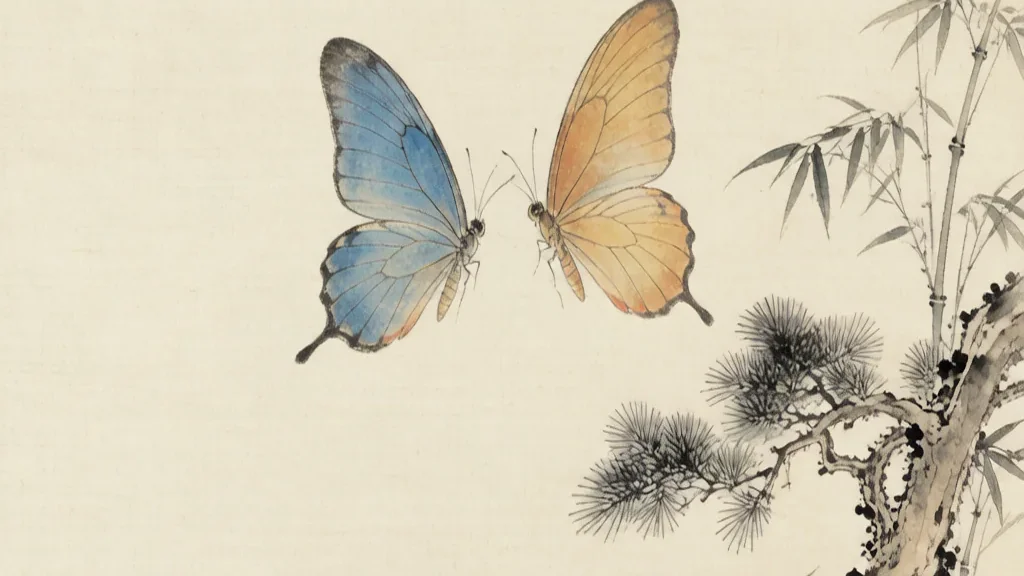
The Butterfly Lovers (梁祝) is the tragedy of Zhu Yingtai and Liang Shanbo, two lovers who unite at last as butterflies.
The Disguised Scholar
Zhu Yingtai was a brilliant young woman from a wealthy family who longed to study at the academy. Since women were not permitted to study, she disguised herself as a man and enrolled under the name Zhu Yingtai. There she met Liang Shanbo, a kind and gifted scholar who became her best friend and roommate. They studied together for three years, and during this time Zhu Yingtai fell deeply in love with Liang Shanbo, though she dared not reveal her true identity.
The Farewell and the Revealed Secret
After three years, Zhu Yingtai was called home by her family. Liang Shanbo accompanied her on the journey. Along the way, Zhu Yingtai dropped hints about her true identity, comparing herself to a maiden and a mandarin duck. But Liang Shanbo, being completely innocent of any deception, failed to understand her meaning. She told him he should visit her home to meet her 'younger sister' - who was actually herself.
The Betrothal and Tragic Separation
When Liang Shanbo finally visited Zhu Yingtai's home, he discovered she was a woman. Overjoyed, he realized his feelings for her. But it was too late - Zhu Yingtai's parents had already betrothed her to a wealthy merchant named Ma Wencai. Liang Shanbo returned home heartbroken, fell ill from grief, and died.
The Transformation into Butterflies
On the day of Zhu Yingtai's forced wedding to Ma Wencai, the procession passed by Liang Shanbo's grave. Zhu Yingtai asked to stop and pay her respects. As she knelt before the grave, a sudden storm arose. The grave split open, and Zhu Yingtai leaped inside. The grave closed, and from it emerged two beautiful butterflies, dancing together in the sunlight. They have been inseparable ever since.
Cultural Legacy
The Butterfly Lovers is one of the Four Great Folktales of China alongside the Legend of the White Snake, the Cowherd and the Weaving Maid, and Meng Jiangnu. The story has been adapted into countless operas, films, and musical works. The most famous adaptation is the Liang Zhu violin concerto, a masterpiece of Chinese classical music.
Historical Context and Evolution
This legend has evolved over centuries, with different dynasties adding new elements and interpretations. The earliest versions were simple oral tales that grew more complex as they were retold and recorded by scholars and writers.
The story reflects the values and concerns of the society that created it. Themes of loyalty, love, justice, and the supernatural reveal much about Chinese cultural priorities.
As the legend spread across China, regional variations developed, each adding local flavor while preserving the core narrative.
Legacy in Modern Chinese Culture
This legend continues to influence modern Chinese culture. It appears in films, television series, novels, and even video games. Contemporary adaptations often reinterpret the story for modern audiences while respecting its traditional roots.
The characters and themes from this legend have become part of everyday Chinese language and thinking. References to the story appear in idioms, proverbs, and common expressions.
Festivals and traditions associated with this legend are still observed in many parts of China, keeping the ancient story alive in the modern world.
Historical Development
The history of this topic spans thousands of years of Chinese civilization. Early records from ancient texts provide glimpses into its origins. Over successive dynasties the subject evolved significantly absorbing influences from different regions.
During the Tang and Song dynasties this field experienced a golden age. Scholars and practitioners refined techniques established standards and created works that influenced generations. The imperial court often patronized this art elevating its status.
The Ming and Qing dynasties saw further refinement. Increased trade brought new ideas from beyond Asia. This cross-cultural fertilization enriched the tradition while maintaining its Chinese character.
In the modern era efforts have been made to preserve traditional practices. The government has designated many related crafts as Intangible Cultural Heritage ensuring their survival.
Regional Variations
Different regions of China have developed their own distinctive styles. Northern styles emphasize bold forms and practicality reflecting harsh climates. Southern styles are more refined and decorative.
Eastern coastal regions developed interpretations influenced by maritime trade with Japan and Korea. Western regions with diverse ethnic populations incorporated elements from minority traditions.
Central China as the historical heartland represents the most classical forms. Many standard techniques were established here and spread to other regions.
Modern Applications
Today this tradition continues to evolve. Contemporary practitioners experiment with modern materials while respecting traditional forms. This creative tension between innovation and tradition drives the field forward.
International interest in Chinese culture has created global markets. Exhibitions and workshops have introduced these traditions to worldwide audiences fostering cross-cultural appreciation.
Educational institutions offer programs training the next generation. These combine traditional apprenticeship with modern approaches ensuring effective knowledge transmission.
Cultural Significance
This subject embodies core Chinese values. Its symbolism draws from Confucian ethics Daoist cosmology and Buddhist spirituality creating layers of meaning that reward deeper study.
Materials colors and forms all carry specific meanings. Motifs represent longevity prosperity happiness or spiritual protection. These choices reflect deliberate artistic and cultural decisions.
Rituals and ceremonies associated with this subject connect practitioners to centuries of tradition serving as living links to the past.
❓ Frequently Asked Questions
📝 Chinese Vocabulary
梁祝 — : Liang Zhu; the Butterfly Lovers
祝英台 — : Zhu Yingtai; the female scholar
梁山伯 — : Liang Shanbo; the male scholar
化蝶 — : Transformation into butterflies
四大民间故事 — : Four Great Folktales of China
同窗 — : Schoolmates, literally sharing a window, the term for Liang Shanbo and Zhu Yingtai's three years of study together.
马文才 — : Ma Wencai, the wealthy man to whom Zhu Yingtai was betrothed, whose marriage she was forced to accept.
越剧 — : Yue opera, the regional opera form most closely associated with the Butterfly Lovers and its famous adaptations.
🎉 Fun Facts
- The Butterfly Lovers is often called China's Romeo and Juliet, but it predates Shakespeare by centuries.
- The Liang Zhu violin concerto was composed in 1959 and is one of the most performed Chinese orchestral works.
- In some versions, the butterflies are colored gold and purple to represent the lovers.
- The legend is especially beloved in the Yangtze delta region of Zhejiang and Jiangsu, where it is staged in local dialects.
- Zhu Yingtai's cross-dressing to attend school has made her a lasting emblem of women's claim to education in Chinese culture.
- Nearly every major Chinese regional opera has its own version of the story, giving each region a distinct musical interpretation of the tragedy.