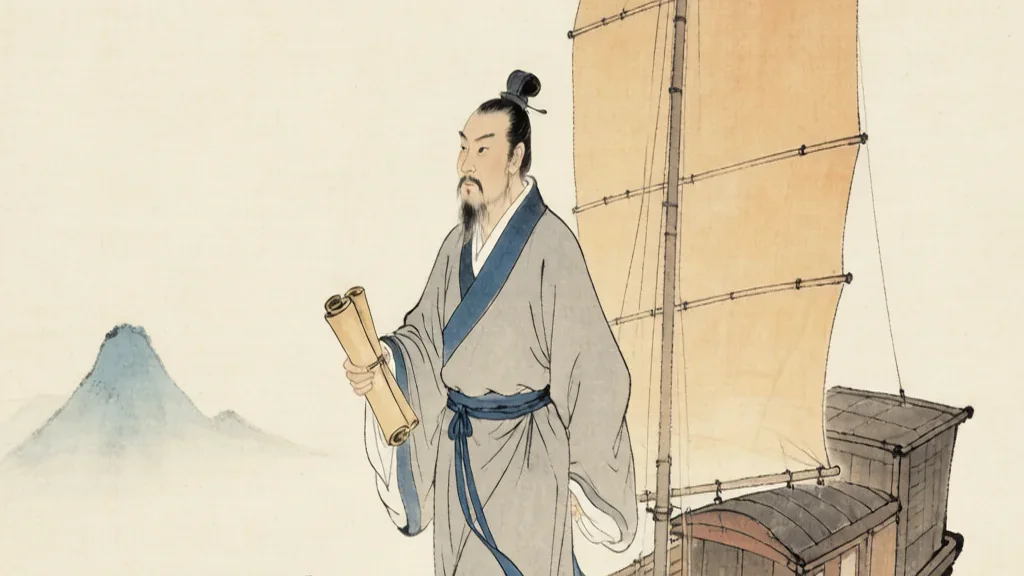
Xu Fu was a Fangshi alchemist and occultist who served at the court of Qin Shi Huang, the founding emperor of the unified Chinese empire, during the late third century before the common era. He is remembered above all for leading a series of enormous maritime expeditions commissioned by the emperor to search for the Isles of the Blessed and the elixir of immortal life. The surviving ancient accounts describe fleets carrying thousands of young men and women, artisans, seed grain, and provisions, sailing eastward across unknown seas in pursuit of a herb that would grant perpetual youth. Xu Fu's story sits at the intersection of early Chinese statecraft, the quest for longevity, and the wider maritime imagination of the classical world, and it has generated centuries of speculation about where his ships ultimately landed.
Historical Sources and the Shiji Account
The principal narrative of Xu Fu survives in the Shiji, the Records of the Grand Historian compiled by Sima Qian in the first century before the common era. Within the chapters devoted to the First Emperor, Xu Fu appears as one of several Fangshi who promised access to supernatural realms and longevity substances. The text records that he reported the existence of three sacred mountains in the ocean, Penglai, Fangzhang, and Yingzhou, where immortals dwelled and where the herb of eternal life might be obtained.
According to the Shiji, Xu Fu petitioned the throne for a large expedition, arguing that the journey required ships, navigators, and a company of boys and girls untouched by the world. The emperor, consumed by anxiety over his own mortality, granted the request and funded the venture at enormous cost to the treasury. The historian frames these episodes within a broader critique of the emperor's credulity and the willingness of court magicians to exploit it for wealth and influence.
The Shiji does not give a precise year for the first voyage, but it places the episodes within the later years of the Qin reign, after the empire had been consolidated and the emperor had begun his restless tours of the realm. Later dynastic histories and local gazetteers retold and embellished the account, but the Shiji remains the foundation on which every subsequent version of Xu Fu's legend is built.
The Three Sacred Mountains of the Eastern Sea
Central to Xu Fu's petitions was the geography of the immortal isles. Penglai, Fangzhang, and Yingzhou were described in early Daoist and geographical lore as floating mountains in the Bohai or the open ocean, appearing and disappearing in mist, guarded by creatures and inhabited by perfected beings who had conquered death. The Shanhaijing and other classical texts preserved related traditions about distant lands beyond the sea.
These mountains were not merely physical places in the ancient imagination but symbols of a cosmological boundary between the mortal world and the realm of the immortals. The emperor's obsession with reaching them reflected a broader classical Chinese belief that longevity and even immortality could be pursued through rare substances, breath cultivation, and contact with transcendent realms. Xu Fu positioned himself as the one who could bridge that boundary.
The elusiveness of the isles became part of the legend itself. Later retellings claimed that whenever an expedition approached, winds and mist drove the ships back, interpreted by court Fangshi as a sign that the immortals withheld their secrets from the unworthy. This motif of the unreachable sacred mountain recurs throughout Chinese mythology and helped explain why no expedition ever returned with the herb.
Xu Fu as a Fangshi at the Qin Court
The term Fangshi refers to a class of specialists in methods, techniques, and occult arts who flourished in the Warring States and Qin periods. They offered rulers divination, weather lore, pharmacology, and access to the supernatural. Figures such as Lu Sheng and Hou Sheng appear alongside Xu Fu in the Shiji as competitors for imperial favor, each promising secrets of longevity.
Xu Fu's particular authority rested on his claimed knowledge of the sea routes and the rites needed to approach the immortal realm. The court of Qin Shi Huang attracted many such individuals because the emperor's appetite for immortality was boundless and his resources were without precedent. The Fangshi occupied an ambiguous position, both honored and perilously exposed when their promises failed.
The danger of the role is clear in the Shiji's account of the burning of books and the execution of several scholars and magicians after failed predictions and disappearances. Xu Fu's eventual departure, whether voluntary or compelled, spared him the fate of others who lost the emperor's trust. His career illustrates both the prestige and the precarity of the occult expert in a centralized monarchy.
The First Expedition and Its Costs
The Shiji describes the scale of Xu Fu's fleets in terms that staggered later readers. He is said to have taken several thousand boys and girls, craftsmen of every trade, seed for crops, and abundant supplies, enough to establish a settlement rather than merely to explore. Such a fleet represented a massive diversion of labor and grain from the nascent imperial administration.
The expense drew criticism even within the court. The First Emperor had levied immense corvee labor for the Great Wall, roads, palaces, and his tomb complex, and the maritime ventures added to the burden. The historian implies that Xu Fu and his colleagues enriched themselves while delivering nothing, returning with excuses about winds and hostile spirits rather than the promised herb.
Modern scholars read these accounts as evidence of early Chinese capabilities in shipbuilding, navigation, and long distance seafaring, even if the exact dimensions are exaggerated. The expedition's multicultural cargo of artisans and farmers suggests a planned colony, not a simple embassy, and reflects the imperial reach of Qin ambition beyond its land borders.
The Second Voyage and the Emperor's Death
After the first expedition returned without the elixir, Xu Fu is recorded as asking for more resources, blaming his failure on a giant fish or sea monster that blocked the path to Penglai. The emperor, consulting omens and a dream, ordered archers to accompany the next fleet and reportedly personally shot a large fish on the coast to clear the way.
This second, larger expedition set out and never returned to Qin. By the time it sailed, the First Emperor was aging and would soon die on a tour of the eastern provinces, in the year conventionally given as two hundred and ten before the common era. With the emperor gone and the Qin state collapsing into civil war, there was no authority to recall or account for Xu Fu.
The silence of the sources after this voyage is precisely what allowed legend to flourish. Ancient writers simply note that Xu Fu departed eastward and was never seen again, leaving later generations to imagine whether he perished at sea, settled on an island, or founded a distant kingdom beyond the horizon.
Later Traditions and the Japan Connection
The most enduring elaboration of the Xu Fu story identifies his destination with the Japanese archipelago. Medieval Japanese chronicles and later Chinese gazetteers associate him with the region of Kumano and the practice of introducing rice cultivation, medicine, and weaving. Local shrines in Japan have long claimed Xu Fu as a civilizing founder and ancestral figure.
These traditions gained force in the centuries after the Han, as maritime contact between the mainland and the Japanese islands became more frequent and as communities sought prestigious origins for their customs. Whether or not there is a historical kernel, the Xu Fu legend became a shared cultural memory linking two civilizations through the figure of a wandering sage.
In both countries, Xu Fu is remembered less as a failed courtier than as a bringer of knowledge. Japanese folk religion absorbed him into local tutelary cults, and Chinese storytellers celebrated his escape from a tyrannical emperor. The dual inheritance shows how a Qin dynasty anecdote migrated into the foundational myths of neighboring peoples.
Cultural Memory in Literature and Drama
Across the imperial period, Xu Fu appeared in poetry, drama, and vernacular fiction as the archetype of the seeker after immortality. Tang and Song poets invoked Penglai and the eastern voyage as shorthand for futile longing or for the transcendence beyond worldly power. The image of the empty fleet became a moral emblem.
In the Ming novel Fengshen Yanyi and in countless operas, the Qin court's obsession with longevity served as a cautionary contrast to the Daoist ideal of effortless transcendence. Xu Fu sometimes appears as a sympathetic figure, a man caught between an emperor's demands and the silence of the immortals, rather than as a mere fraud.
The durability of his story reflects a tension at the heart of Chinese thought about death. The same culture that venerated ancestors and accepted mortality also nursed a powerful dream of conquering it, and Xu Fu embodied that dream's grandeur and its danger in equal measure.
Archaeology and the Question of Evidence
Modern archaeologists have found no direct inscription or wreck证实 Xu Fu's fleet, but coastal sites in Shandong and the Yangtze region show the scale of Qin era maritime activity, including large terracotta and bronze objects, harbor works, and remains of ocean going vessels. These finds confirm that the Qin state possessed the capacity the legends describe.
Investigations around the Bohai and Yellow Seas have recovered sacrificial pits and ceremonial deposits that some local scholars link to the emperor's eastern cult sites, where he performed rites to the sea and to the immortals. Such evidence supports the Shiji's claim that maritime immortality cults were state sponsored enterprises rather than fringe superstition.
Claims of Xu Fu relics in Japan remain circumstantial, resting on place names, folk ritual, and later inscriptions rather than contemporary records. Scholars treat the Japan connection as plausible cultural memory rather than proven history, a useful reminder that legend and evidence occupy different registers of truth.
Symbolism of the Elixir Quest
At its deepest level, the Xu Fu legend dramatizes the encounter between absolute political power and the limits of nature. The First Emperor unified script, law, and measure, but he could not unify mortal flesh with immortal spirit, and his hired magicians could not deliver what the cosmos withheld.
The boy and girl colonists symbolize a human future projected beyond the known world, a utopian seed carried past the edge of empire. Their absence from history becomes a vanished possibility, a lost colony of the imagination that later storytellers repopulated with every hope their own age required.
Read this way, Xu Fu is not a footnote to Qin tyranny but a meditation on ambition itself. The eastward voyage sails out of every empire that mistakes control for mastery, and it returns, like the empty ships of the Shiji, with only the wind and the silence of the gods.
Modern Legacy and Tourism
Today Xu Fu is commemorated at sites in Jiangsu, Shandong, and across the strait in Japan, where festivals and museums retell his voyage as a story of cultural exchange rather than mere superstition. Local governments have cultivated his memory as a bridge between Chinese and Japanese heritage and as a symbol of early maritime courage.
Scholars continue to debate the historicity of the Japan landing, but the debate itself sustains interest in Qin seafaring and in the broader history of East Asian contact before the great age of ocean exploration. Xu Fu has become a figure through whom both nations negotiate identity, migration, and the long memory of the sea.
In popular culture he appears in films, comics, and historical fiction as the restless explorer who outwitted an emperor and vanished into legend. That enduring appeal confirms the power of his story: a court alchemist who turned a tyrant's fear of death into a voyage no boundary could contain.
❓ Frequently Asked Questions
Who was Xu Fu in Chinese history?
Xu Fu was a Fangshi alchemist at the court of Qin Shi Huang who led massive maritime expeditions to find the elixir of immortality, as recorded in the Shiji.
What were the three sacred mountains he sought?
They were Penglai, Fangzhang, and Yingzhou, immortal isles said to float in the eastern sea and to guard the herb of eternal life.
Did Xu Fu ever return from his voyage?
Ancient sources state that his final expedition sailed east and was never seen again, leaving later generations to speculate about his fate.
Is there a connection between Xu Fu and Japan?
Later Chinese and Japanese traditions identify his destination with the Japanese islands, where shrines honor him as a civilizing founder, though evidence remains circumstantial.
Why did Qin Shi Huang fund such expensive expeditions?
The emperor was obsessed with achieving longevity and was willing to spend vast treasury resources and corvee labor to obtain the deathless herb.
What is the historical source for the Xu Fu story?
The primary account is the Shiji, the Records of the Grand Historian by Sima Qian, with later embellishment in gazetteers and legend.