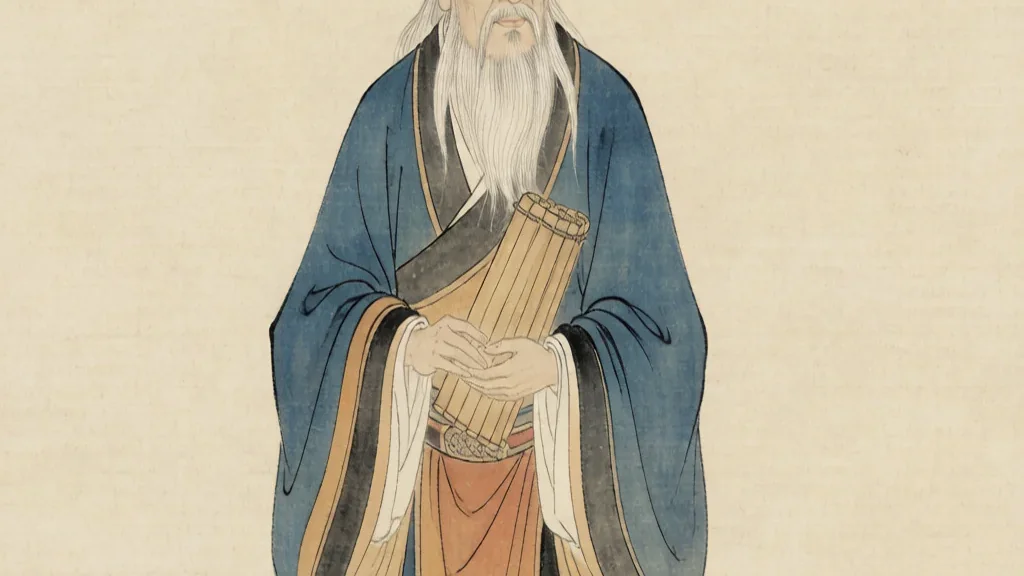
Cangjie is the legendary official credited with the invention of Chinese writing during the reign of the Yellow Emperor, the culture hero regarded as a founding ancestor of Chinese civilization. Described in later texts as having four eyes and a supernatural capacity to perceive patterns, Cangjie is said to have derived the first characters from the tracks of birds and the markings of beasts, fixing spoken language into durable visible signs. The moment of his invention is remembered as world altering: according to the myth, the heavens rained grain and ghosts wailed at night, because the creation of writing let human affairs be recorded and thereby ended the age of innocent oblivion. Cangjie thus stands at the origin of literacy, administration, and historical memory in the Chinese cultural sphere.
The Legend of Four Eyes and Heavenly Patterns
Later hagiographies grant Cangjie four eyes, a conventional marker in Chinese lore of extraordinary insight, signaling that he could see what ordinary mortals could not. This prodigious vision allowed him to study the natural world and to isolate the recurring forms by which things differ and correspond.
The standard account says he observed the footprints of birds and the hoof marks of animals, noticing that each creature leaves a distinct trace by which it can be known. From these tracks he abstracted the principle of the sign: a mark that stands for a thing without being the thing. Writing, on this view, begins with attentive looking at the world's own notations.
The four eyed seer became an icon of the scribe as sage. Temple imagery shows him with a calm, doubled gaze, often accompanied by a tortoise or bird, reminders of the creatures whose traces inspired the first graphs. The motif insists that invention is discovery, not fabrication, a reading of nature into form.
Cangjie and the Yellow Emperor's Court
Cangjie is placed at the court of the Yellow Emperor, Huangdi, the sovereign under whom many foundational arts are said to have been systematized, from calendar and medicine to cart and boat. As the historiographer or recorder of the court, Cangjie faced the problem of memorizing and transmitting an expanding store of decrees, rites, and accounts.
Before writing, the legend implies, affairs were bound to memory and to knotted cords, a method inadequate to a growing realm. Cangjie's invention answered the administrative need for a stable medium that outlasts the voice. In this framing, script is born of governance as much as of inspiration.
His role as official historiographer also explains why writing and history are inseparable in the Chinese tradition. To write was to record the acts of the ruler and the order of the cosmos, and Cangjie's office fused the scribe with the keeper of collective memory from the very beginning.
The Bird Tracks and the Origin of Graphs
The most celebrated detail of the legend is the inspiration drawn from bird footprints in the snow or mud. Each species leaves a characteristic track, and Cangjie realized that a deliberate mark could similarly distinguish one thing from another. This analogy underlies the pictographic and ideographic logic of early script.
Later commentators extended the story: he studied river patterns, star arrangements, and the physiognomy of mountains, gathering models for the strokes of characters. The six principles of character formation later systematized by Xu Shen, including pictographs and ideographs, are retrospectively traced to Cangjie's intuitive taxonomy of the world.
The bird track origin also carries a moral. Unlike speech, which slips away, the track endures as evidence; writing thus introduces accountability, the possibility that a deed is fixed and witnessed. The myth quietly links literacy to law and to the surveillance of power.
The Heavenly Grain Rain and the Wailing Ghosts
The founding myth reaches its climax with a cosmic response: when Cangjie completed the characters, the sky rained millet and the ghosts wept in the night. These signs register the gravity of fixing language in visible form, an act that disturbed the natural and spirit orders.
The grain rain symbolizes abundance brought by literacy, since record keeping stabilizes agriculture, taxation, and the storing of seasons. The weeping ghosts represent the loss of a prior obscurity in which misdeeds and secrets dissolved; writing exposes and preserves, ending the spirits' dominion over the forgotten.
This dual portent captures the ambivalence of writing. It is a blessing that organizes civilization and a curse that entombs error and intention for judgment. The legend thereby honors Cangjie as a civilizer whose gift carried both progress and peril, a nuance rare in tales of invention.
Cangjie in the Received Historical Tradition
The earliest firm references to Cangjie appear in Warring States and Han texts such as the Xunzi and the Shiji, where he is named as the inventor of characters rather than as a fully fleshed narrative figure. Sima Qian lists him among antiquarian culture heroes, establishing his canonical status.
The Han etymological dictionary Shuowen Jiezi, compiled by Xu Shen, opens by invoking Cangjie as the first to separate the classes of things by written signs, and it presents the six principles of character formation as the elaboration of his insight. The dictionary thus institutionalizes him as the patron of philology.
Over time Cangjie migrated from historiographic footnote to popular deity. Tang and later courts granted him titles, and scribes' guilds venerated him as a patron saint of letters, building halls where examinations and the new year were observed with rites to the inventor of script.
Temples, Cults, and the Patron of Scribes
Throughout imperial China, Cangjie was worshipped by those whose livelihood depended on writing: clerks, teachers, students, and calligraphers. Temples dedicated to the Sage of Characters stood in several provinces, and his image presided over schools as a guardian of literacy.
The cult peaked around the examination system, when success in writing determined social ascent. Candidates offered petitions to Cangjie for steady hand and clear mind, blending reverence for the inventor with anxiety about performance. The deity mediated between the mortal scribe and the vast tradition he had founded.
Folk ritual also linked him to the arrival of spring and to the awakening of insects, because his birthday was sometimes celebrated with the hope that writing, like rain, quickens the world. These local observances show how a courtly myth rooted itself in village calendar custom.
Relationship to Other Culture Heroes
Cangjie belongs to a cluster of Yellow Emperor era inventors that includes the silkworm goddess, the wheel maker, and the calendar maker. Together they represent the classical Chinese account of civilization as a set of coordinated inventions bestowed by sage officials rather than by a single god.
His task complements that of Fu Xi, who is credited with the eight trigrams, an earlier system of symbolic notation. Where Fu Xi mapped cosmic structures through lines, Cangjie mapped the myriad things through graphs, and later thought saw the two as stages in the refinement of notation from omen to writing.
This placement within a pantheon of inventors explains his restrained, functional aura. Cangjie is not a thunderous deity but a quiet civil servant of the cosmos, the clerk who made all later clerks possible, and that modesty is central to his enduring respect.
Calligraphy, Literacy, and Cultural Identity
Because Chinese identity long centered on the written character, Cangjie became a symbol of what unifies a vast and dialect diverse realm. The shared script allowed administration and poetry to span regions that could not speak to one another, and he stands at the head of that unity.
Calligraphers traced their art to the moment signs became beautiful as well as useful, and the legend's emphasis on perceiving natural pattern foreshadowed the aesthetic ideal that writing should imitate the vital movement of the world. Cangjie is thus an ancestor of both clerk and artist.
In the modern era his myth supports the pride of a continuous literary tradition spanning more than three thousand years of attested inscriptions. To honor Cangjie is to honor the conviction that a civilization is, above all, a community of readers and writers bound by the character.
Modern Scholarship and the Real Origins of Writing
Modern archaeology shows that Chinese writing developed gradually from Neolithic symbolic marks through oracle bone inscriptions of the late Shang, centuries after the mythical Yellow Emperor. Cangjie is therefore understood as a personification of a long collective process rather than a single inventor.
Scholars note that the attribution to one sage reflects the classical preference for a heroic origin story and for crediting the Yellow Emperor's golden age with every foundational art. The legend encodes a truth about the social function of writing even as it simplifies its chronology.
Yet the myth remains historically valuable as evidence of how the Chinese conceived their own literacy: as a deliberate, world observing, cosmos altering achievement. Cangjie survives not as fact but as the culture's self portrait at the instant it learned to remember in signs.
❓ Frequently Asked Questions
Who was Cangjie in Chinese myth?
Cangjie was the legendary historiographer of the Yellow Emperor credited with inventing Chinese writing after observing bird and beast tracks.
Why is he depicted with four eyes?
The four eyes symbolize extraordinary insight, marking him as a sage who could perceive the patterns of the world that others missed.
What happened when he invented characters?
The myth says the sky rained grain and ghosts wailed, signifying that writing brought civilization but also ended the age of oblivion.
Did one person really invent Chinese writing?
Modern scholarship sees Cangjie as a personification of a long collective development from Neolithic marks to Shang oracle bones.
How is Cangjie connected to literacy culture?
Scribes, teachers, and students venerated him as patron of letters, and the Shuowen Jiezi entrenched him as the sage of philology.
What inspired the first characters?
According to legend he studied the distinct tracks of birds and animals, abstracting the principle that a mark can stand for a thing.