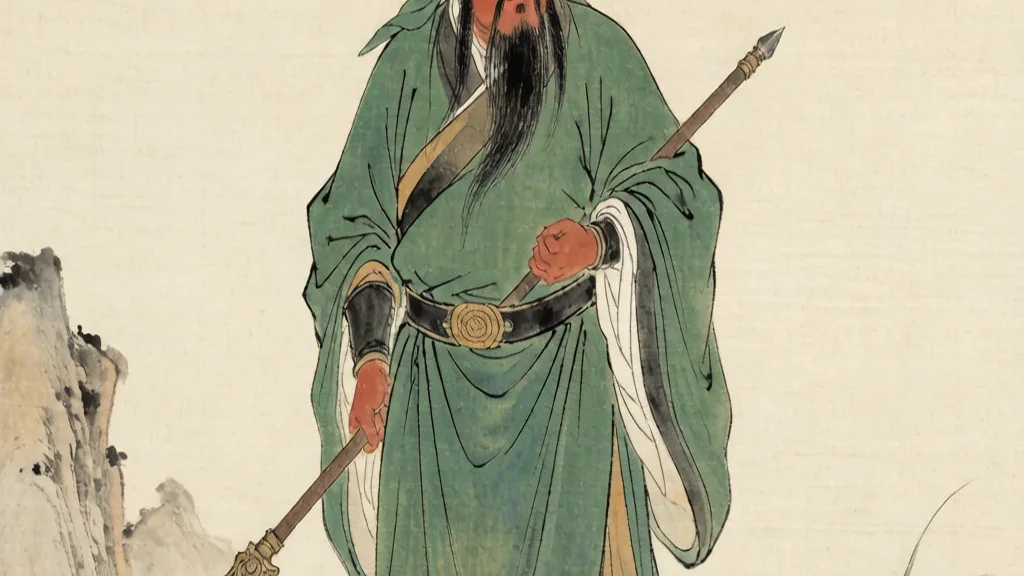
Guan Yu, also revered as Guan Gong or the Saint of War, is one of the most remarkable examples in world folklore of a historical person transformed into a god. A loyal general who served the warlord Liu Bei during the late Han dynasty and the fractured era later romanticized as the Three Kingdoms, Guan Yu died in the early third century, yet his reputation for righteousness, bravery, and unwavering fidelity grew across the centuries until imperial courts formally canonized him and ordinary people worshipped him as a protector of merchants, soldiers, and oath bound brothers alike. Unlike many mythological beings born purely from imagination, Guan Yu began as a documented commander whose deeds were recorded in history and then magnified by novelists, playwrights, and temple priests into a suprahuman paragon of loyalty. Today his red faced image, holding a long blade and often reading a book, stands in restaurants, police stations, banks, and household shrines throughout the Chinese cultural world, a testament to how completely a mortal memory can harden into living divinity.
Historical Guan Yu of the Three Kingdoms
The real Guan Yu appears in the official histories of the Han and the successor states as a formidable warrior and trusted lieutenant of Liu Bei, one of the contenders for the ruined Han empire. He was known for martial prowess, personal courage, and a famous episode in which he endured a wound treatment while calmly playing a board game, a story that became a favorite symbol of stoicism. His loyalty to Liu Bei survived separation, temptation, and battlefield reversals that might have broken a weaker bond.
His career ended in defeat and execution after a campaign against the forces of the rival state of Wu, an ignominious end for a hero that the later storytelling tradition could not leave unredeemed. The gap between his historical death and his mythical glory is precisely where legend did its work, transforming a fallen general into a martyr of loyalty whose blood was merely the seed of his godhead. History gave the skeleton; folklore supplied the radiant flesh.
What distinguished him in the records was not merely skill at arms but a reputation for honor that even enemies acknowledged, a trait rare enough among the warlords of his age to be memorable. That kernel of attested character, the loyal and formidable retainer, proved fertile soil for the enormous mythological growth that followed across more than seventeen hundred years.
The Romance of the Three Kingdoms and Literary Apotheosis
The single most influential source for the Guan Yu legend is the long historical novel that dramatizes the struggles of the Three Kingdoms period, a work that blends recorded event with invention and decisively shaped popular memory of the era. In its pages Guan Yu becomes the radiant center of the virtue of brotherhood, bound to Liu Bei and to the swift strategist Zhang Fei by an oath sworn in a peach garden to live and die for a common cause.
The novel magnifies his exploits into the superhuman: single combat against overwhelming odds, a night ride to deliver a severed enemy head, and a calm reading of military texts by lamplight that fuses scholar and soldier into one icon. These episodes are not history but they became more real to the popular imagination than history, because they expressed what people wanted to believe about loyalty made bodily.
Through the novel and its countless stage adaptations, Guan Yu migrated from the page into ritual. Performers and audiences treated his representation with reverence, and some troupes refused to portray him carelessly, a sign that fiction had already tipped into veneration. The literary character thus became a devotional object, and the boundary between reading about a hero and praying to a god grew thin.
From General to God: The Process of Deification
The elevation of Guan Yu from admired ancestor to enrolled deity was a slow, cumulative process driven by both popular devotion and state interest. Local shrines to his memory appeared early, maintained by soldiers and by people who had known his story, and these grassroots cults gradually attracted the attention of rulers who found his image useful for promoting loyalty among troops and subjects alike.
Successive dynasties granted him escalating titles, culminating in honors that named him a emperor or a sage comparable to the worthies of the Confucian pantheon. Each grant of title was a political act as much as a religious one, since a state that worshipped loyalty effectively taught loyalty, and Guan Yu's biography supplied the perfect textbook. The throne and the temple reinforced each other in building his cult.
By the late imperial period he had accumulated a vast string of honorific names and was worshipped under several aspects simultaneously: as a martial saint parallel to the civil sage Confucius, as a protector of the state, and as a personal guardian of the family altar. Few figures in Chinese religion attained such layered, officially sanctioned divinity while retaining a recognizable human biography at the core.
Symbols and Iconography of the Red Faced Saint
Guan Yu is almost always shown with a face painted or carved in deep red, a feature so fixed that the phrase red faced has become a byword for his loyalty and fiery integrity in everyday speech. The redness is explained in legend by a transfusion of blood from a righteous stranger or by the natural heat of his virtuous indignation, but its function is to mark him instantly as the man of unbending principle.
He carries a distinctive long handled blade, a weapon associated with his martial identity and often depicted resting across his shoulder or planted before him like a standard. In many images he is also shown reading or writing, usually the military classic attributed to a great strategist, which signals that his strength is tempered by learning and self discipline rather than mere violence.
His long, luxuriant beard is another signature, referenced in both history and fiction as a mark of dignified masculinity, and temple statues often elaborate it into a flowing attribute of majesty. Together the red face, the blade, the book, and the beard compose an iconographic language that any worshipper could read at a glance, conveying loyalty, power, learning, and gravity in a single figure.
Guan Yu as God of War and of Wealth
Paradoxically for a god of war, Guan Yu is also widely worshipped as a patron of commerce and prosperity, especially by merchants, shopkeepers, and members of traditional trade guilds. The logic of this dual role lies in his reputation for trustworthiness: business depends on sworn fidelity and fair dealing, and who better to guard a ledger than the paragon of loyalty who kept his oath unto death.
In the martial aspect he is invoked by soldiers, police, and martial artists who seek courage and protection, and his temples have historically stood near garrisons and academies of boxing alike. The same figure who blessed the battlefield thus also blessed the marketplace, a union of strength and honesty that made him uniquely suited to a mercantile society that needed both.
This combination explains his presence in such unlikely places as banks and restaurants, where owners place his image to invite integrity and fortune simultaneously. The god who guaranteed loyalty in brotherhood now guarantees loyalty in transaction, showing how a military cult can morph into a civic one without losing its original emotional charge.
Temples, Rituals, and Popular Worship
Shrines and temples dedicated to Guan Yu spread across China and throughout the diaspora, ranging from grand state sponsored complexes with full liturgical calendars to tiny household alcoves where a single image receives incense each morning. The act of offering him incense, fruit, or burns of paper money is a daily piety for many, performed without elaborate theology but with sincere confidence in his protection.
Annual observances mark his birthday and the anniversaries of his legendary deeds, drawing crowds who stage operas, processions, and feasts in his honor. These festivals double as community gatherings that reinforce local identity and commercial solidarity, since guilds historically organized the celebrations and used them to display their standing and mutual obligation.
In the household he frequently shares the altar with other protective figures, and new businesses often install his image before opening, a ritual of consecration meant to secure honest success. The persistence of these practices into the present shows that his worship is less a matter of doctrine than of habit, comfort, and the social bond expressed through shared reverence.
Guan Yu in Opera, Drama, and the Stage
Traditional theater made Guan Yu a central repertoire figure, with entire plays built around his victories, his captivity, and his death, performed in styles from northern percussion drama to southern melody theater. Because his character was sacred to many spectators, actors prepared for the role with purification and offered prayers, and some troupes banned vulgar joking during rehearsals of his scenes.
The stage face paint for his role follows a strict convention: a red base with a few black accents that indicate his steadfastness and his moments of lethal anger, and the performer moves with a measured, monumental carriage to suggest monumental virtue. Audiences read the makeup as they would read a saint's halo, and the convention itself taught viewers how to feel about the man before a word was spoken.
Through these performances his story reached people who could not read the novel, embedding his legend in oral and visual memory across classes and regions. The stage Guan Yu became a kind of moving icon, carrying the same reassuring message of loyalty and protection into villages and city squares generation after generation.
Comparisons with Other Culture Heroes
Guan Yu belongs to a worldwide pattern in which a historical warrior becomes a focus of worship, resembling in function the veneration of martial saints and national protectors found elsewhere in Asia and beyond. What sets him apart is the extraordinary symmetry of his cult, balancing the civil and martial, the state and the shop, the family and the army, within a single biography.
Unlike purely mythical war gods who were never persons, Guan Yu carries the weight of a documented life, which gives his worship a peculiar concreteness: people venerate a remembered ancestor as much as an abstract power. This fusion of history and holiness is a hallmark of Chinese popular religion, where the line between the honored dead and the divine is porous by design.
He also parallels the figure of the sworn brother and the righteous outlaw found in other traditions, the champion who keeps faith against a corrupt world, but his official canonization lent him a respectability that outlaws rarely enjoy. The result is a hero acceptable to emperor and merchant, to priest and playwright, a rare consensus figure in a divided cultural landscape.
Modern Legacy and Global Spread
In the contemporary world Guan Yu remains visible far beyond religious contexts, appearing in films, television serials, video games, and comic books that retell the Three Kingdoms with varying fidelity. His image travels with Chinese communities abroad, and temples to him flourish in Southeast Asia, where he serves diaspora merchants as a link to homeland identity and a mascot of upright enterprise.
He has also been adopted as a symbolic figure by police and fraternal organizations that value the same virtues of loyalty and brotherhood his legend celebrates, and his statues stand in places where the line between folklore and emblem is deliberately blurred. The red faced saint has become, in effect, a brand of trustworthiness recognizable even to those who know no details of his life.
Perhaps his most striking modern role is as a quiet moral reference point in a society wary of betrayal and instability, a living reminder that fidelity still commands reverence. Whether honored with incense or merely printed on a shop wall, Guan Yu continues to perform the ancient task of making loyalty visible, proving that a general who lost his last battle can still win an endless war for memory.
Why the Legend Endures
The durability of the Guan Yu legend rests on its answers to needs that do not change: the hunger for trustworthy allies, the respect for courage disciplined by principle, and the comfort of a protector who is also a person one could, in imagination, share a cup with. He satisfies the desire for a hero who is strong without being cruel and holy without being distant.
Because his story is anchored in a real life, it resists the drift into abstraction that weakens lesser myths, and because his virtues are communal rather than solitary, he binds worshippers to one another as much as to him. The oath of the peach garden is, finally, the heart of his appeal: a promise kept is the smallest unit of civilization, and Guan Yu is its eternal patron.
In the end the legend survives because it tells people that loyalty is not only praised in stories but rewarded across centuries, that a man who kept his word can become a god, and that the red faced saint at the threshold is watching to ensure the promise holds. That assurance, repeated in temple smoke and televised battle alike, is why his name still carries weight.
❓ Frequently Asked Questions
Was Guan Yu a real person?
Yes. He was a historical general who served Liu Bei during the late Han and Three Kingdoms period and died in the early third century. His documented life of loyalty and valor was later magnified by novelists and priests into the deity worshipped today.
Why is Guan Yu's face red?
The red face is his iconic symbol of loyalty and fiery righteousness, explained in legend by a transfusion of righteous blood or by the heat of his virtue. In everyday language a red face has become shorthand for incorruptible fidelity.
Why is a war god also a god of wealth?
Merchants adopted him because his defining trait is trustworthiness, the foundation of fair trade. A god who guaranteed loyalty in brotherhood naturally came to guarantee loyalty in business, so he protects both the battlefield and the ledger.
What is the Oath of the Peach Garden?
It is the sworn brotherhood of Liu Bei, Guan Yu, and Zhang Fei, who pledged in a peach orchard to live and die for a common cause. The oath is the emotional core of his legend and a model of fraternal loyalty in Chinese culture.
How was Guan Yu deified?
Popular shrines to his memory grew over centuries and attracted imperial patronage; successive dynasties granted him rising titles, eventually naming him a sage and emperor. State and temple together built his cult into an officially sanctioned divinity.
Where is Guan Yu worshipped today?
His temples and images appear across China and the diaspora in Southeast Asia and beyond, in homes, shops, banks, police stations, and restaurants. He remains a living symbol of loyalty in both religious and secular contexts.