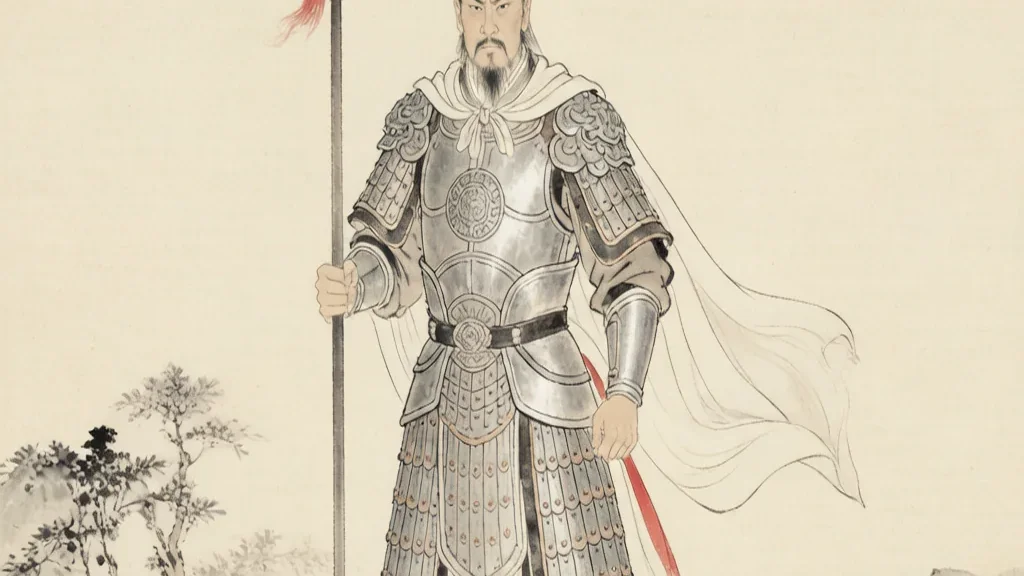
Zhao Yun, whose style name is Zilong and whose name is written in Chinese as 赵云 (zhào yún), is the paragon of the loyal and chivalrous warrior in the literature of the Three Kingdoms, the turbulent era at the end of the Han dynasty when rival warlords fought for the falling empire. A commander who served the Shu ruler Liu Bei with unbroken fidelity, he is best remembered for riding alone into the host of the enemy Cao Cao at the Battle of Changban to rescue his lord's infant son and carry him to safety on a white horse. Celebrated in the novel Romance of the Three Kingdoms as a man of flawless courage and modest virtue, Zhao Yun became the model of the gentleman warrior, admired not only for martial skill but for his restraint, loyalty, and concern for the people caught in war.
Zhao Yun in the Romance of the Three Kingdoms
The figure of Zhao Yun reached the widest audience through the Romance of the Three Kingdoms, the late imperial novel attributed to Luo Guanzhong that dramatized the wars of the third century. In that sweeping narrative he is presented as one of the champions of the righteous Shu kingdom, a warrior whose deeds are told with open admiration and whose character is kept free of the flaws that mar other heroes.
The novel belongs to a long tradition of Three Kingdoms storytelling that grew from history, drama, and oral performance, and Zhao Yun's reputation was shaped as much by the stage and the storyteller as by the official histories. Over centuries his image was polished into an ideal type, the soldier who is both invincible in battle and humble in victory, a combination that made him a favorite of audiences.
Service to Liu Bei
Zhao Yun entered the service of Liu Bei, the claimant to Han legitimacy who founded the state of Shu, and remained with him through exile, defeat, and the slow building of a kingdom. Unlike commanders who shifted allegiance for advantage, Zhao Yun is portrayed as constant, following Liu Bei through his worst fortunes and never bargaining for rank or land.
This loyalty was not blind obedience but a shared commitment to the ideal of restoring order and righteousness, and Zhao Yun repeatedly offered counsel that put the welfare of the realm above personal gain. His long service gave him the standing to speak frankly to his lord, and the records credit him with remonstrances that protected the people rather than the army's pride.
The Battle of Changban
The episode that sealed Zhao Yun's fame is the Battle of Changban, where the forces of Cao Cao overwhelmed Liu Bei's fleeing column and scattered his family. Amid the chaos Zhao Yun plunged back into the enemy throng, refusing to save himself while his lord's wife and infant son were unguarded, and fought his way to the child.
According to the legend he took the baby, Liu Shan, and strapped him to his body, then cut a path out through waves of Cao Cao's soldiers, slaying commanders and breaking encirclements until he returned the heir safely to Liu Bei. The single-handed rescue against overwhelming odds became the defining image of his career and the proof of his devotion.
The White Horse and Silver Spear
Zhao Yun is almost always depicted on a white horse wielding a silver spear, an iconography that sets him apart on the battlefield and in art. The white mount and bright lance gave him a striking, almost celestial appearance that suited his reputation for purity of purpose, and storytellers delighted in describing the flash of his charge.
The visual identity of the white horse and silver spear also helped audiences recognize him instantly in opera and illustration, where color and prop carried meaning as clearly as words. In the swirl of a multi-army battle, the white rider became a symbol of hope for the Shu side and a figure of dread for their enemies, a literary device as much as a historical memory.
Loyalty and Modesty
What distinguishes Zhao Yun from many warrior heroes is his modesty and his refusal to exploit his fame. Tales record that after great deeds he accepted little reward and deferred to others, and that he used his influence to plead for the soldiers and civilians rather than for himself, behavior unusual among ambitious commanders.
This restraint made him a Confucian ideal as well as a martial one, for he embodied the virtue of the gentleman who exercises power without cherishing it. Later moralists held him up as proof that the man of arms could also be a man of principle, and his example was cited to show that true greatness lies in service rather than in titles.
The Rescue of the Heir
The infant Zhao Yun rescued at Changban, Liu Shan, would grow up to become the second ruler of Shu, which gave the episode a dynastic importance beyond its drama. By saving the heir, Zhao Yun was seen as preserving the continuity of Liu Bei's line and therefore the legitimacy of the Shu state itself.
The bond between the savior and the saved became a recurring motif, and the story gains pathos from the contrast between the helpless child and the desperate ride that secured his life. Generations of readers understood the rescue as the moment when personal courage upheld the fate of a kingdom, a neat fusion of the intimate and the historic.
Later Campaigns
Beyond Changban, Zhao Yun took part in the campaigns that established and defended Shu, including the long struggles against Cao Cao in the west and the contested marches of the Shu armies. He is credited with both bold frontal assaults and careful rearguard actions that protected retreating forces from destruction.
In one noted episode he covered a difficult withdrawal with a small guard and an open camp, using calm and bluff to deter a far larger enemy, a tale that shows his skill as a tactician and not merely a duelist. Such stories broadened his legend from single-combat heroism to the steadier virtue of a commander who could be trusted with the whole army.
The Five Tiger Generals
The Romance of the Three Kingdoms ranks Zhao Yun among the Five Tiger Generals of Shu, the elite band of commanders headed by the mighty Guan Yu and the fierce Zhang Fei. Within this company he is often granted the highest moral standing, the one whose excellence is untarnished by pride or cruelty.
His placement among the tigers reflects both his battlefield record and his popularity with later audiences, who preferred him as the most admirable of the group. The ranking became a fixed feature of Three Kingdoms lore, ensuring that Zhao Yun would always be listed beside the greatest names of the age even when the histories gave him a somewhat smaller role.
Zhao Yun in Opera and Popular Culture
On the stage of Chinese opera Zhao Yun is a stock heroic role, his entrance on the white horse greeted with recognition, and his Changban ride staged as a tour de force of stylized combat. The episode was adapted into individual scenes that could be performed on their own, carrying the whole legend in miniature.
In modern media he appears across film, television, video games, and comics based on the Three Kingdoms, usually as the upright champion whose skill is matched by his heart. The durability of these adaptations shows that his appeal is not bound to a single era but speaks to a lasting appetite for the hero who is both strong and good.
Why He Endures
Zhao Yun endures because he resolves a tension at the center of the warrior ideal, the fear that great power corrupts. Where other famous generals are shown as proud, violent, or tragically flawed, Zhao Yun remains steady, humane, and self-effacing, offering a version of strength that ordinary people can admire without reservation.
His legend also satisfies a deep cultural preference for loyalty that survives misfortune, since he stayed faithful through Liu Bei's darkest years and asked for nothing in return. In a storytelling tradition rich with ambitious and unstable men, the constant white-robed general stands as a reassuring figure, proof that honor and ability can dwell in the same person.
❓ Frequently Asked Questions
Who was Zhao Yun?
Zhao Yun was a commander who served the Shu ruler Liu Bei during the Three Kingdoms period and became the ideal of the loyal, chivalrous warrior in Chinese legend.
What is his most famous deed?
At the Battle of Changban he rode alone into Cao Cao's army and rescued Liu Bei's infant son, carrying the heir to safety on his white horse.
Why is he so revered?
He combined battlefield brilliance with modesty, loyalty, and care for the people, making him a model of the gentleman warrior untarnished by pride.
What is his signature image?
He is depicted on a white horse with a silver spear, an appearance that marks him instantly in art and opera.
Was he a real historical figure?
Yes, he was a genuine Shu general, though the Romance of the Three Kingdoms greatly expanded his deeds into legend.
Who were the Five Tiger Generals?
They were the elite commanders of Shu named in the Romance of the Three Kingdoms, among whom Zhao Yun is ranked for his virtue and skill.