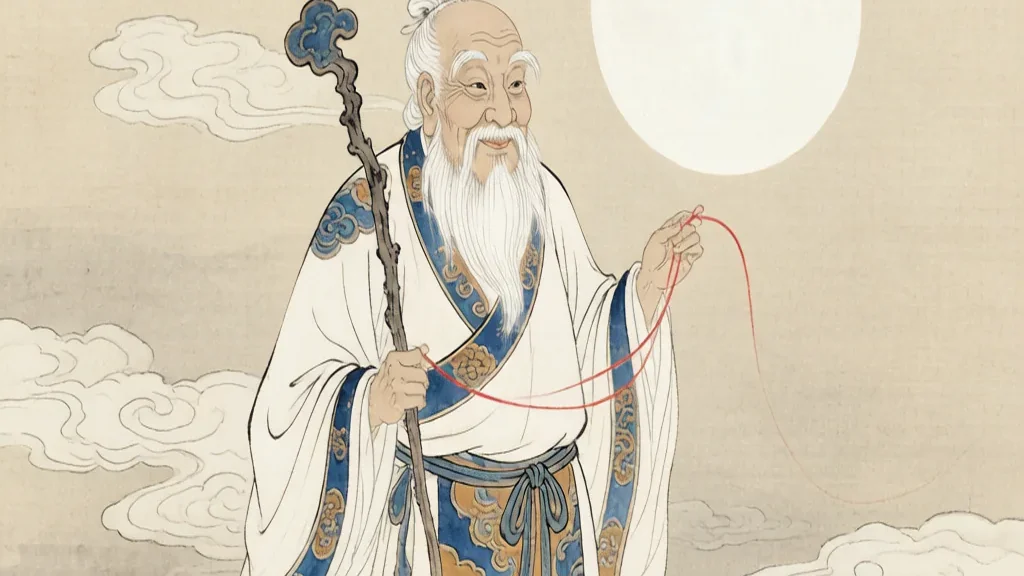
Yuelao, the Old Man under the Moon, is the Chinese god of marriage and matchmaking, the benevolent deity who binds destined couples together with an invisible red thread. His legend originates in a Tang dynasty tale recorded by Li Fuyan, in which a scholar named Wei Gu encounters an old man reading a book of marriages by moonlight and learns that the red cord the deity ties around the ankles of fated partners cannot be broken by any human effort. As the patron of matchmakers, husbands and wives, and happy unions, Yuelao remains one of the most beloved figures invoked at Chinese weddings, the gentle guarantor that love is written in the stars and that the right person, however distant or humble, is already bound to arrive. In a culture that treated marriage as the foundation of family and society, the Old Man under the Moon was the unseen hand that joined what heaven had decided.
Origin in a Tang Tale
The legend of Yuelao is preserved in a Tang dynasty story, the work of the writer Li Fuyan, who collected marvel tales in which the supernatural intrudes on everyday life to reveal a hidden order. The Yuelao episode is among the most charming of these, a nocturnal encounter that turns a young man's impatience into a lesson about fate.
What is striking is that the god enters literature as a fully formed character, an old man with a book and a cord, suggesting he may already have circulated in oral folklore before the written tale fixed him. The Tang author gave the popular belief a memorable plot, and the plot then fed the belief back to the people.
The dating matters because it places Yuelao among the later, literary deities of Chinese religion rather than the archaic nature gods. His authority is administrative and romantic at once, the bureaucrat of the heart, and his origins in a refined tale suit that genteel office.
The Old Man by Moonlight
In the tale the scholar Wei Gu, restless and eager to marry, meets an old man beneath the moon who is consulting a book by the light of the lantern he carries. The moonlit setting is essential: the moon is the cold, clear witness of destinies, and the old man's work by its light marks him as a reader of fates rather than a maker of them.
The encounter is casual yet world altering. Wei Gu, like any young man, wishes to hurry his marriage, and the old man quietly corrects him, explaining that the match is already decided and that no hurry or interference can alter what the cord has bound. The moon becomes the lamp under which the soul's pairing is studied.
The image of the old man under the moon is one of the tenderest in Chinese myth, a grandfatherly figure tending the loves of strangers with patient care. He is not distant or terrible but near and gentle, the opposite of the fearsome judges of the underworld, a deity of blessing rather than accounting.
The Red Thread of Fate
The central symbol of Yuelao is the red thread, or red cord, which he ties around the ankles, or sometimes the little fingers, of the man and woman destined to marry. Once bound, the pair are drawn together across any distance or obstacle, and no human power can sever the connection the deity has made.
The red colour is itself auspicious in Chinese culture, the hue of joy, luck, and vitality, so the thread that joins lovers is also a token of blessing. To be tied by Yuelao is to be marked by fortune, the red line a scarlet signature across two separate lives.
The thread's invisibility is part of its power. The bound partners may not know each other, may be separated by rank or geography, yet the cord already links them, working through circumstance to bring them face to face. The symbol assures the lovelorn that absence is only temporary, the thread still taut.
The Book of Marriages
Besides the thread, the old man carries a book, the register of marriages, in which every destined union is already written. The book is the celestial counterpart of the family genealogies that recorded earthly alliances, a master ledger of the heart kept by the deity who tends it by moonlight.
The register implies that marriage is not a matter of chance or mere family arrangement but of prior inscription, a destiny entered before the partners are born. This belief could comfort the unwilling bride or groom by suggesting that the match, however strange, was ordained, and could console the lonely by promising that a page was already reserved.
With book and thread together, Yuelao administers a complete system: the ledger records the pair, and the cord binds it. The deity is both clerk and knot tier, the civil servant of romance who files the union and then ties it tight against the world.
Wei Gu and the Servant Girl
The plot of the Tang tale turns on a prophecy. The old man tells Wei Gu that his future wife is a humble servant's daughter, not the elevated match the young scholar hopes for. Disdainful, Wei Gu tries to prevent it, even arranging an attack on the child, yet years later he marries exactly that girl, marked by the scar of the old attempt, and learns that fate cannot be evaded.
This twist is the moral core of the legend. It teaches that resistance to one's destined match is futile and that the bound partner, however unlikely, is the right one. The scar becomes the seal of the prophecy, the body remembering what the mind rejected.
The story also gently mocks snobbery. Wei Gu's objection is social rank, and the tale punishes it by making the humble girl inevitable, suggesting that the red thread honours the heart's match above the family's ambition. Love, in Yuelao's book, is democratic.
Yuelao as Patron of Matchmakers
Because he binds marriages, Yuelao became the patron of matchmakers, the go betweens who arranged unions in a society where most marriages were negotiated by intermediaries rather than chosen by the couple. The human matchmaker was seen as the agent of the old man under the moon, carrying out a destiny already written.
This patronage dignified a practical trade. The matchmaker, often a figure of comic suspicion in literature, received divine cover in Yuelao, who authorised her negotiations as the working out of the cord. To consult a matchmaker was, in this view, to consult the god by proxy.
Temples to Yuelao arose where the lovelorn and the marriage minded could pray, and matchmakers themselves honoured him as their guild deity. The bond between the human go between and the lunar old man closed the circle from heaven to household.
Yuelao in Wedding Custom
At Chinese weddings Yuelao's presence is invoked in images, couplets, and blessings that wish the couple a union tied by the red thread. The red decorations of the ceremony, from the bride's veil to the double happiness characters, echo the cord that the old man is said to have already drawn.
Newlyweds and their families might visit a Yuelao shrine to give thanks or to pray for harmony, treating the deity as a guardian of the marriage after as well as before the vows. The god who tied the knot was trusted to keep it from fraying.
The persistence of these customs into the present shows the durability of the figure. Even in an age of love matches, the Old Man under the Moon survives as a charming symbol of destined union, the gentle claim that some meetings are written before they happen.
The Moon as Matchmaker
The choice of the moon as Yuelao's setting deepens the legend's poetry. The moon is traditionally associated with reunion and with the feminine in Chinese symbolism, and as the calm light of the night it presides over the secret affections that daylight propriety conceals. The old man works where lovers' thoughts already wander.
The moon also measures time and cycle, linking the deity to the rhythms within which marriages are made and remembered, the annual festivals of reunion under the full moon. To be matched by the moon is to be matched by the great clock of togetherness that governs the emotional year.
In this symbolism Yuelao is the moon's tender function made personal, the face behind the light that has always stood for meeting and parting. The Old Man under the Moon is, finally, the moon's own promise that the separated will be joined.
Symbolism of Destined Love
At bottom Yuelao symbolises destined love, the comforting belief that the right partner is fixed by a power beyond accident, and that the search for love is discovery rather than manufacture. The red thread is the image of a connection that survives ignorance, distance, and resistance.
The legend also softens the anxiety of marriage in a matchmaking culture. By locating the union in the deity's book, it relieves the couple and the families of total responsibility while still honouring the human work of the matchmaker. Fate and arrangement cooperate, the cord and the contract together.
In the end Yuelao remains the Old Man under the Moon who ties what heaven has joined, the gentle guarantor that love is no accident but a bond already drawn in red. To invoke him is to trust that the person meant for you is, even now, bound by a thread that nothing can break.
❓ Frequently Asked Questions
Who is Yuelao?
Yuelao, the Old Man under the Moon, is the Chinese god of marriage and matchmaking who binds destined couples with a red thread.
What is the red thread of fate?
It is the invisible cord Yuelao ties around the ankles or fingers of fated partners, drawing them together so that no human power can part them.
Where does the legend come from?
It appears in a Tang dynasty tale by Li Fuyan about the scholar Wei Gu, who meets the old man reading a book of marriages by moonlight.
What is in Yuelao's book?
The book is the register of marriages, in which every destined union is already written before the partners are born.
Who worships Yuelao?
Matchmakers honour him as their patron, and couples pray to him at weddings and shrines for harmony and a destined union.
What does Yuelao symbolise?
He symbolises destined love, the comforting belief that the right partner is fixed by heaven and that true union survives distance and resistance.