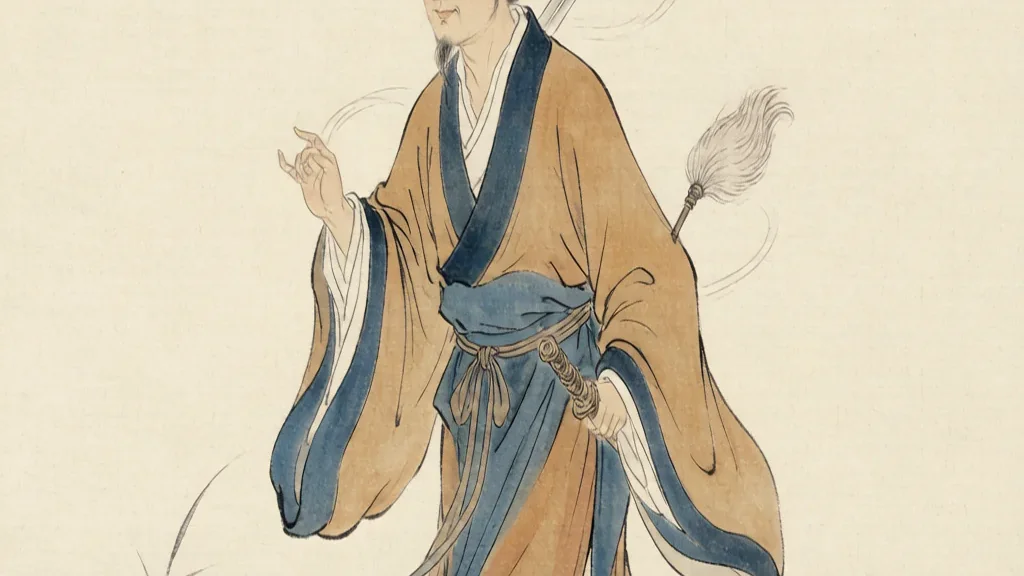
Lu Dongbin, whose given name was Lu Yan and whose style name is written in Chinese as 吕洞宾 (lǚ dòng bīn), is the most human and most active of the Eight Immortals of Daoist legend, the scholar-knight who trades a career in office for the path of immortality. Among the Eight Immortals he is usually treated as the leader or central figure, the one who travels the world testing and teaching ordinary people, slaying dragons and delusions with a flashing sword. His story bridges history and myth, for he is said to have lived as a real Tang dynasty scholar before his encounter with the immortal Zhongli Quan transformed him into a wandering adept. Through centuries of legend, drama, and sectarian Daoism, Lu Dongbin became a model of the educated man who turns learning into compassion and action.
Lu Dongbin in the Eight Immortals
The Eight Immortals are a beloved group of Daoist adepts whose varied backgrounds, a beggar, a woman, an old man, a cripple, a courtier, and others, make them approachable figures who represent the wish that immortality is open to all kinds of people. Lu Dongbin stands at the heart of this company as the most frequently named and the most literary of the eight.
He is typically depicted as a gentleman in a scholar's robe carrying a sword across his back and sometimes a fly-whisk, with a calm and slightly mischievous expression that signals his role as a tester of human character. Because he moves among mortals more than the other immortals, he serves as the bridge between the heavenly assembly and the everyday world of the stories.
Historical Origins as Lu Yan
Unlike many purely mythical figures, Lu Dongbin is rooted in a historical person, a scholar of the Tang dynasty named Lu Yan who was reputed for his learning and his poetry. Tradition places him in the late Tang, a period of declining imperial order when many educated men turned from official careers toward Daoist cultivation and retreat.
The historical Lu Yan was remembered as a man of talent who repeatedly sat for the civil examinations, the gate to government office, and whose life took a decisive turn through a spiritual encounter. Later devotees embellished this biography until the scholar became fully identified with the immortal, so that the line between the man of the Tang and the god of the temples grew comfortably blurred.
The Meeting with Zhongli Quan
The decisive moment of Lu Dongbin's transformation is his meeting with Zhongli Quan, the stout immortal who becomes his teacher. The two encounter one another at an inn or a wayside inn in some versions, where Zhongli Quan begins to reveal the emptiness of worldly ambition through a series of tests designed to wear down Lu's attachment to fame and fortune.
Zhongli Quan is said to have set Lu Dongbin a battery of ten trials, in which he faced temptations, insults, and dangers without losing his composure, proving himself ready for initiation. This pattern of testing became a hallmark of Lu Dongbin's own later behavior, since he in turn tests the mortals he meets, reproducing the pedagogy he once received.
The Yellow Millet Dream
The best-known of Zhongli Quan's lessons is the Yellow Millet Dream, in which the teacher causes Lu Dongbin to fall asleep and dream an entire lifetime of success, office, wealth, family, and eventual ruin, all while a pot of millet simmers on the fire. When Lu awakens, the millet is still not cooked, and he realizes that a whole human life passed in the time it takes to prepare a meal.
This episode is one of the most quoted parables in Chinese literature, a compact statement of the Daoist insight that worldly striving is fleeting and that the pursuit of rank and riches is a kind of dream. The story was so influential that it spawned its own dramatic and fictional treatments, and the phrase "yellow millet dream" entered the language as a way of dismissing the vanity of ambition.
The Magic Sword
Lu Dongbin's signature attribute is his sword, which he uses not for ordinary violence but to cut through illusion, slay dragons, and dispatch the demons of greed and desire. The blade symbolizes discernment, the power to sever the false from the true, and it marks him as a martial counterpart to the gentler immortals.
In legend he is called upon to subdue flood dragons and to defend the vulnerable, and his sword tricks often double as moral lessons, since the creatures he fights are embodiments of human failing as much as literal monsters. The weapon thus expresses the ideal of the scholar who can act decisively in the world while remaining detached from its confusions.
Teacher and Tester of Mortals
After his own awakening, Lu Dongbin becomes a wanderer who mingles with mortals in disguise, rewarding the worthy and exposing the hypocrite. Many tales turn on a poor or humble person who shows kindness to a strange traveler, only to discover that the visitor was the immortal in disguise who grants long life or fortune in return.
This role as tester gives Lu Dongbin a strong moral function in popular storytelling, for his judgments reinforce the values of generosity, filial piety, and sincerity. At the same time, his fondness for appearing as an ordinary or even disreputable figure lends the legends a democratic tone, suggesting that wisdom may arrive from the least expected source.
Poetry and the Scholar Ideal
Lu Dongbin is celebrated as a poet, and a corpus of verses is attributed to him in Daoist collections, expressing themes of detachment, the refinement of inner energy, and the folly of clinging to status. His literary reputation reinforced his appeal to the educated class, who saw in him the ideal of the gentleman who keeps his learning while transcending the grind of official life.
The image of the immortal poet also suited the Daoist aim of cultivating both mind and body, since verse was a means of refining spirit as surely as breathing exercises refined breath. Lu Dongbin therefore became a patron for scholars who wished to pursue both worldly letters and inner freedom, a synthesis that gave him lasting prestige among the literate.
Connection to Quanzhen Daoism
In the history of organized religion, Lu Dongbin became a central figure of the Quanzhen, or Complete Perfection, school of Daoism that rose to prominence in the later imperial period. The founders of Quanzhen claimed him as a patriarch and wove his legend into the sect's teachings about internal alchemy and the transformation of the self.
Within Quanzhen devotion he was honored alongside other perfected beings as a source of revelation, and temples dedicated to the lineage would recite his texts as part of practice. This institutional embrace transformed the wandering folk immortal into a doctrinal authority, ensuring that his name would survive not only in stories but in the liturgy of a major religious order.
Patron of Professions
Over time Lu Dongbin acquired the patronage of several earthly trades, a development common to popular Chinese deities. He is especially associated with barbers and, in some regions, with the theatrical profession and with scholars, reflecting both his sword, which barbers once ritually honored, and his literary fame.
The assignment of occupational patrons allowed communities to bring the immortal into daily economic life, so that a barber or an actor might pray to Lu Dongbin for skill and protection. These cults show how a high mythic figure was localized and domesticated, made useful to ordinary workers who had little interest in the subtleties of internal alchemy.
Legacy in Art and Festivals
Lu Dongbin appears throughout Chinese visual culture, from temple murals of the Eight Immortals to New Year prints in which the group brings good fortune to the household. He is a standard figure in the birthday celebrations held for the immortals and in the operas that dramatize their adventures, particularly the episodes of his testing and his sword fights.
In modern times he remains a familiar character in films, television, comics, and games that draw on the Eight Immortals, usually cast as the wise and witty leader. His enduring appeal lies in the combination he represents, the learning of a scholar with the freedom of a wanderer and the compassion of a teacher, a figure through whom the highest Daoist ideals are made lively and approachable.
❓ Frequently Asked Questions
Who is Lu Dongbin?
Lu Dongbin is a Tang dynasty scholar turned Daoist immortal, regarded as the leader of the Eight Immortals and a wandering teacher who tests and helps mortals.
What is the Yellow Millet Dream?
It is the lesson in which his teacher Zhongli Quan makes him dream a whole lifetime of glory and ruin in the time it takes to cook millet, showing the fleeting nature of worldly ambition.
What does his sword represent?
His sword symbolizes the power to cut through illusion and desire, slaying the inner and outer demons that bind people to confusion.
Was Lu Dongbin a real person?
He is based on a historical Tang scholar named Lu Yan, whose biography was later expanded into the immortal legend known today.
Which Daoist school honors him?
The Quanzhen, or Complete Perfection, school venerates Lu Dongbin as a patriarchal figure and source of revealed teachings.
Why is he called a tester of mortals?
He travels in disguise, rewarding kindness and exposing hypocrisy, so his encounters teach lessons about sincerity, generosity, and detachment.