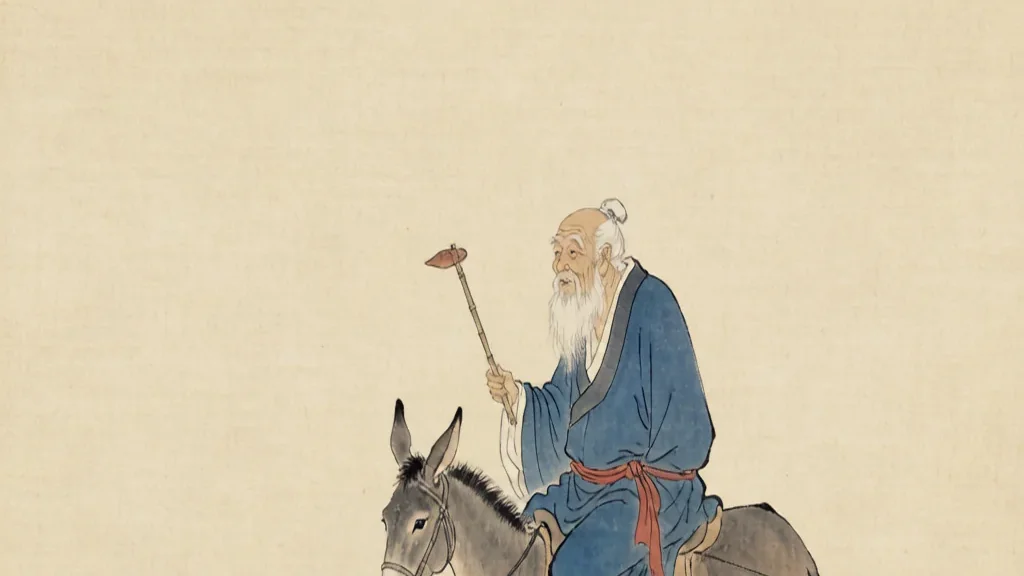
Zhang Guolao is the Eight Immortal most associated with old age, magic, and the comical wisdom of the reverse path, famous above all for riding a small white donkey backwards, facing its tail, and for being able to fold that donkey into a wallet sized packet and revive it with a puff of water. Behind the legend stands a historical Daoist named Zhang Guo who served at the Tang court and was summoned again by later rulers, a man renowned for his claims of immense age and his mastery of the arts of longevity. Among the Eight Immortals he is the patron of magicians, fortune tellers, and all who delight in the paradox that the shortest road may be the one travelled the wrong way round. His white beard and his reversed seat announce that the elder may see what the young, staring straight ahead, cannot.
The Historical Zhang Guo
The figure rests on a partly historical base. A Daoist adept named Zhang Guo was known in the Tang period, associated with the Zhongtiao mountains and reputed to practise the techniques of nourishing life that promised extraordinary longevity. Court records and anecdote alike note his appearance before emperors who were curious about the secret of his apparent age.
Unlike purely mythical immortals, Zhang Guo appears in official biographies of the Tang, where he is described as a hermit of unusual vitality who declined honours and baffled interrogators with his evasions. The historians treated him with a mixture of respect and scepticism, exactly the tone that surrounds a wonder worker at court.
This historical kernel gave the legend unusual solidity. Because a real person stood behind the tale, storytellers could attach marvels to a name already recorded, and the resulting figure straddles the line between biography and myth, the documented hermit and the immortal who outlived dynasties.
The Backwards Riding Donkey
The single most famous image of Zhang Guolao is the old man seated on a white donkey facing its tail rather than its head. The reversal is no mere whimsy; it is a visual joke with a serious point, suggesting that the immortal perceives the world differently from ordinary travellers, who rush forward without seeing where they came from.
Riding backwards, Zhang Guolao appears to move away from his destination while actually arriving, a paradox that mirrors the Daoist teaching that progress often looks like its opposite. The donkey, a humble beast of burden, becomes the vehicle of a wisdom that needs no fine chariot, only patience and a willingness to face the other way.
In festival prints the backwards donkey is rendered with obvious delight, the white beard streaming, the donkey's placid expression contrasting with the absurdity of the pose. The image conveys that enlightenment may arrive disguised as comedy, and that the elder who seems to go the wrong way may in fact be the only one going right.
The Folded Donkey Trick
Closely tied to the donkey is Zhang Guolao's signature miracle: when his journey ends, he folds the living animal into the size of a piece of paper or a wallet, tucks it away, and when he needs to travel again he unpacks it and sprinkles water from his mouth, whereupon the donkey springs back to life and full size. The trick is the immortal's calling card.
The feat belongs to a wider repertoire of Daoist transformation magic, the art of compressing and expanding matter at will, which signaled mastery over the ordinary limits of space and substance. To fold a donkey is to prove that the adept is not bound by the weight of the world.
Children especially loved this episode, and it became a staple of street entertainment lore, the kind of wonder that made Zhang Guolao the immortal most readily imagined as a performing magician. The folded donkey is the perfect emblem of a power that is at once domestic, comic, and absolute.
Zhang Guolao and the Imperial Court
Legends multiply the occasions on which Zhang Guolao was summoned by rulers eager for the secret of long life. The Empress Wu and the Emperor Xuanzong of Tang are both named in different accounts as patrons who invited him, tested him, and were variously amazed or subtly rebuked by his evasions and wonders.
In these court scenes the immortal typically resists enrolment in the bureaucracy, accepting no office and revealing no formula that the emperor can bottle. The refusal is itself the lesson: longevity cannot be commanded by decree, and the sage serves no throne but the Dao. The comedy of the backwards donkey thus carries a quiet political edge.
The contrast between the aged hermit and the splendid court is the dramatic engine of these tales. Around the golden hall walks a man who folds donkeys and declines empires, the living proof that the greatest power in the realm may be the one who wants nothing from it.
The Fish Drum and the Phoenix Feather
Zhang Guolao carries two emblems: a bamboo tube drum known as the fish drum, beaten with a small stick, and a feather whisk or banner, sometimes called the phoenix feather, used in ritual. The fish drum is both a musical instrument and a tool of divination, its rhythm accompanying the songs that reveal destiny.
The drum links him to the tradition of blind bards and fortune tellers who chanted by percussion, and it explains his patronage of those trades. The feather, light and clean, symbolises the dispelling of dust from the mind, the sweeping away of illusion that the true adept performs with a single stroke.
Together the two objects mark Zhang Guolao as a figure of sound and of purification, the immortal who both announces fate and clears the vision to read it. They are the working implements of the magical elder, as central to his identity as the donkey itself.
Arts of Longevity
The historical Zhang Guo was credited with the practices of nourishing life, the Daoist regimens of breath, diet, and motion said to extend vitality far beyond the ordinary span. His legend turns these regimens into marvels, presenting him as a man who had lived through the reigns of many emperors and remembered the distant past firsthand.
Such arts were a serious branch of Daoist practice, pursued by court and cloister alike, and Zhang Guolao became their friendly popular face. The white beard and the claim of great age advertise the payoff of the discipline, while the comedy keeps the promise from seeming like a grim labour.
In this he differs from the immortals won by sudden grace; his longevity is portrayed as the fruit of technique sustained over unimaginable time. The message to ordinary followers was encouraging: the elixir is not only a gift of heaven but a practice of daily life, available to the patient.
Zhang Guolao Among the Eight
Within the fellowship of the Eight Immortals, Zhang Guolao is the elder statesman of paradox, the one whose reversed seat and folded beast keep the group from taking itself too seriously. His presence balances the hotter tempered members with a dry, elderly humour that sees through ambition.
In the crossing the sea tableau he rides his donkey across the water, or simply floats the folded creature, demonstrating once more that the immortal's power is personal and peculiar, not a uniform ability shared by all. Each immortal crosses by means of his or her own nature, and Zhang Guolao's is the nature of the comic sage.
The group's unity depends on such variety, and Zhang Guolao supplies the note of venerable mischief. He is the grandfather of the company, the one whose age entitles him to contradict everyone, and whose contradictions turn out, as usual, to be right.
Patron of Magicians
Because of the folded donkey and the fish drum, Zhang Guolao became the patron of stage magicians, illusionists, and the blind diviners who told fortunes by song. Troupes of performers and practitioners of sleight of hand invoked him as their professional ancestor and protective spirit.
The association also reached into the household, where his image on a child's toy or a magician's prop conferred a blessing of cleverness and harmless wonder. To be like Zhang Guolao was to delight an audience while hinting at a deeper truth behind the trick.
In a culture that valued both seriousness and play, the immortal of magic held a useful place, licensing the joy of the impossible while reminding the wise that the impossible is sometimes only the unseen made visible. The folded donkey is the creed of the conjurer made sacred.
Symbolism of the Reverse Path
The deepest meaning of Zhang Guolao lies in his reversal. To ride backwards is to suggest that understanding comes from attending to what is behind us, the past, the source, the road already travelled, rather than only to the lure of the unseen ahead. The immortal watches where he has been in order to know where he goes.
This symbolism dovetails with Daoist and broader Chinese respect for age and ancestry. The elder who faces the tail is the tradition facing its own origins, confident that the future is best approached by honouring the ground already covered. The reversed seat is a posture of reverence disguised as jest.
In the end Zhang Guolao teaches that wisdom may look like folly, that the long way may be short, and that the old man on the donkey, apparently going nowhere in particular, is in fact arriving precisely where he intends. He remains the Eight Immortals' cheerful proof that the Dao often moves backward into the truth.
❓ Frequently Asked Questions
Who is Zhang Guolao?
Zhang Guolao is one of the Eight Immortals, based on a historical Tang Daoist, famous for riding a white donkey backwards and for his mastery of longevity and magic.
Why does he ride the donkey backwards?
The reversed seat symbolises that true wisdom comes from attending to the past and the source, and it marks him as the comic sage who sees what others rushing forward miss.
What is the folded donkey trick?
Zhang Guolao folds his living donkey into a small packet when not travelling and revives it to full size with a puff of water, demonstrating mastery over substance.
Was Zhang Guolao a real person?
A Daoist adept named Zhang Guo appears in Tang records as a hermit of great vitality, around whom the immortal legends later accumulated.
Who worships Zhang Guolao?
Magicians, illusionists, and blind fortune tellers honour him as their patron, and his image blesses cleverness and harmless wonder.
What do his emblems mean?
The fish drum announces fate through rhythm, and the feather whisk sweeps illusion from the mind, together marking him as a figure of sound and purification.