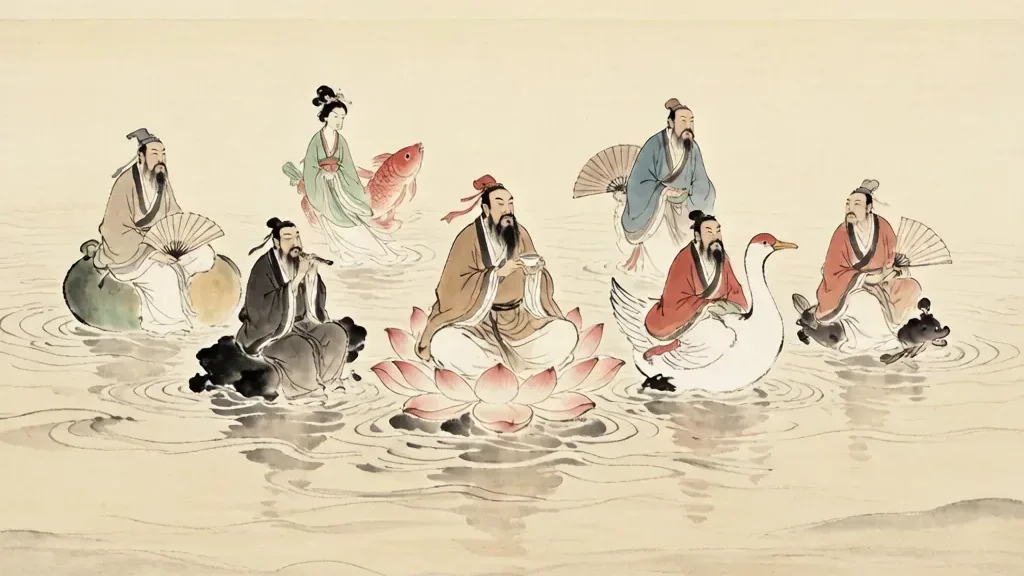
Of all the colorful figures in Chinese mythology, few are as beloved — or as varied — as the Eight Immortals. They are not a uniform pantheon of perfect gods. They are a messy, wonderful ensemble: a cripple, a nobleman, a hermaphrodite, an old man, a young woman, a scholar, a musician, and a royal. Together, they represent the Daoist ideal that enlightenment is not reserved for any single type of person, but can be attained by anyone, from any walk of life.
The tale of how these eight legendary beings crossed the Eastern Sea is one of the most famous stories in Chinese folklore. It gave birth to one of the language's most enduring idioms — "the Eight Immortals cross the sea, each showing their divine power" (八仙过海,各显神通) — meaning that different people bring different strengths to a common challenge. It is a story about individuality within community, about the value of diverse talents working toward a shared goal.
A Feast in Heaven
The story begins, as so many Chinese myths do, with a banquet. The Eight Immortals had been invited to attend the Peach Banquet hosted by the Queen Mother of the West, Xiwangmu, at her jade palace on Mount Kunlun. The peaches of immortality, which ripened only once every three thousand years, were being served, and the immortals had gathered to celebrate. There was wine and music, laughter and conversation, and the company of heaven's most illustrious beings.
When the feast ended, the Eight Immortals set out for home. Their route took them to the shores of the Eastern Sea, that vast and treacherous body of water that separated the mortal world from the mythical Penglai, the island paradise where immortals dwelled. As they stood on the beach, gazing out at the endless waves, someone made a suggestion.
"Why don't we each cross the sea using our own power?" proposed Lü Dongbin, the scholar-immortal, with a mischievous glint in his eye. "Rather than riding together on a cloud as we usually do, let us each demonstrate our unique abilities. Let the sea itself be our test."
The others agreed eagerly. After all, what was a challenge to those who had conquered death itself?
Eight Powers, Eight Paths
And so, one by one, the Eight Immortals stepped forward to cross the sea in their own way.
Iron-Crutch Li (铁拐李) was the first. He was the eldest and the strangest-looking of the eight — a crippled beggar with an iron crutch and a blackened face, the result of his spirit wandering too long from his body and returning to find his original form had been cremated. Li tossed his iron crutch onto the waves and leaped onto it. The heavy iron floated like a leaf, carrying him steadily across the water.
Han Zhongli (汉钟离), a stout, bearded figure with a feather fan, was next. Once a great general of the Han dynasty, he had abandoned the ways of war for the pursuit of immortality. He placed his fan upon the sea, and it expanded into a raft large enough to carry him. The fan's gentle breeze propelled him forward, his laughter echoing across the waves.
Zhang Guolao (张果老), the eccentric old man who loved to ride his white mule backwards, simply rode his donkey across the surface of the water. The beast's hooves touched the waves but did not sink, as if the sea itself had solidified beneath them. Zhang sat serenely on its back, playing his bamboo drum.
Lü Dongbin (吕洞宾), the most famous of the eight, drew his magical sword — the Demon-Slaying Sword — and stepped onto its blade. The sword flew just above the water's surface, carrying him like a silver streak across the sea. Lü was a scholar, a poet, and a swordsman; in him, intellect and martial prowess met.
He Xiangu (何仙姑), the only woman among the eight, stepped onto her lotus flower. The blossom expanded beneath her feet, glowing with soft pink light, and carried her gently over the waves. He Xiangu had attained immortality at a young age by eating a magical peach, and her purity and grace shone in every movement.
Lan Caihe (蓝采和), the most unconventional of the immortals — sometimes depicted as male, sometimes female, often dressed in tattered robes and singing in the streets — tossed a basket of flowers onto the water. The flowers multiplied, weaving themselves into a floating carpet that carried Lan across the sea, petals scattering in their wake.
Han Xiangzi (韩湘子), the nephew of the great Tang dynasty scholar Han Yu, was a master of the flute. He played a haunting melody as he walked across the waves, his jade flute held to his lips. The music was so beautiful that fish leaped from the water to listen, and the sea calmed before him, offering a smooth path to the other side.
Cao Guojiu (曹国舅), the last to cross, was a nobleman — the brother of an empress. He had renounced his wealth and status to pursue the Dao. He placed his official tablets of office, two jade boards used by imperial officials, upon the water and stepped onto them. They carried him across as regally as if he were crossing a palace courtyard.
The Dragon King's Wrath
The crossing might have been a peaceful display of divine power, but the sea was not empty. Below the waves, the Dragon King of the Eastern Sea watched the eight immortals pass over his domain with growing irritation. Who were these beings, cavorting on his waters as if they owned them? Had they asked permission? They had not.
Enraged, the Dragon King dispatched his sea guards to capture the immortals. A fierce battle erupted on the surface of the ocean. Waves towered like mountains. Lightning split the sky. The Dragon King's sons and generals rose from the depths, armed with tridents and ancient magic. They managed to seize one of the immortals — most versions say it was Lü Dongbin, the most powerful — and drag him down to the dragon palace at the bottom of the sea.
The remaining seven were incensed. How dare the Dragon King attack them? They launched a coordinated assault on the dragon palace, each using their unique powers in concert. Iron-Crutch Li used his gourd to release fire that boiled the sea. Han Zhongli fanned storms with his feather fan. He Xiangu's lotus blazed with light. Together, they threatened to destroy the entire ocean if their companion was not returned.
The Dragon King, facing the combined might of seven furious immortals, realized his mistake. He released Lü Dongbin and begged for peace. A compromise was reached — the immortals would cease their assault, and the Dragon King would never again interfere with their travels. The Eight Immortals continued on their way, united and triumphant.
What the Story Teaches
The tale of the Eight Immortals crossing the sea is, on its surface, a delightful adventure. But beneath the surface, it carries layers of meaning that have resonated with Chinese audiences for centuries.
First and foremost, it celebrates diversity. The Eight Immortals are deliberately drawn from every stratum of society — a cripple, a general, a noble, a woman, a beggar, a scholar, a musician, an eccentric. There is no single "type" of person who can achieve immortality, just as there is no single "right" way to approach a challenge. Each immortal brings their own strength, their own tool, their own method. None is superior to the others; all are necessary.
The story also teaches the value of solidarity. When the Dragon King captured one of their number, the others did not abandon him. They did not negotiate or compromise. They fought, together, until their companion was freed. In a culture that has always prized collective harmony over individual glory, this message is particularly powerful.
Finally, the story is a meditation on the nature of power itself. The immortals do not use boats. They do not use clouds. They use themselves — their own cultivated abilities, refined over centuries of practice. The message is clear: true power comes from within, and the path to it is open to anyone willing to walk it.
The Eight in Modern China
Today, the Eight Immortals remain among the most recognizable figures in Chinese culture. They appear in opera and film, on porcelain vases and New Year's paintings, in comic books and video games. The idiom they inspired — "each showing their divine power" — is used in boardrooms and classrooms across China to encourage people to bring their unique talents to a shared task.
Temples dedicated to the Eight Immortals can be found throughout China, Taiwan, and Southeast Asia. The most famous, the Baxian Temple in Xi'an, draws worshippers year-round, especially during festivals. Devotees light incense and pray not to the immortals as distant gods, but as kindred spirits — human beings who, through effort and grace, achieved something extraordinary.
And perhaps that is the greatest gift of the Eight Immortals. They remind us that greatness is not born; it is made. That the path to enlightenment is not a single road, but many. That we each carry within us a unique power, waiting only to be discovered and used. The sea is wide, and the journey long, but we do not cross it alone — and we do not cross it the same way. The Eight Immortals knew this. And in their story, we find a mirror for our own lives.
Eight Characters, One Ideal
The Eight Immortals are a study in deliberate variety. Among them are a limping beggar, a courtly general, a backwards-riding hermit, a scholar, a young woman, a singing eccentric, a flute-playing nephew, and a noble brother-in-law to an empress. This mix is the point: the group proves that immortality is not reserved for one type of person but can be reached from any station in life. Age, gender, wealth, and ability do not predict who crosses to the other shore, only effort and fate do. The ensemble thus became a folk sermon on equality, beloved because everyone could find themselves in one of the eight. Where other pantheons stress rank and splendor, the Eight Immortals stress inclusion, and that democratic warmth is why they outlasted stricter, colder gods in the affection of ordinary people.
The Treasure of Each Immortal
Each immortal carries a signature object that doubles as a tool and a symbol. Iron-Crutch Li has his iron crutch and gourd of medicine, Han Zhongli his fan of wind, Zhang Guolao his bamboo drum and mule, Lu Dongbin his demon-slaying sword, He Xiangu her lotus, Lan Caihe their flower basket, Han Xiangzi his flute, and Cao Guojiu his royal tablets. In the crossing story each floats on this treasure, so the object is both a pun and a power, a reminder of the owner's story and skill. Art lovers prize these items because they make the eight instantly recognizable, and because each tool quietly teaches a virtue: music, healing, humility, or learning. The array of treasures turned the immortals into a kind of illustrated catalogue of human gifts, where the right instrument in the right hand can move even the sea.
The Immortals in Art and Festival
The Eight Immortals are fixtures of Chinese visual and festive culture. Porcelain sets, jade carvings, and New Year prints show them crossing the sea or feasting on peaches, and their images hang in shops to invite good fortune and teamwork. Temple fairs stage their tale as opera, and the idiom they inspired, each showing their own power, is invoked from boardrooms to classrooms when people must cooperate with different strengths. In the Baxian Temple of Xi'an and similar shrines, devotees light incense not to distant lords but to kindred spirits who were once human. Their story also travels into comics, film, and games, where the eight appear as a quirky squad. Few myths stay so useful: the immortals keep working because the lesson of diverse strength toward a common goal never goes out of season.
❓ Frequently Asked Questions
📝 Chinese Vocabulary
八仙 — : "The Eight Immortals" — a group of legendary Daoist figures representing different types of people who achieved immortality.
各显神通 — : "Each shows their divine power" — part of the famous idiom meaning everyone displays their unique abilities.
过海 — : "To cross the sea" — refers to the immortals' famous crossing of the Eastern Sea.
神仙 — : "Immortal" or "divine being" — a person who has achieved immortality through Daoist cultivation.
铁拐李 — : Iron-Crutch Li, the eldest of the Eight Immortals, a beggar sage who rides his iron crutch across water.
吕洞宾 — : Lu Dongbin, the scholar-swordsman and most famous of the Eight Immortals, master of the Demon-Slaying Sword.
何仙姑 — : He Xiangu, the only woman among the Eight Immortals, who crosses the sea upon a lotus.
张果老 — : Zhang Guolao, the eccentric immortal who rides his white mule backward and plays a bamboo drum.
🎉 Fun Facts
- The idiom "八仙过海,各显神通" (Eight Immortals cross the sea, each shows their divine power) is one of the most commonly used idioms in modern Chinese, often applied to business and teamwork.
- Each immortal is associated with a specific "treasure" or magical item — the iron crutch, the feather fan, the donkey, the sword, the lotus, the flower basket, the flute, and the jade tablets.
- Lü Dongbin, the most famous of the eight, is said to still appear in the mortal world, often disguised as a scholar, to help those in need — and to test the generosity of strangers.
- The Eight Immortals are often depicted in Chinese art sailing on a boat — a humorous nod to the original story, in which they specifically chose NOT to use a boat!
- The Eight Immortals deliberately mix ages and roles, including the old and young, male and female, rich and poor, and even a person with a disability.
- Worshippers often pray to a particular immortal for a particular need, asking He Xiangu for health or Cao Guojiu for office.
💞 Check Your Compatibility
Just as the Eight Immortals each had unique qualities that complemented one another, discover how your Chinese zodiac sign interacts with others in love, friendship, and work.
Check Compatibility →