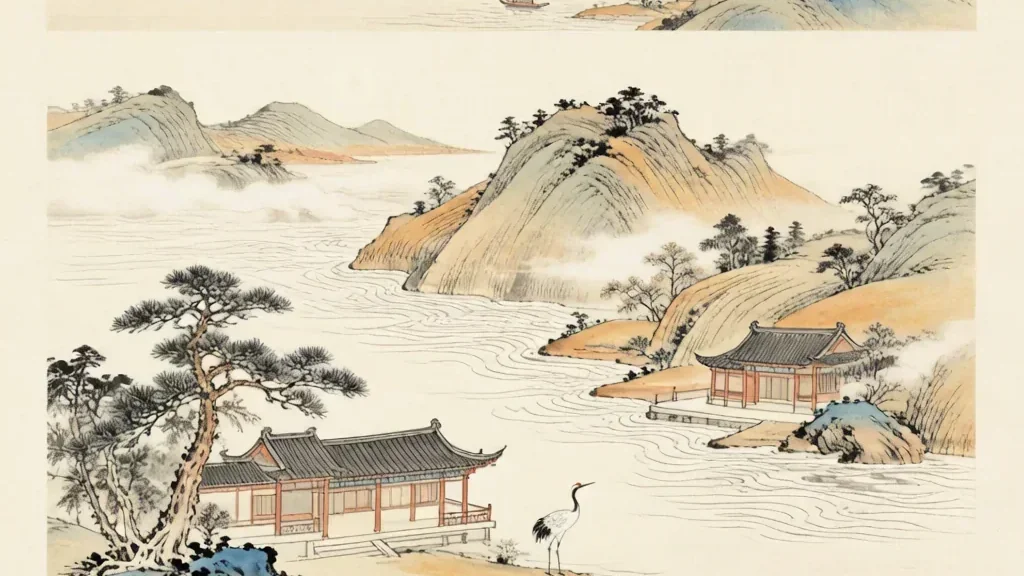
South of the great Yangtze, where the Xiang River gathers the waters of Hunan and flows toward the east, lies a lake that has been central to Chinese poetry and memory for two thousand years. Dongting Lake — 洞庭湖 (Dòngtíng Hú) — is one of the great freshwater lakes of the Yangtze basin, a shifting expanse of water and marsh whose moods have inspired verse, shaped floods, and sustained the rice fields of the south. To know Dongting is to know a landscape where nature and literature meet.
The Lake of the Xiang River
Dongting Lake lies in northern Hunan Province, fed by the Xiang and other rivers that drain the surrounding hills and plains, and connected at its northern end to the Yangtze. Like Poyang to the east, it is a dynamic lake whose area swells in the flood season and contracts in the dry months, its shoreline a moving line between water and land. The Xiang, the principal river of Hunan, gives the lake much of its identity and its name in the regional imagination.
The lake's basin is low and flat, a landscape of water, reed, and rice. For centuries the surrounding countryside has depended on the lake's waters for irrigation and transport, and the rhythm of its rise and fall has set the calendar for farming. Dongting is not a static sheet of water but a breathing system tied to the whole middle Yangtze.
Yueyang Tower and a Thousand Years of Poetry
On the lake's shore stands Yueyang Tower, one of the most celebrated pavilions in Chinese literature. A famous essay written about it in the Song dynasty describes the tower overlooking the lake's "boundless" waters in storm and in calm, using the scene to reflect on the scholar's duty to worry before others and rejoice after them. The tower became a symbol of literary and moral feeling, drawing visitors who wished to stand where the words were written.
Dongting's place in poetry runs deep. Tang poets wrote of its vastness and its mists, and the lake appears as a metaphor for separation and longing, especially in connection with the Xiang River and the southern frontier. To read Chinese literature is repeatedly to meet Dongting, a lake that became a stage for the emotions of an entire civilization.
An Ecological Heart of the South
Beyond its cultural fame, Dongting is a vital wetland. Its reed beds and shallows provide habitat for fish, crustaceans, and a great diversity of birds, including migratory species that winter on its flats. The lake's marshes filter water and buffer the Yangtze's floods, functioning as both nursery and sponge for the middle reaches of the river.
In recent decades the lake's ecology has faced serious stress. Reclamation for farmland, sedimentation from upstream, and the construction of engineering works on the Yangtze altered its hydrology, shrinking some of its open water and disturbing the wetland balance. Efforts to restore the lake now focus on returning farmland to wetland, controlling pollution, and letting the water reclaim some of its old range.
Floods, Farming, and the Yangtze
Dongting's intimacy with the Yangtze is a mixed blessing. In years of heavy rain, the lake absorbs enormous volumes of floodwater, protecting downstream cities but submerging its own shores and the fields beyond. The lake's ability to expand and contract is what makes it valuable, and any attempt to fix its shores too rigidly risks losing that protective flexibility.
The people of Hunan have farmed the lake's margins for generations, growing rice in the fertile soils renewed by annual floods. Their livelihood depends on reading the water correctly — planting after the recession, harvesting before the next rise. Dongting thus teaches, as the Loess Plateau does in the north, that survival in China has always meant negotiating with the water rather than commanding it.
The Lake in Regional Identity
For Hunan, Dongting is more than a feature on a map; it is part of the provincial soul. The phrase "eight hundred li of Dongting" appears in old descriptions celebrating its immensity, and the lake anchors the identity of a region known for both its natural abundance and its fierce, independent spirit. The foods, dialects, and folk traditions of the lakeside all bear the mark of the water.
The lake also connects Hunan to the wider Yangtze world, linking the province's interior rivers to the great artery that carries goods and people between the highlands and the sea. Dongting is a hinge between the local and the national, a place where a single province's waters join the destiny of the whole river.
Dongting Today and Tomorrow
Modern Dongting is a managed landscape, where navigation, fishing, farming, and conservation must share the same shifting waters. Protected areas safeguard key wetlands and the birds that use them, and ecological restoration aims to recover some of the lake's lost capacity to buffer floods and support life. The challenge is to honor both the lake's practical value and its poetic one.
To stand at Dongting today is to see the continuation of an ancient relationship. The mists still rise, the reeds still bend in the wind, and the tower still looks out over waters that have carried the Chinese imagination for millennia. The Lake of the Xiang River remains, as ever, a mirror for both nature and the human heart.
Junshan Island and Its Famous Tea
Junshan, a small verdant islet rising from the center of Dongting Lake, has been celebrated for more than a thousand years as a place of legends and fine tea. Local lore ties it to the grieving consorts of the ancient emperor Shun, whose tears are said to have left spotted bamboo still found on the island. Its misty groves and quiet shores also produce Junshan Yinzhen, a delicate yellow tea once reserved as tribute for the imperial court and still prized today. Reached by ferry from Yueyang, Junshan offers a quieter face of the great lake, where pavilions, bamboo, and tea gardens sit amid water that changes with the seasons. For visitors, the island is a reminder that Dongting is not only a vast, shifting expanse of reed and wave but also a cultural landscape where nature, myth, and craft have long been woven together.
A Lake Reshaped by Reclamation
For centuries the people of Hunan treated Dongting as land to be won. In calm seasons they built dikes and drained the margins to plant rice, gradually converting wetland into fields and shrinking the open water. This reclamation reached its peak in the twentieth century, when new embankments and the diversion of tributaries cut the lake's area sharply and weakened its ability to absorb Yangtze floods. The cost became clear in major disasters, when the compressed lake could no longer buffer the surge. Since the late twentieth century the logic has partly reversed: authorities have breached dikes and returned farmland to wetland, letting the water reclaim some of its old range. These restoration projects aim to recover the lake's natural flood storage and its bird habitat, balancing the needs of farmers with the limits of a living, breathing lake.
❓ Frequently Asked Questions
📝 Chinese Vocabulary
洞庭湖 — : Dongting Lake, the Lake of the Xiang River.
湖 — : lake, a broad body of fresh water.
湘江 — : the Xiang River, the lake's main feeder.
岳阳楼 — : Yueyang Tower, the lake's famous pavilion.
长江 — : the Yangtze River, to which the lake connects.
八百里洞庭 — : Eight hundred li of Dongting, a classical phrase praising the lake's vastness.
芦苇 — : Reeds, the wetland plants that cover the lake's shores and shelter birds.
水患 — : Flood peril, the threat of flooding that the lake has long posed to surrounding farmland.
🎉 Fun Facts
- Dongting Lake is one of the great freshwater lakes of the Yangtze basin and changes size dramatically between flood and dry seasons.
- Yueyang Tower on its shore inspired a famous Song-dynasty essay still studied for its reflection on a scholar's duties.
- Old descriptions celebrated "eight hundred li of Dongting," praising the lake's immensity.
- Dongting Lake is one of the largest freshwater lakes in China, and its surface area can swell to several times its dry-season size when the Yangtze floods, briefly becoming one of the biggest lakes in the country.
- Junshan Island in the middle of the lake is famous for Junshan Yinzhen, a rare yellow tea considered one of China's great historical tribute teas.
- The lake's reed beds shelter large flocks of wintering migratory birds, including endangered cranes, making it a key stop on the East Asian flyway.