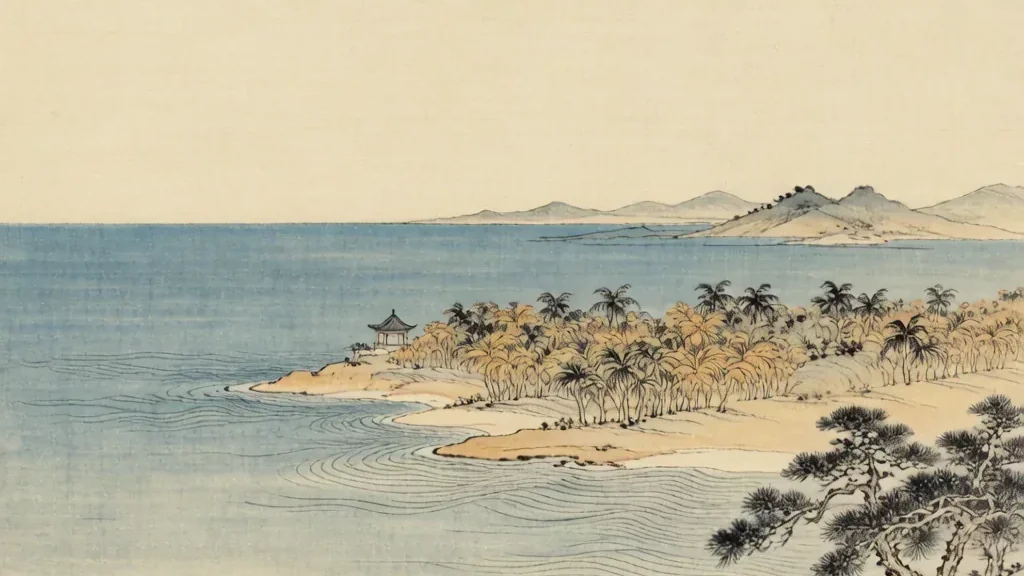
Far to the south of China's mainland, separated by a narrow strait from the province of Guangdong, lies an island of palms, warm rain, and turquoise water. Hainan — 海南 (Hǎinán), "south of the sea" — is China's southernmost province and its largest island, a tropical world apart from the wheat fields and cold winters of the north. Though once a place of exile and frontier, Hainan today is known for its beaches, its rainforests, and its role as a window onto the cultures of the sea.
An Island at the Edge of the Map
Hainan sits in the South China Sea, just below the Leizhou Peninsula, from which it is separated by the shallow Qiongzhou Strait. Roughly the size of a small country, the island is dominated by low mountains and hills in its center and south, with broad coastal plains where most people live. Its position places it closer to Southeast Asia than to Beijing, and that geography has shaped its history as a meeting point of peoples and currents.
Because Hainan lies in the tropics, its climate is warm and humid year-round, with a monsoon rhythm that brings heavy summer rains and the occasional typhoon sweeping in from the sea. The island's soils and warmth support crops that cannot grow on the mainland's colder north, from rice in the valleys to rubber, coconuts, and tropical fruit in abundance.
The Heart of the Island: Mountains and Rainforest
The interior of Hainan is not flat beach but rugged highland, its central spine formed by mountains that catch the moist ocean air and wring from it the rain that feeds the island's rivers. These forests are among the most biologically rich in China, home to a great variety of plants, birds, and rare animals, including some found almost nowhere else. The mountain of Wuzhi, often called the "Five Finger Mountain," is the island's highest point and a cultural symbol for the Li people who have long lived in its shadow.
Protecting these rainforests has become a priority, as they are not only habitats but also the source of the clean water on which the coastal cities depend. Walking into the interior, a visitor passes quickly from coastal towns into misty, vine-hung forest, a reminder that Hainan's fame as a beach destination is only half its story.
Peoples of the Sea and the Hills
Hainan is home to several ethnic groups, including the Han Chinese who form the majority along the coast, and the Li and Miao peoples whose ancestors settled the interior highlands. The Li, with their distinctive woven textiles and their long history on the island, are among the oldest established communities in the region, and their culture is woven into the identity of Hainan itself.
Off the coast, the sea has shaped a way of life built on fishing, trade, and navigation. The island's harbors have long been stops for ships moving through the South China Sea, and its people have inherited skills of boat-building and wayfinding that connect Hainan to the wider maritime world of Southeast Asia. The island is as much a culture of the water as of the land.
From Exile to Holiday
In imperial times, Hainan's distance from the capital made it a place of banishment, where officials who fell from favor were sent to live out their years far from the centers of power. The poet Su Shi, one of China's most beloved literary figures, spent part of his life in exile on the island, and his presence there is remembered as a moment when high culture met the frontier.
That same remoteness later became Hainan's asset. In the late twentieth century the island was designated a special economic zone, and its warm climate and beaches drew investment in tourism. Today cities like Sanya are famous across China as winter escapes, where visitors from the cold north come to swim, and the island has reinvented itself from frontier to playground without losing its distinct character.
Tropical Agriculture and the Ocean's Bounty
Hainan's warmth gives it an agricultural calendar unlike anywhere else in China. Rice can be planted and harvested multiple times a year, and the island produces tropical fruits — mangoes, pineapples, bananas, and the famously fragrant Hainan coconut — that are shipped north to markets far away. Rubber plantations, a legacy of earlier efforts to grow strategic crops, still cover hillsides in places.
The surrounding sea is equally generous. Hainan's waters are rich in fish, shrimp, and shellfish, and the island is a major base for China's fishing fleet. Pearls, once harvested from the island's oysters, were prized in imperial courts. The relationship between the islanders and the ocean is old, practical, and deeply woven into daily life.
Hainan in China's Southern Geography
Hainan matters to China not only for its tourism but for its position. As the country's southern gateway to the South China Sea, the island sits at the crossroads of maritime trade routes and is a strategic point for both commerce and environmental stewardship of tropical waters. Its ports and its free-trade ambitions make it a laboratory for China's engagement with the tropics and with its neighbors across the sea.
For the traveler, Hainan offers a compact lesson in contrast: within a short distance one can move from a bustling beach resort to a misty mountain village, from a seafood market to a quiet temple. It is, in every sense, an island at the edge of China that opens onto a much larger world.
Coral Reefs and Marine Life
Around Hainan's shores lies a warmer, wilder world than the beaches suggest. The island sits in the northern tropics of the South China Sea, where coral reefs fringe the coast and shelter a wealth of marine life: parrotfish, sea turtles, and countless small reef dwellers among the branching coral. These reefs protect the shoreline from waves and support the fisheries that feed island communities. Yet they are fragile: warming seas, coastal construction, and pollution have bleached and damaged parts of the reef, prompting marine reserves and restoration efforts. The sea also carries the island's monsoon rains and shapes its weather, linking the land and water of Hainan into one tropical system. To understand the island fully, one must look beyond the sand to the living reef that hums just below the surface.
The Li and Their Woven Art
Long before resorts rose along the coast, the Li people built their lives in Hainan's interior highlands. Recognized as one of China's oldest established island communities, the Li are celebrated for their textile art, especially a bark-cloth and woven brocade decorated with bold geometric patterns passed down through generations of women. Their language, festivals, and house styles mark a distinct cultural thread in the island's fabric, and their closeness to the mountains and forests shaped a knowledge of herbs, rice, and rainfall suited to the tropics. Today Li villages welcome visitors to see weaving demonstrations and to learn songs and dances, even as younger generations balance tradition with modern life. The Li remind us that Hainan's story is not only one of beaches and exile but of an enduring highland culture at the heart of the island.
❓ Frequently Asked Questions
📝 Chinese Vocabulary
海南 — : Hainan, "south of the sea," China's tropical island province.
岛 — : island, a land surrounded by water.
椰子 — : coconut, a signature crop of the island.
热带 — : tropics, the warm belt near the equator.
五指山 — : the Five Finger Mountain, Hainan's highest peak.
黎族 — : The Li, Hainan's earliest established ethnic community, known for woven textiles.
三亚 — : Sanya, the southern resort city famous for beaches and warm winter sun.
琼州海峡 — : The Qiongzhou Strait, the channel separating Hainan from the mainland.
🎉 Fun Facts
- Hainan is China's largest island and lies closer to Southeast Asia than to the national capital.
- The poet Su Shi, one of China's most celebrated writers, lived in exile on Hainan in imperial times.
- Hainan's interior rainforests are home to plants and animals found almost nowhere else in China.
- Hainan is about the size of a small country, and its long curved coastline is lined with bays, coral reefs, and palm-fringed beaches that draw visitors from across China.
- The island's warm waters support both a large fishing fleet and the farming of pearls, and Hainan pearls were once prized as tribute for imperial courts.
- In recent years Hainan has been developed as a free-trade port, with plans to become one of China's most open coastal economies and a hub for duty-free shopping and tourism.