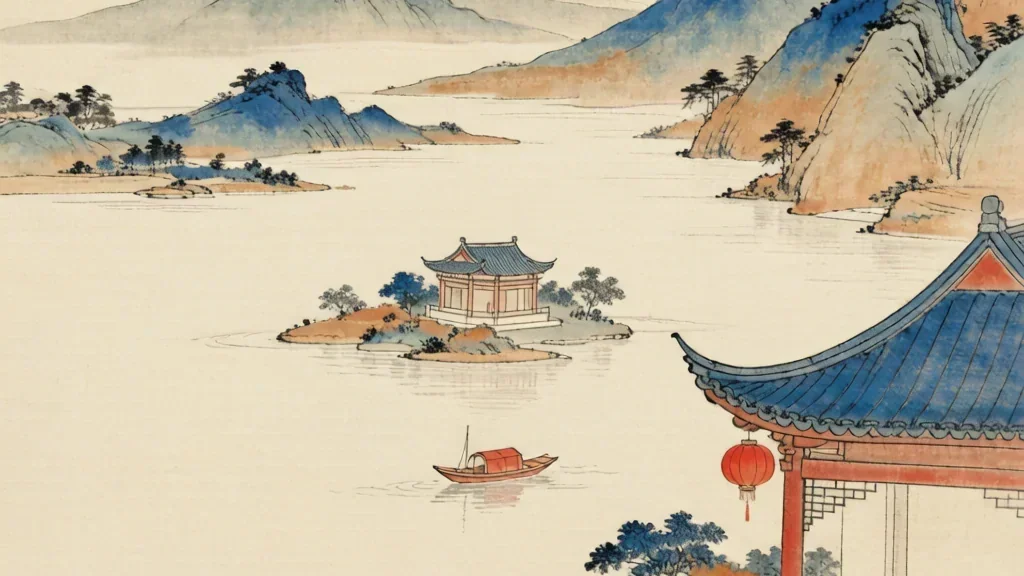
There is a well-worn Chinese saying that perfectly captures the essence of West Lake (西湖): "上有天堂,下有苏杭" — "Above there is heaven; below there are Suzhou and Hangzhou." And at the heart of Hangzhou lies West Lake, a body of water so beautiful, so perfectly proportioned, so rich with history and legend that it has been described as paradise on earth for over a thousand years. This UNESCO World Heritage Site is not grand in scale — it covers just 6.5 square kilometers, with an average depth of only 2.27 meters — but what it lacks in size, it more than makes up for in cultural density. Every island, every causeway, every pagoda has a story to tell.
West Lake was originally a shallow bay of the Qiantang River before silt deposits gradually separated it from the main channel around the 8th century. What could have been a forgettable lagoon was transformed over centuries by human hands into one of the world's most celebrated landscapes. Dredging projects, causeway construction, temple building, and the planting of willows and lotus turned West Lake into a living canvas — a work of art that blurs the line between the natural and the man-made.
The Ten Scenes of West Lake (西湖十景)
Since the Southern Song Dynasty (1127–1279), West Lake has been celebrated through a canonical set of views known as the "Ten Scenes of West Lake (西湖十景)". These are not merely picturesque spots but carefully curated moments — each combining a specific location with a specific season, time of day, or weather condition. The ten scenes are: Spring Dawn at Su Causeway (苏堤春晓), Lotus in the Breeze at Crooked Courtyard (曲院风荷), Autumn Moon over the Calm Lake (平湖秋月), Lingering Snow on Broken Bridge (断桥残雪), Orioles Singing in the Willows (柳浪闻莺), Viewing Fish at Flower Pond (花港观鱼), Leifeng Pagoda in Evening Glow (雷峰夕照), Twin Peaks Piercing the Clouds (双峰插云), Evening Bell Ringing at Nanping Hill (南屏晚钟), and Three Pools Mirroring the Moon (三潭印月).
Each scene has been immortalized in countless poems and paintings. The Su Causeway (苏堤), a 2.8-kilometer tree-lined dike built by the great Song Dynasty poet and governor Su Shi (苏轼), is particularly beloved in spring when peach and willow blossoms frame views of the lake on both sides. Three Pools Mirroring the Moon features three small stone pagodas rising from the water; on the night of the Mid-Autumn Festival, candles are placed inside them, and their light reflects on the water's surface alongside the moon, creating the illusion of multiple moons. The scene is so iconic that it appears on the back of China's one-yuan banknote.
The Legend of the White Snake
No discussion of West Lake is complete without the Legend of the White Snake (白蛇传), one of China's Four Great Folktales. The story begins at West Lake's Broken Bridge (断桥), where a young scholar named Xu Xian (许仙) meets a beautiful woman named Bai Suzhen (白素贞) during a spring rain. He lends her his umbrella, and they fall in love. But Bai Suzhen is not an ordinary woman — she is a thousand-year-old white snake spirit who has attained human form through Daoist cultivation.
Their love story unfolds against the backdrop of West Lake, with its most dramatic moment occurring at Leifeng Pagoda (雷峰塔). When a Buddhist monk named Fahai (法海) discovers Bai Suzhen's true nature, he imprisons her beneath the pagoda, separating the lovers. According to the legend, the pagoda would not fall until "the West Lake dries up and the Leifeng Pagoda collapses." In 1924, the pagoda did collapse (though the lake did not dry up), and a new pagoda was built on the site in 2002, complete with an elevator — a modern twist on an ancient legend.
West Lake Through the Ages
West Lake's fame spread far beyond China's borders centuries ago. When Marco Polo visited Hangzhou in the late 13th century — then called "Kinsay" and serving as the capital of the Southern Song Dynasty — he described it as "the City of Heaven, the finest and noblest in the world." He wrote of the lake's "delightful palaces and mansions" and "beautiful gardens with trees of great size," marveling at a city whose sophistication far exceeded anything in medieval Europe.
The lake has also been a crucible of Chinese literary culture. The Tang Dynasty poet Bai Juyi (白居易), who served as governor of Hangzhou, oversaw the construction of an earlier causeway and wrote lovingly of the lake: "I remember most the beauty of West Lake; I lean on the balustrade and gaze, unable to leave." The Song Dynasty poet Su Shi, who built the Su Causeway, compared the lake to Xi Shi (西施), one of ancient China's Four Great Beauties, in his most famous couplet: "欲把西湖比西子,淡妆浓抹总相宜" — "If one compares West Lake to Xi Shi, light or heavy makeup, she is always beautiful." This comparison gave the lake its poetic nickname: Xizi Lake (西子湖).
A Living Cultural Landscape
Today, West Lake remains a vibrant part of Hangzhou life. Early mornings see elderly residents practicing tai chi along its shores while rowers glide across the misty water. Cherry blossoms in spring and lotus flowers in summer draw crowds of photographers and painters. The lake is ringed by tea plantations that produce the world-famous Longjing tea (龙井茶), and visitors can hike into the hills to sample freshly brewed tea at the source.
In 2011, West Lake was inscribed as a UNESCO World Heritage Site under the category of "cultural landscape," recognizing it as "an ideal fusion between humans and nature" that has "influenced landscape design in the rest of China as well as Japan and Korea over the centuries." The designation acknowledges what the Chinese have known for a millennium: West Lake is not merely a lake. It is a poem written in water and stone, a painting brought to life, and one of the most perfect expressions of the Chinese aesthetic ideal — harmony between humanity and nature.
The Causeways of West Lake
Two great dikes give West Lake its graceful layout. The Bai Causeway is linked to the Tang poet Bai Juyi, who oversaw early lake works during his term as Hangzhou's governor. The longer Su Causeway, nearly three kilometers, was built by the Song poet and official Su Shi, who had the lake dredged and used the silt to raise a planted embankment. These causeways did real engineering work, controlling silt and easing travel, but they also framed the water as a series of views. Walking them remains the classic way to experience the lake, with willows, bridges, and distant hills composing a scene that changes with every step and season.
Longjing Tea and the Hills
The low hills west of West Lake produce Longjing, or Dragon Well, tea, one of China's most prized green teas. The name comes from a local spring, and the leaves are pan-roasted into their distinctive flat shape, giving a clear, chestnut-sweet infusion. The tea has been cultivated here for centuries and was once presented as tribute to the imperial court. Visitors can hike the terraced plantations, watch the spring picking, and taste fresh brews at village houses. The close pairing of lake, hill, and tea is part of what UNESCO recognized as a living cultural landscape, where agriculture, scenery, and refinement are inseparable.
West Lake in Garden Design
West Lake became a model for Chinese landscape design and influenced gardens well beyond Hangzhou. Its principle of borrowing distant scenery, framing views through windows and bridges, and balancing water with planted banks shaped classical gardens from Suzhou to the imperial retreats of Beijing. The idea travelled to Japan and Korea, where scholars adapted its 'one lake, one hill' composition for temple and stroll gardens. More than a place, West Lake offered a grammar of beauty: suggest rather than display, leave space for mist and imagination, and let human making imitate nature so closely that the two cannot be told apart.
Preserving the Living Landscape
Maintaining West Lake has always required constant human effort. The lake silts up naturally and has been dredged dozens of times across its history, with major projects led by Bai Juyi and Su Shi. In modern times, the 2011 UNESCO inscription as a cultural landscape brought international attention and stricter protection of its viewsheds, water quality, and historic buildings. Authorities limit lakeside construction, manage visitor flow, and restore wetland margins that filter the water. The challenge is to keep a working urban lake both beautiful and ecologically healthy while receiving millions of guests a year, a balance the city continues to refine.
❓ Frequently Asked Questions
📝 Chinese Vocabulary
- 西湖 (Xī Hú) — West Lake, the iconic lake in Hangzhou celebrated as "paradise on earth" and a UNESCO World Heritage Site.
- 上有天堂,下有苏杭 — "Above there is heaven; below there are Suzhou and Hangzhou." A famous saying extolling the beauty of these two cities.
- 西湖十景 (Xī Hú Shí Jǐng) — The Ten Scenes of West Lake, a canonical set of views established during the Southern Song Dynasty.
- 白蛇传 (Bái Shé Zhuàn) — The Legend of the White Snake, one of China's Four Great Folktales, set at West Lake.
- 欲把西湖比西子,淡妆浓抹总相宜 — "If one compares West Lake to Xi Shi, light or heavy makeup, she is always beautiful." Su Shi's famous lines comparing the lake to one of China's Four Great Beauties.
🎉 Fun Facts
- The "Three Pools Mirroring the Moon" scene appears on the back of the one-yuan RMB banknote, making it one of the most widely viewed landscapes in China — seen by over a billion people every day.
- West Lake has been dredged at least 23 times throughout its history to prevent it from silting up, with major dredging projects led by both Bai Juyi (9th century) and Su Shi (11th century).
- The original Leifeng Pagoda, under which the White Snake was said to be imprisoned, collapsed in 1924 — but not because of any curse. Local residents had been secretly chipping away bricks from its base for good luck charms!
- West Lake covers only about 6.5 square kilometers yet has inspired thousands of poems, paintings, and songs over the centuries.
- The lake began as a shallow bay of the Qiantang River before silt separated it from the river around the eighth century.
- Each year West Lake draws millions of visitors, making it one of the most popular scenic destinations in China.